
Extended Producer Responsibility: What It Actually Is, and How It Actually Works
Extended Producer Responsibility (EPR) gets projected around as a sustainability buzzword, but most explanations stop at the slogan “producers pay for their waste" without explaining the mechanics. This is the version with the mechanics included: what EPR is, how money moves, how physical waste moves, and why those two things almost never meet.
What EPR Actually Is
EPR is a policy framework that shifts financial and/or physical responsibility for a product's end-of-life management from municipalities and taxpayers onto the producer who put that product on the market. Before EPR, a manufacturer could sell a product wrapped in difficult-to-recycle, multi-layer packaging and the cost of dealing with that packaging, including collection, sorting, landfilling, fell entirely on local government. EPR tries to internalize that cost back into the producer's economics, on the theory that if disposal costs money, producers will eventually design products that cost less to dispose of.
It is not a single law. It is a regulatory model implemented differently across jurisdictions, most aggressively in the EU (WEEE Directive for electronics, the Battery Directive, packaging waste directives), and increasingly in Canada and a growing list of US states (Oregon, Colorado, California, Maine, and others have all passed packaging EPR laws in the last few years).
How It Runs: The Compliance Mechanism
The system has three core mechanisms, sometimes used in combination:
- Take-back programs – The producer is obligated to accept and process the product at end of life. This is common for electronics, batteries, and tires, high-value or hazardous items where reverse logistics actually pencils out economically.
- Eco-fees / advance disposal fees – The producer pays a fee, calculated from the volume or weight of packaging/product they put into the market, into a collective fund that finances collection and recycling infrastructure. This is the dominant mechanism for ordinary consumer packaging.
- Deposit-refund schemes – The consumer pays a small deposit at purchase and gets it back on returning the classic bottle deposit. This is the one EPR mechanism with a direct consumer incentive baked in, rather than relying purely on producer-side fees.
- Performance standards – Minimum recycled content requirements or mandated recyclability targets, layered on top of the above.
How a Producer Actually Pays
For the fee-based mechanism, which covers most consumer packaging, the math is straightforward:
Fee owed = (reported quantity of packaging put on market, by material type) × (fee rate per material category)
The process:
- The producer self-reports, typically annually, how much packaging it put into the market broken down by material, e.g., 12,000 kg of PET bottles, 3,000 kg of cardboard, 800 kg of aluminum.
- The PRO (Producer Responsibility Organization, a third-party body, sometimes mandated by law, that collectively administers compliance for member producers) applies a fee per kilogram per material category.
- In mature schemes, these rates are eco-modulated, harder-to-recycle materials (multi-layer composites, black plastic, mixed materials) are charged a higher rate, and easily recyclable materials (mono-material plastics, glass, aluminum) are charged less. This is the actual design-incentive lever in the whole system, it's where EPR tries to nudge product design, not at the collection stage.
- The producer pays the invoice. That's the entire physical interaction the producer has with the system.
- Self-reported figures are audited periodically, but audits are sample-based, not exhaustive — under-reporting happens and is caught unevenly. This is one of the system's known weak points.
The Part Most Explanations Skip: How Collection Actually Works in the Physical World
Here's where the "producer responsibility" framing becomes misleading if taken literally. Packaging does not physically return to the producer. There is no mechanism that identifies which specific used item came from which specific producer once it enters the waste stream, not at scale, not for ordinary consumer packaging.
The physical path looks like this:
- Consumer disposal. The packaging enters the waste stream via curbside recycling, a drop-off depot, or a retailer take-back point (the last of these mainly for batteries and electronics).
- Existing municipal or contracted waste collection infrastructure picks up infrastructure that, under EPR, is partly or fully subsidized by the fees producers paid into the PRO fund.
- Sorting at a Materials Recovery Facility (MRF). Mixed waste is sorted at high-speed using optical scanners, magnets, and density separation sorted by material type (is this PET or HDPE, is this aluminum or steel), never by brand. There is no barcode or RFID scanning of individual packages at this stage; the volume and speed of waste processing make item-level tracking economically and technically unworkable for ordinary packaging.
- Baling and sale as commodity feedstock. Once sorted, material is baled and sold to recyclers as a commodity “mixed PET bale," for instance, completely decoupled from any producer or brand identity.
So, the question "how does the system know whose packaging it collected" has a blunt answer: it doesn't, at the individual level.
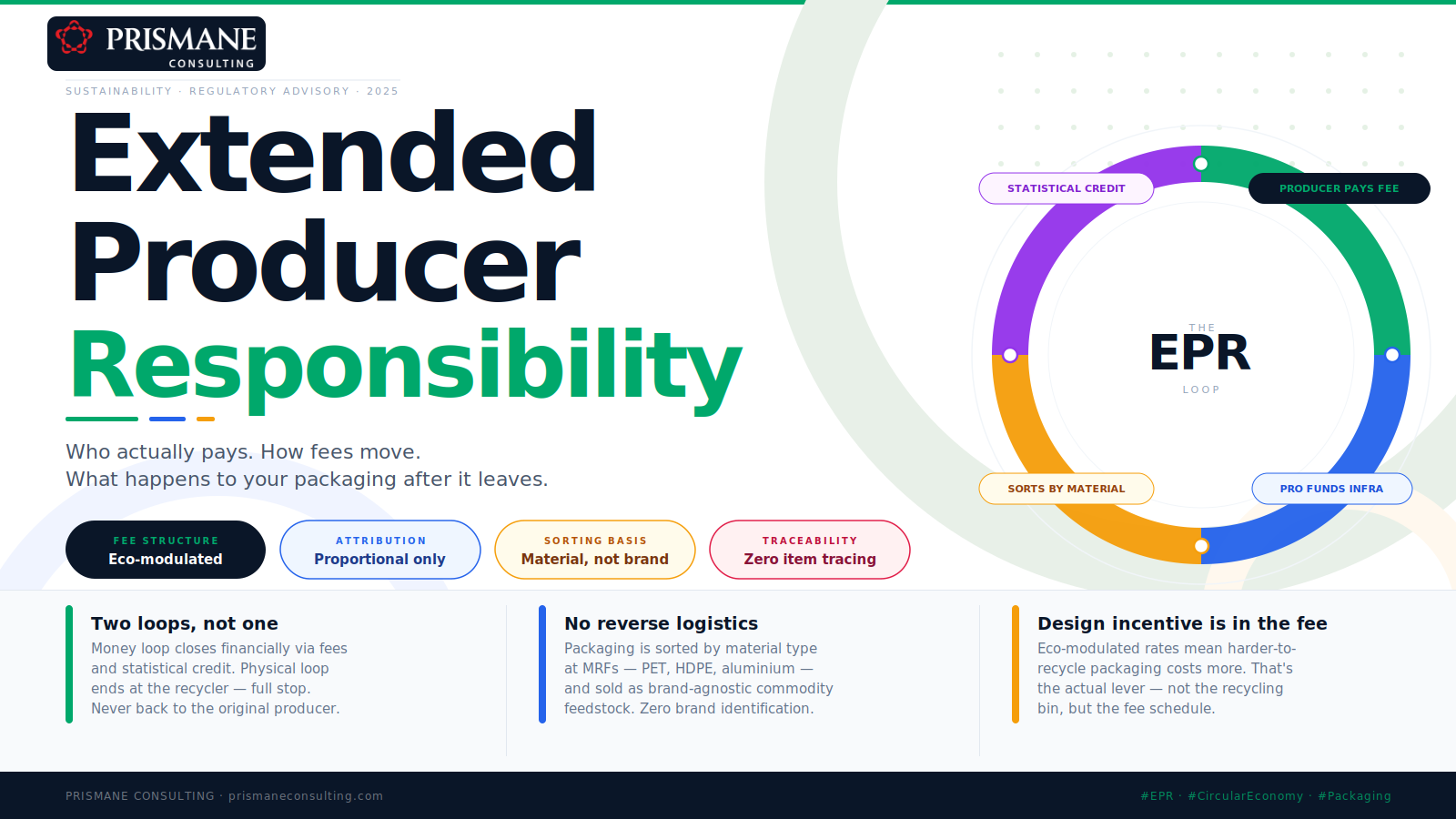
Compliance is closed through a pooled, proportional, statistical model instead:
- The PRO tracks total tonnage collected and recycled across the entire system — all member producers combined.
- That aggregate recycling rate is then attributed back to each producer proportionally, based on the volume of packaging they reported.
- If the system recycles 70% of all PET nationally, every producer who reported PET packaging is credited with 70% compliance on that material, regardless of whether any of their actual bottles were among the ones recycled.
This is the mechanism in essentially every deployed EPR scheme for consumer packaging. The exceptions, true closed-loop, brand-specific take-back exist mainly for electronics, certain batteries, large appliances, and B2B packaging like pallets and drums, where item value or hazard level justifies the cost of dedicated reverse logistics. A $0.05 plastic bottle does not clear that bar; RFID-tagging consumer packaging at the unit level would cost more than the packaging itself.
The flow below separates the two loops that EPR consists of the money/compliance loop and the physical material loop, because conflating them is where most confusion about "how EPR works" comes from. They are linked only by reported tonnage and audited statistics, not by tracking any individual package back to its producer.

Is It Helpful for Producers?
Short answer: not to the bottom line, directly. EPR is a cost center for the individual firm — fees, take-back logistics where applicable, and reporting overhead, with no direct revenue offset. In the US specifically, the patchwork of state-level laws (different definitions of "packaging," different fee schedules, different covered materials) adds real compliance complexity, and that overhead falls disproportionately on smaller producers, since compliance admin doesn't scale down linearly with revenue.
There is a plausible upside, but it's a systems-level argument more than a firm-level one:
- Producers who redesign packaging for recyclability early get ahead of standards before they tighten further.
- Leaner packaging, driven by eco-modulated fees, can reduce material input costs over time, a real effect observed in mature EU markets.
- EPR closes the gap between producers who were already absorbing responsible disposal costs and competitors who were externalizing them, it levels a playing field that wasn't level before.
But none of that changes the fact that, on a given year's P&L, EPR shows up as an expense line, not a revenue opportunity.
The Bottom Line
EPR works as an accounting closure, not a physical one. Producers pay into a system based on self-reported volume; that money funds the waste infrastructure that already exists; the infrastructure sorts and recycles material by type, completely agnostic to brand; and producers are credited with compliance proportionally based on aggregate system performance, not on any traceable connection between what they made and what got recycled. If you're picturing a literal loop where your packaging finds its way back to you, that loop doesn't exist for ordinary consumer goods, and understanding that distinction is the difference between understanding EPR and just understanding its name.