
For most of the last decade, biomethane projects were built on the strength of a capital grant and the hope that someone would buy the gas. That model produced plants, but it produced them slowly, and it left developers carrying a demand risk that lenders were never comfortable pricing. The shift now underway is subtler and more consequential: governments have started guaranteeing the buyer rather than subsidizing the builder. India's approval of the GOBARdhan scheme on 6 August 2026 is the clearest expression of that shift anywhere in the world, and it lands at a moment when Europe, the market that has defined the industry so far, is quietly falling behind its own targets. The trends below are the ones that matter for anyone modelling this market over the next five years.
India has made the largest demand-side commitment in the industry's history, and its supply base is nowhere near ready
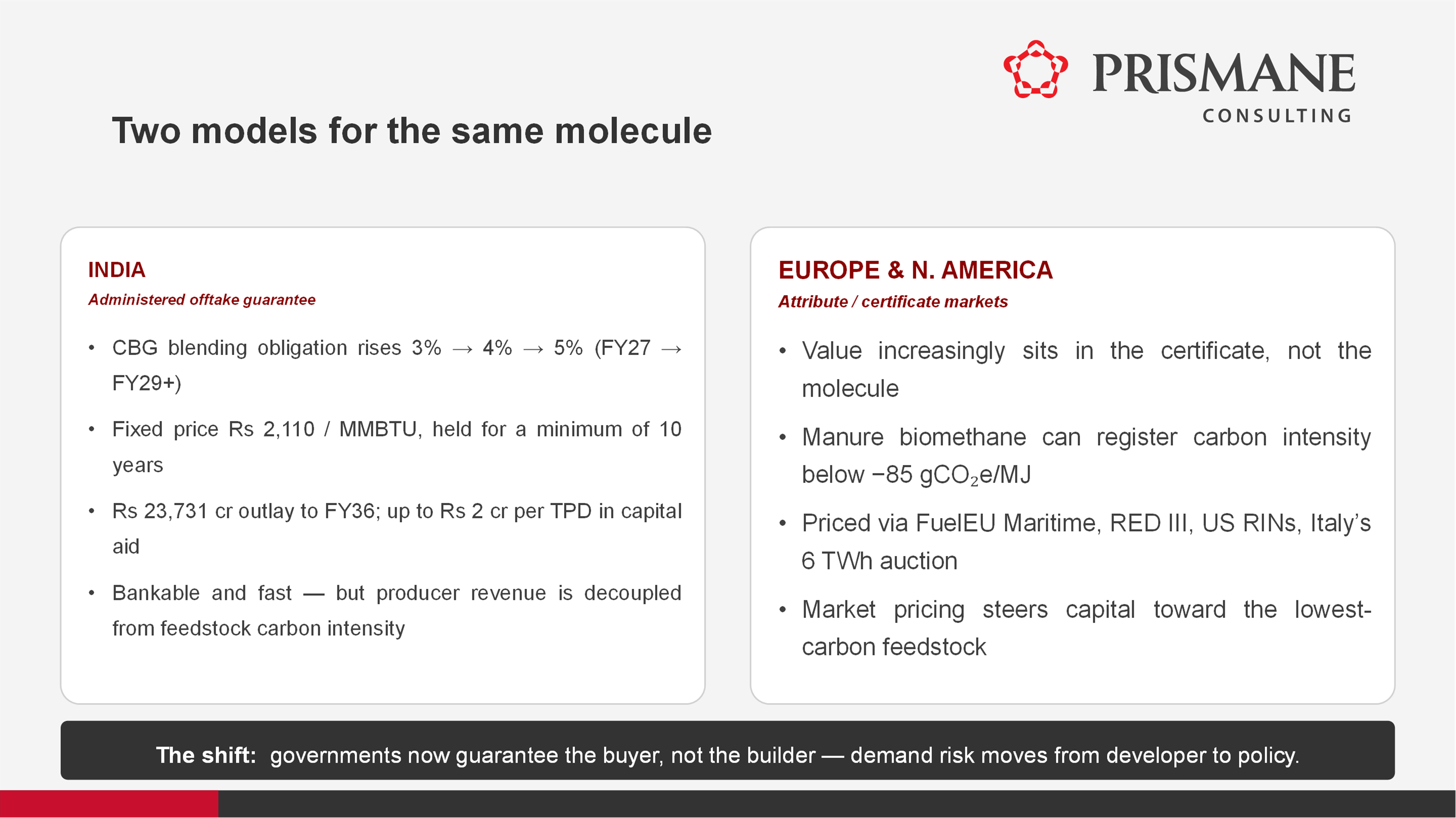
The Union Cabinet approved GOBARdhan, the National Circular Bioenergy Scheme, with an outlay of Rs. 23,731 crores running from FY 2026-27 to FY 2035-36 under the Ministry of Petroleum and Natural Gas. The mechanism that matters is not the money, but the obligation attached to it: city gas distribution entities must meet a compressed biogas (CBG) blending trajectory of 3% in FY 2026-27, rising to 4% and then 5% from FY 2028-29 onwards. That is paired with an administered price of Rs. 2,110 per MMBTU held over a minimum ten-year horizon, capital assistance of up to Rs. 2 crore per tonne per day of installed capacity, and a credit guarantee mechanism aimed squarely at MSME developers. Against this sits a commissioned SATAT base of roughly 132 plants producing about 920 tonnes per day (TPD) as of January 2026. The scheme's stated ambition of near ten-fold production growth would take India to roughly 3.4 million tonnes a year, a genuine step change, but still a fraction of SATAT's original 15 million tonne vision, and a reminder that the constraint was never the target.
Europe's growth is real, and it is still not fast enough to meet REPowerEU
Installed European biomethane capacity reached 8.2 bcm per year by the end of Q2 2026, up 17% on the prior year, with plant numbers rising from 1,678 to 1,975 and committed investment climbing to EUR 36 billion. On any absolute measure, that is a strong year, more than 1 bcm of capacity added in twelve months. The problem is the denominator.

REPowerEU targets 35 bcm of domestic biomethane by 2030, which from an 8.2 bcm base requires compound growth close to 38% a year for the rest of the decade. Europe is delivering less than half that rate, and the gap is widening rather than closing. Forecasts that assume the 2030 target is met are, in our view, modelling a policy aspiration rather than a market.
Plant scale, not plant count, now separates the serious markets from the rest
The European average plant size sits at 472 Nm3/h, but that average conceals two entirely different industrial models. Denmark runs comparatively few facilities at an average of 1,528 Nm3/h, while France leads on plant count with an average of just 212 Nm3/h. Germany and Italy fall in between at roughly 607 and 667 Nm3/h.

Larger units carry lower unit upgrading costs, justify dedicated grid injection, and can support the feedstock logistics contracts that smaller plants cannot. India's early experience points the same way: typical CBG utilization has run in the 40-50% band, against isolated well-run assets operating above nameplate. For anyone sizing this market, effective utilized output is the number to forecast, not installed capacity.
Feedstock aggregation, not capital, is the binding constraint
Feedstock accounts for roughly 40-55% of operating cost in a typical CBG plant, and it is the line item most exposed to seasonality, competing uses and fragmented collection. India generates well over 700 million tonnes of agricultural residue annually, but theoretical availability has never been the issue, moving it from field to digester at a predictable price is. This is why the Biomass Aggregation Machinery scheme, with an outlay of Rs. 564.75 crore and 37 proposals worth close to Rs. 248 crores approved by 16 March 2026, matters more to project economics than its modest size suggests. GOBARdhan's Ecosystem Challenge Fund extends the same logic to district-level feedstock mapping and aggregation infrastructure. Developers who lock in multi-season feedstock agreements early will hold a structural cost advantage that no capital subsidy can offset.
The co-product economy has stopped being an afterthought
Digestate and biogenic carbon dioxide are moving from disposal problems to revenue lines. India's Market Development Assistance scheme pays Rs. 1,500 per metric tonne for fermented organic manure, liquid fermented organic manure and phosphate-rich organic manure produced by CBG plants, with 120 CBG and biogas plants registered on the fertilizer portal as of 4 March 2026. On a 10 TPD plant, manure revenue is no longer rounding error. The same applies to the concentrated CO2 stream separated during upgrading, which is among the cheapest biogenic carbon sources available and is increasingly contracted into food-grade, beverage and emerging CO2-to-chemicals applications. Project models that value only methane are now systematically understating returns.
Molecule value is splitting from attribute value, except where administered pricing prevents it
In Europe and North America, a growing share of biomethane's realized value sits in the certificate rather than the gas. Manure-derived biomethane can register a carbon intensity below minus 85 gCO2e/MJ, which is worth far more under FuelEU Maritime, RED III transport targets or US RIN markets than the energy content alone. Italy's competitive allocation of 6 TWh to six gas shippers for the 2026/2027 thermal year is an early signal of how these attributes get priced through a market rather than a tariff. India has taken the opposite route: a single administered price of Rs. 2,110 per MMBTU delivers bankability and speed, but it deliberately decouples producer revenue from feedstock carbon intensity. That trade-off will build capacity quickly; it will not, on its own, steer investment toward the lowest-carbon feed stocks.

What it means
Prismane estimates the global biomethane market at approximately USD 7.0 billion in 2025, growing at a CAGR of around 7.5% to reach roughly USD 13.5 billion by 2034, with Europe holding the majority of value today and Asia-Pacific contributing the bulk of incremental volume growth over the forecast period. The winners in that shift are upgrading technology licensors with a credible India delivery model, EPC contractors positioned for a wave of 10-25 TPD projects, and developers who treat feedstock aggregation as their core business rather than a procurement function. The exposed are subscale European operators whose economics depended on legacy feed-in tariffs, and Indian developers who read GOBARdhan as a capital subsidy scheme rather than a fifteen-year supply obligation. The obligation trajectory of 3-5% applies to the CNG transport and PNG domestic segments alone, not India's full gas basket, a nuance most coverage has skipped, and one that separates a realistic demand forecast from an inflated one.
Prismane Consulting tracks the global biomethane and compressed biogas value chain, plant-level capacity, feedstock availability, upgrading technology shares, offtake pricing and regional demand, through its Energy & Sustainability practice.
For the full Global Biomethane Market Study, visit prismaneconsulting.com or write to us at sales@prismaneconsulting.com.