
Battery Separator Market Is Moving Beyond Capacity
Three years ago, the battery separator market was described almost entirely in square meters: how much film capacity a company had announced and where that capacity would be located. In 2026, a more important question is emerging: what can that film do once it is coated, qualified and integrated into a battery cell?
The industry is not abandoning capacity growth. Global EV battery separator consumption reached approximately 11.7 billion square meters during January to July 2026, representing a 24.9% increase from the same period a year earlier. However, capacity alone no longer captures the full development of the market. Increasing attention is moving toward separator coatings, battery-grade PVDF, process technology and the qualification work that determines which new capacity can enter commercial supply.
This shift is creating a different competitive landscape. Coating is becoming a localization strategy, PVDF is becoming a more application-specific battery material, India is entering the separator market at several points, and China’s dominance remains substantial even as regional battery supply chains expand elsewhere.

Coating Has Become a Localization Strategy
Separator coating was traditionally viewed as a technical layer added to improve properties such as thermal stability, adhesion or dimensional stability. It is increasingly becoming something more strategic: a way for separator suppliers to establish regional supply without necessarily relocating the entire base-film manufacturing process.
Asahi Kasei provides a clear example. In August 2026, the company completed a new Hipore wet-process separator coating line at its Celgard facility in Charlotte, North Carolina, with commercial production scheduled for the second half of fiscal 2026. The investment is intended to establish North American coating and supply capabilities for wet-process separators alongside Celgard’s existing dry-process manufacturing.
This approach can provide a faster route to regionalization than building an entirely new wet-process separator manufacturing complex. The membrane can continue to be produced within an established global network, while coating and final separator supply move closer to battery customers.
That matters because coated separators are becoming more important in cell manufacturing. A supplier with an existing base-film footprint can potentially add regional value through coating, qualification and customer-specific formulations without duplicating every upstream manufacturing step.
The result is a more distributed supply structure in which film production, coating and final separator conversion can increase in different regions.
PVDF Is Becoming a Qualified Battery Material
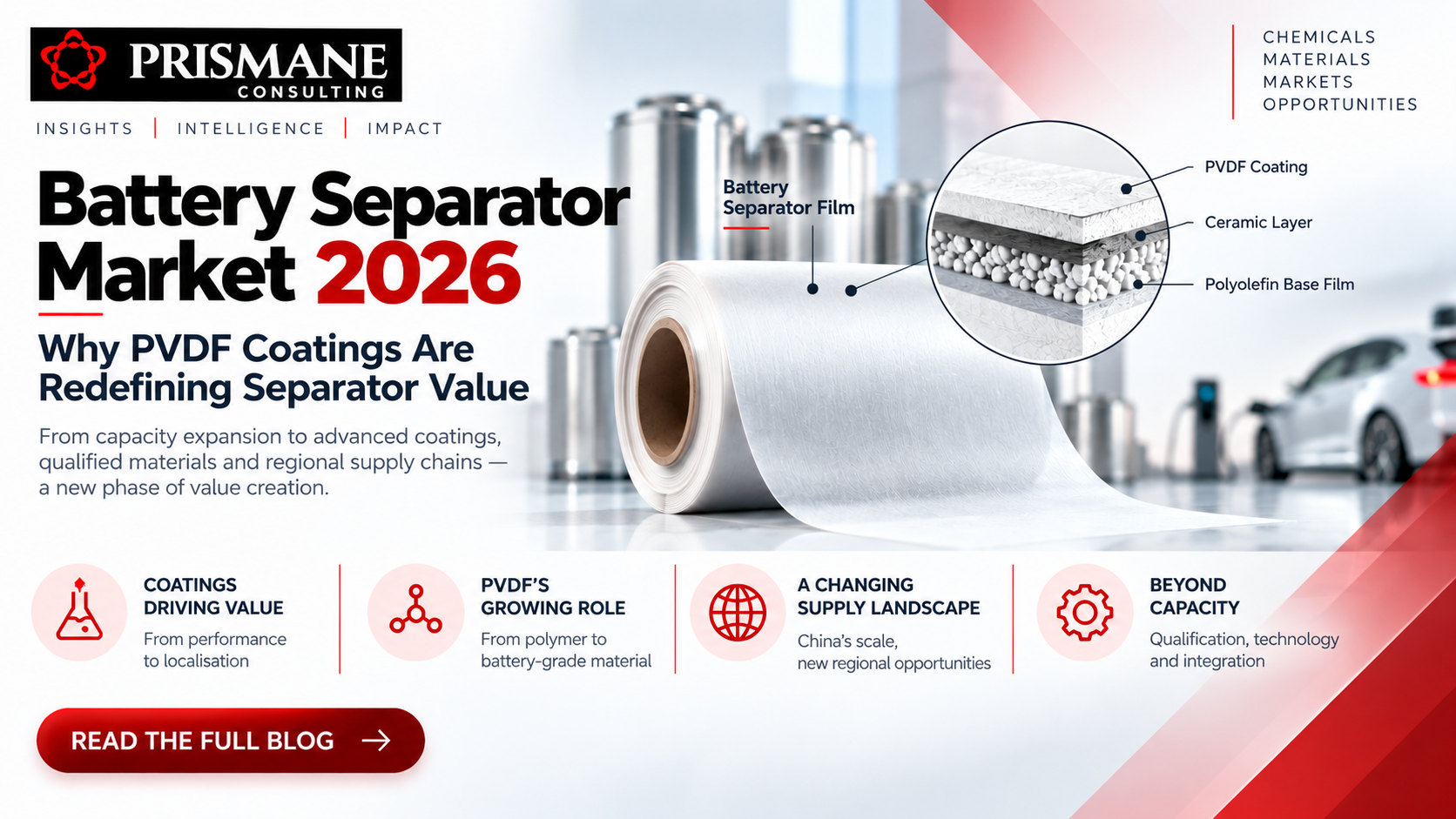
PVDF is not challenging polyethylene or polypropylene as the core separator membrane. Its growth is downstream, particularly in separator coatings and electrode binders. In separator applications, PVDF can be used as an adhesive layer or alongside ceramic particles to improve the interface between the separator and electrodes while maintaining the required electrochemical and thermal characteristics.
This creates a downstream opportunity for PVDF producers as separator manufacturers move toward more engineered structures. Instead of replacing the underlying polyolefin membrane, PVDF becomes part of the functional coating applied to that membrane. The resulting separator can combine the mechanical and porous characteristics of the base film with the adhesion, thermal and interfacial properties delivered by the coating.
This distinction is increasingly important for the broader PVDF market. The battery opportunity is not determined only by how much PVDF capacity is announced. Product grade, consistency, processing behavior and customer qualification are becoming increasingly important to commercial value.
Arkema positions its Kynar PVDF portfolio for battery separator coatings, while Syensqo has been expanding its battery-materials production capabilities in the United States. These developments reflect a wider shift toward fluoropolymers developed around specific battery applications rather than treated simply as general-purpose specialty polymers.
Separator Coatings Are Becoming More Specialized
The coating layer is also becoming more sophisticated. Ceramic coatings remain important for thermal and mechanical performance, while PVDF-based adhesive layers can provide additional functionality at the separator-electrode interface.
Arkema’s 2026 battery portfolio demonstrates this direction. Its Kynar PVDF portfolio is positioned for separator coatings, while its Incellion range includes an acrylic binder designed for ceramic-coated separators and a co-binder for PVDF adhesive layers.
The separator coating market is therefore unlikely to converge around one universal chemistry. Ceramic, PVDF-based, ceramic-PVDF and acrylic-based systems can address different combinations of adhesion, thermal stability, wettability and processing requirements. The appropriate formulation depends on separator construction, cell chemistry, coating process and the performance requirements of the battery manufacturer.
For PVDF producers, this means participation in batteries increasingly depends on application development and qualification rather than simply having polymer capacity available.
India Is Entering the Separator Market at Several Points
India’s separator opportunity is not limited to building a competitor to China’s existing film capacity. TCPL Packaging is investing approximately US$ 14 million, or ₹125 crore, over 18 months to establish an initial separator film capacity of approximately 70 million square meters per year. The company has targeted commercial production for Q4 FY2028 and indicated a longer-term ambition to scale toward approximately 500 million square meters per year, subject to demand and market conditions.
The more interesting point is that India’s participation extends beyond film. Bengaluru-based STEER World has secured an approximately US$ 6.8 million, or ₹60 crore, export order to supply UHMWPE processing technology for a lithium-ion battery separator project in China. The technology was selected after a nine-month technical evaluation, with commissioning expected in FY2027. STEER has also indicated potential additional revenue from aftermarket products, process upgrades, spare parts and technical services.
That order demonstrates another route into the separator market. India does not necessarily need to compete with established Asian producers only through separator film capacity. Equipment, processing technology and technical services can provide another entry point. The specialty-material layer is also developing.
Gujarat Fluorochemicals, through GFCL EV, is building an integrated battery-materials portfolio that includes LiPF6, electrolyte formulations, LFP cathode active material and fluoropolymer binders. The company has allocated approximately US$ 261 million, or ₹2,300 crore, of FY2026-27 capex across its battery-materials portfolio and expects its PVDF binder business to commence commercially in the first half of FY2027 following qualification.
Together, TCPL, STEER World and GFL illustrate three different dimensions of India’s emerging battery-materials opportunity: separator film manufacturing, processing technology and specialty materials.
Regionalization Is Growing Alongside China’s Existing Scale
The global separator market is growing rapidly outside China, but China’s position remains substantial. According to research conducted by Prismane Consulting, the global EV battery separator consumption reached approximately 11.7 billion square meters during January to July 2026, while consumption outside China reached approximately 4.0 billion square meters and grew 43.2% year on year.
Chinese separator suppliers held a 91.5% share of global EV separator consumption by company nationality in Q2 2026, compared with 5.7% for Japanese suppliers and 2.7% for Korean suppliers.
The numbers create an important distinction.
Regionalization in North America and India is real, and ex-China demand is expanding rapidly, but it is growing from a smaller base. Current data therefore point toward additional regional capacity alongside China’s existing scale rather than an immediate displacement of Chinese suppliers.
A North American coating line or an Indian separator plant should not automatically be interpreted as a transfer of global market share away from China. In many cases, the immediate objective is to support new battery production closer to customers, diversify supply and reduce exposure to logistics or trade-related risks.
The longer-term question is whether these regional ecosystems can develop enough upstream integration, scale and qualification history to materially change the existing supply structure.
Qualification Will Matter as Much as Nameplate Capacity
Announced capacity and qualified capacity are not the same thing. Separator manufacturing is highly sensitive to defects, thickness variation, pore structure and process consistency. Battery manufacturers therefore need to evaluate new suppliers through laboratory testing, pilot production, cell validation and customer qualification before moving meaningful volumes into commercial supply.
The same applies to coating chemistries and PVDF grades. A material with stronger adhesion or better thermal behavior still needs to operate within the customer’s coating, drying, cell assembly and formation processes without creating new defects, increasing costs or reducing throughput.
This makes qualification a commercial barrier as much as a technical one. STEER World’s separator technology order is a useful example, with the technology selected after a nine-month technical evaluation and application-development programme.
For separator and battery-material suppliers, the commercial question is therefore increasingly how quickly production can become qualified, repeatable and commercially accepted, rather than simply how much nameplate capacity can be installed.
Battery-Material Companies Are Building Integrated Platforms
One of the more significant developments in the battery-materials landscape is the move toward integrated platforms.
Gujarat Fluorochemicals provides a strong Indian example. GFCL EV is developing a portfolio spanning electrolyte salt, electrolyte formulations, LFP cathode active material and PVDF/PTFE binders. Its FY2026 disclosures state that Phase I capacities have been commissioned and contracted with anchor customers, while the PVDF binder qualification process has been completed and commercial business is expected in the first half of FY2027.
This is materially different from a conventional PVDF producer selling one polymer into multiple end-use markets. The strategy creates potential for deeper participation in battery qualification and customer relationships because multiple materials are being developed within the same cell ecosystem.
The same convergence is visible among global specialty-material and separator companies. Arkema and Senior signed a 2026 cooperation agreement covering battery materials and advanced separator technologies, including adhesion, controlled deposition and coating processes, low-temperature cell assembly and emerging semi-solid battery manufacturing.
The boundary between material supplier, coating specialist, separator producer and cell-technology partner is therefore becoming less rigid.
China’s PVDF Expansion Changes the Competitive Question
The PVDF investment story also needs to be viewed through China’s existing fluorochemical manufacturing base. Chinese producers including Juhua, Dongyue, Dongyangguang, Haohua and Yonghe are developing or expanding PVDF and related fluorochemical capacity for battery applications. This creates substantial domestic supply potential alongside expansion programmes announced by global producers.
But more capacity does not automatically translate into a PVDF shortage. China has experienced significant PVDF capacity expansion, while utilization and pricing conditions can differ by product grade. Battery-grade materials require customer qualification, tighter product consistency and application-specific performance.
This creates a growing distinction between total PVDF capacity and qualified battery-grade PVDF capacity.
For separator manufacturers and cell producers, the latter is the more commercially relevant metric. The competitive question for the PVDF market is therefore increasingly about how much battery-grade PVDF can be produced consistently and economically, rather than simply how much nominal capacity exists.
The Value Migration Is Happening Above the Base Membrane
This is the central shift in the battery separator market. The base membrane remains critical. Without the correct pore structure, thickness, mechanical strength and defect control, no coating can turn an unsuitable film into a high-performance separator.
But once a high-quality base film is established, additional value can increasingly be created through coating chemistry, PVDF grade selection, ceramic formulation, surface treatment, adhesion, process optimization and customer qualification. These activities require more application knowledge and closer collaboration with cell manufacturers than conventional film production. The separator market is therefore moving from a simple capacity race toward a more layered materials and technology competition.
- For separator producers, differentiation may increasingly come from what happens after the base film is manufactured.
- For PVDF producers, the opportunity is to move closer to the separator and cell interface through application-specific grades.
- For equipment suppliers, the opportunity lies in improving extrusion, stretching, pore formation, coating and defect control.
Safety Remains at the Centre of Separator Development
Safety continues to be one of the fundamental reasons for separator innovation. Polyolefin separators can undergo dimensional changes at elevated temperatures. Functional coatings and engineered structures can improve thermal stability and dimensional behavior, particularly where ceramic and polymer systems are combined.
PVDF can contribute through its role as an adhesive and coating component. Arkema highlights thermal dimensional stability, electrolyte wettability and wet and dry adhesion among the performance attributes of its PVDF separator-coating grades. At the same time, thinner separators create a more difficult engineering trade-off.
Manufacturers need to balance lower thickness and controlled porosity with mechanical integrity, thermal stability, low defect rates and competitive cost. Achieving these requirements simultaneously is becoming one of the central engineering challenges for separator manufacturers.
The Separator Market Is Expanding Beyond Electric Vehicles
Electric vehicles remain a major demand driver, but separator demand is broader. Consumer electronics, electric two-wheelers and three-wheelers, passenger vehicles, commercial vehicles and stationary energy storage all require separator materials, although their specifications and economics can differ.
Energy storage is becoming particularly relevant as renewable power deployment and data-centre electricity demand support additional battery-storage investment. This creates additional demand pools for separator producers and coating suppliers. Separator requirements will therefore increasingly depend on battery chemistry, cell format and application, rather than one universal separator specification.
What It Means for the Battery Separator Market
The global battery separator market is growing rapidly, but the more important change is happening in the composition of value. Separator film remains the foundation, but coating is becoming a localization tool and a performance layer. PVDF is moving deeper into the battery value chain as a qualified material for separator coatings and electrode binders. Equipment suppliers are finding opportunities in processing technology, while battery-material companies such as GFL are moving toward integrated portfolios rather than standalone molecules.
Meanwhile, China’s dominance remains substantial. The 91.5% share held by Chinese separator suppliers in Q2 2026 shows that regionalization is developing alongside an already powerful supply base rather than immediately replacing it.
The commercial question for the industry is therefore changing. It is no longer simply about who can produce the most separator film. Increasingly, it is about who can deliver the right film, the right coating, the right material grade and the right qualification at the required cost.
That shift is particularly important for PVDF. A producer can add significant nominal capacity, but the commercial opportunity depends on whether that capacity can produce the grades required by battery manufacturers and whether those grades can pass qualification.
The same principle applies to separators. A 500 million square meter capacity announcement is strategically interesting, but a smaller line with established customer qualification can be commercially more relevant.
The next phase of the battery separator market will therefore be shaped not only by capacity additions, but by the migration of value toward coating chemistry, battery-grade PVDF, process technology, application engineering and qualification.
For separator manufacturers, fluoropolymer producers, coating specialists, equipment suppliers and battery-material companies, that creates a market where material science and manufacturing scale increasingly need to work together.
The separator is still measured in square meters. But increasingly, its value is being determined by what happens to those square meters before they enter the cell.
The battery separator market is moving from a straightforward capacity expansion story toward more complex materials and technology opportunity.
Three developments stand out: coating is becoming strategically important, battery-grade PVDF is becoming more application-specific, and qualification is becoming a critical commercial differentiator.
India’s emerging participation across separator film, processing technology and specialty battery materials adds another dimension to the market, while China’s substantial existing scale means regionalization is likely to develop alongside established Asian supply networks rather than in isolation.
For market participants, the strategic opportunity increasingly lies above the base membrane. Companies that can combine material performance, processing capability, customer qualification and reliable commercial supply will be positioned to participate in the higher-value layers of the separator ecosystem.
Prismane Consulting tracks the global battery separator and PVDF value chains, including film capacity, coating technology, regional investment and battery-grade qualification, through its Chemicals & Materials practice. For the full Global Battery Separator Market Study, visit Prismane Consulting or contact sales@prismaneconsulting.com