
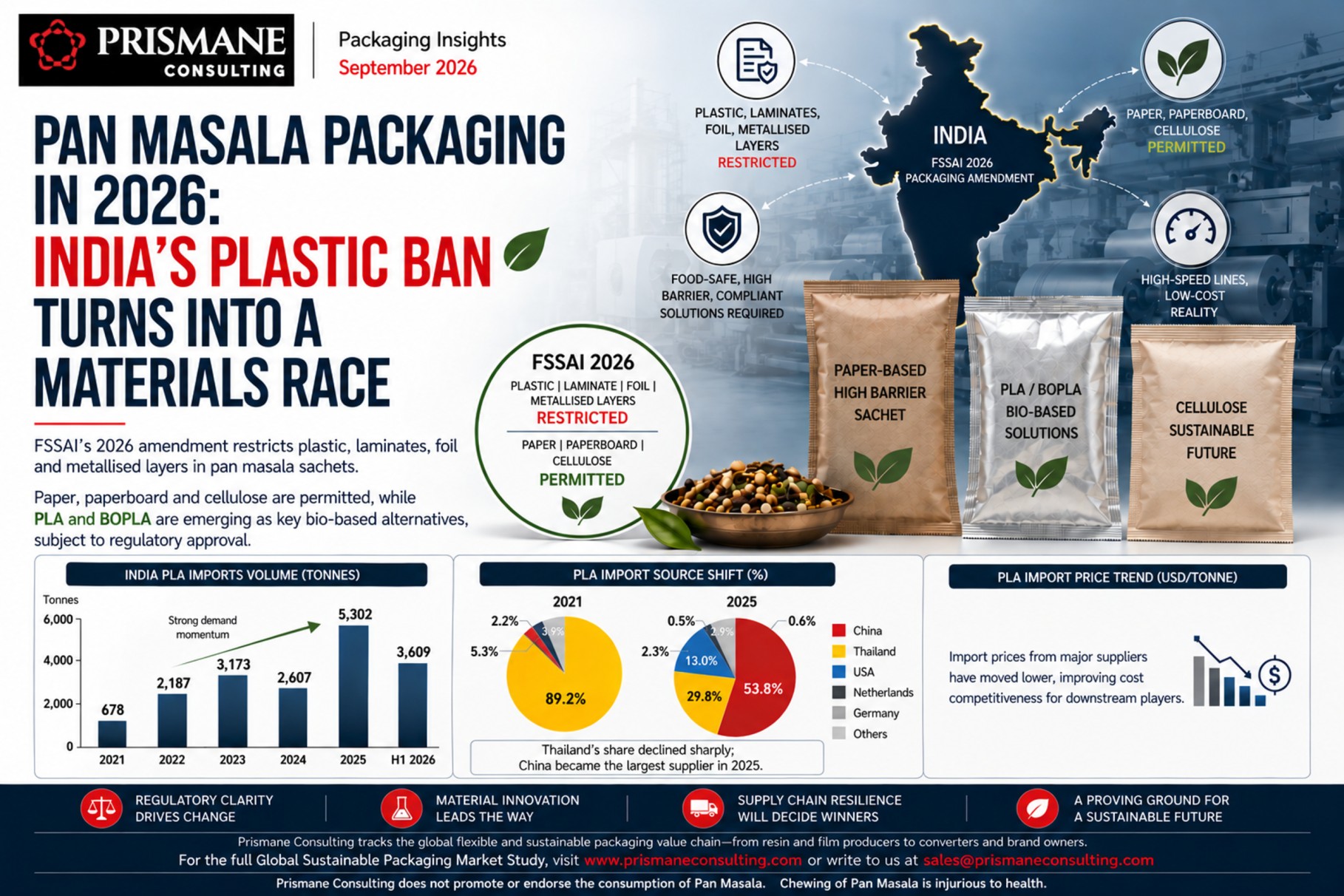
Pan Masala Packaging in 2026: India's Plastic Ban Turns Into a Materials Race
Prismane Consulting | Packaging Insights | September 2026
Three years ago, the story around pan masala packaging was told in sustainability pledges and pilot sachets. In 2026, it is being told in regulatory notifications, standards-body challenges, and feedstock investment decisions. FSSAI's amendment restricting plastic, synthetic laminates, aluminium foil, and metallised layers in pan masala packaging has turned a slow-moving sustainability conversation into an urgent materials and supply-chain problem, and one of India's most demanding flexible-packaging formats now has a compliance deadline attached to it. Here are the trends shaping how that transition plays out.
Regulation has become the forcing function, not a talking point
FSSAI's August 2026 packaging amendment does more than encourage alternatives to plastic in pan masala sachets. It names what is permitted (paper, paperboard, cellulose) and what is restricted (plastic, synthetic polymers, laminates, aluminium foil, metallised layers). That specificity changes the calculus for manufacturers who might otherwise have waited out a voluntary sustainability push. It also explains why the Bureau of Indian Standards and the Department of Consumer Affairs moved quickly to launch BIOPackathon 2026, a challenge aimed squarely at biodegradable sachet solutions that are food-safe, barrier-performing, and economically viable at high-speed line volumes, not just biodegradable in a lab setting.
Paper is the front-runner, but only if barrier coatings keep pace
High-barrier paper is the most commercially advanced pathway, but the ambition has shifted from swapping paper for plastic film to engineering paper that performs like a laminate. This means achieving moisture and aroma barrier, reliable heat sealing, high-speed machinability, printability, and food-contact compliance, all at sachet-level cost. That is a coatings and fibre-engineering problem as much as a paper problem, and it is why functional coating suppliers and cellulose material developers, not just paper mills, are the ones positioning products for this specific application.
Biodegradable does not automatically mean plastic-free
PLA and BOPLA (biaxially oriented PLA film) are the other major technology track under discussion, but they carry a compliance risk that paper does not. Being bio-based or biodegradable is not the same as meeting FSSAI's plastic-free packaging requirement for this application. Any BOPLA-based sachet solution has to be tested against the specific regulatory definition, not marketed on biodegradability credentials alone. That distinction will separate genuinely compliant PLA formats from ones that stall at the approval stage.
Domestic Polylactic Acid (PLA) capacity is now datable, and import dependence is measurable
PLA supply into India has historically leaned on imports, and the import data show how quickly demand has been building. PLA imports rose from 678 tonnes in 2021 to 2,187 tonnes in 2022, 3,173 tonnes in 2023, and a slight dip to 2,607 tonnes in 2024, before jumping to 5,302 tonnes in 2025. In the first six months of 2026, imports already reached 3,609 tonnes. Balrampur Chini Mills' planned domestic PLA facility, with a capacity of 80 KT and a scheduled start in October 2026, is therefore the development to watch. If it comes online on time and at scale, it would dramatically reduce import dependence and pull downstream investment into PLA films, BOPLA, and related coatings. That is a resin-availability story, not yet a finished-sachet story, but it is now a story with a specific capacity figure and a start date attached.
The more revealing signal is where India's imported PLA is coming from. Thailand accounted for 89.2% of import volume in 2021, but its share fell to 29.8% by 2025. Over the same period, China's share increased from just 2.2% to 53.8%, making China the largest source of imported PLA by 2025. The U.S. also increased its share from 0.9% to 13.0%. This shift suggests that India's PLA supply base is becoming more diversified geographically, but it is also becoming increasingly exposed to changing Asian supply economics and Chinese availability.
For pan masala packaging, this matters because resin availability alone will not determine whether PLA becomes a commercially viable alternative. The origin mix, import lead times, pricing, grade availability, and consistency of supply will all influence the economics of downstream BOPLA film and sachet conversion.

The bottleneck is moving downstream, from resin to film and converting
Even with domestic PLA capacity coming online, the sachet supply chain runs from feedstock to resin to BOPLA film to barrier and sealing treatment to converting, and each of those downstream steps needs its own capacity build-out. Resin availability improving faster than film and conversion capacity is a realistic scenario, not a hypothetical one, especially if Balrampur's 80 KT plant starts on schedule while downstream investments lag. That imbalance favors BOPLA film producers who move early, while converters and brand owners will be the ones absorbing qualification delays and price volatility if downstream capacity does not keep pace.
Import pricing adds another layer to this equation. India's average PLA import economics vary significantly by source, with Thailand's reported import price declining from approximately US$ 3,560/tonne in 2021 to US$ 2,726/tonne in 2025, while China's price declined more sharply from approximately US$ 5,867/tonne to US$ 2,294/tonne over the same period. The U.S. also moved from a reported US$ 26,667/tonne in 2021 to US$ 2,962/tonne in 2025. These movements indicate that the cost competitiveness of imported PLA has been changing rapidly, which could influence the relative attractiveness of domestic resin once the new Indian capacity becomes operational.

The real prize extends well beyond pan masala
Whichever combination of barrier paper, cellulose materials, coatings, and bio-based films clears the pan masala bar (high volume, low cost, high-speed lines, strict barrier performance) will have solved a harder packaging problem than most food and personal-care formats present. That makes pan masala less a niche compliance exercise and more a proving ground. Suppliers who scale here have a credible path into other small-format flexible packaging categories, subject to each category's own regulatory requirements.
Cost parity and early-mover qualification will separate winners
The technical debate often overlooks the commercial reality: pan masala sachets are produced on high-speed lines built for plastic-film economics. Paper and BOPLA solutions that clear FSSAI but raise cost per thousand sachets by a wide margin will struggle to scale, regardless of their sustainability story. Early qualification trials with major pan masala brands are therefore critical. Suppliers who are already running line trials and accumulating performance data will have a significant advantage once the compliance window narrows. Late movers face not only technical qualification risk but also the risk of being locked out of procurement cycles that reward proven, cost-competitive formats.
What it means
Based on study conducted by Prismane Consulting, India sustainable packaging market was valued at USD 11.2 billion in 2025, growing to USD 26.6 billion by 2034 at a CAGR of 8.2% from 2026-2034. Paper and coating suppliers with sachet-grade barrier performance already qualified are best positioned for near-term share. BOPLA producers gain the most if domestic PLA capacity lands on schedule, and with Balrampur's 80 KT facility targeting an October 2026 start, that timeline is now more concrete. Converters and brand owners carry the qualification and cost risk in between. If the Balrampur plant slips, import dependence will persist and the downstream investment case will weaken, but paper-based solutions will become even more attractive as a hedge. The eventual winner in pan masala packaging will not be the material with the best sustainability story. It will be the one that clears FSSAI's compliance bar without breaking a packaging line built for plastic-film economics.
Prismane Consulting tracks the global flexible and sustainable packaging value chain; from resin and film producers to converters and brand owners, through its Packaging practice.
For the full Global Sustainable Packaging Market Study, visit www.prismaneconsulting.com or write to us at sales@prismaneconsulting.com.