
India is now the world's second-largest footwear producer, manufacturing close to 3 billion pairs a year and accounting for roughly 12% of global output. For most of that history the industry has been an inward-facing one, serving a domestic market of 2.8 billion pairs while shipping only a modest slice abroad. That is beginning to change. In FY2024-25, India's leather and footwear exports rose about 25% to USD 5.7 billion, overshooting the government's own target by a billion dollars, and the Council for Leather Exports expects the figure to cross USD 6.5 billion in FY2025-26 and reach USD 13.7 billion by 2030.
Most commentary on this shift focuses on the shoes themselves. The more overlooked question is what happens to the industries that supply the factories building them. For producers of EVA, TPU, polyurethane systems, polyolefin elastomers, adhesives and specialty additives, the export surge represents a concentrated new pull-on demand that could exceed USD 150 million annually at maturity, much of which India currently imports.

The trigger: a trade deal and a supply-chain reshuffle
Two forces are converging. The first is trade policy. On 27 January 2026, India and the European Union concluded negotiations on a Free Trade Agreement that will remove EU import duties of up to 17% on Indian leather and footwear, opening preferential access to a European footwear market worth close to USD 100 billion. It is important to be precise about timing: the agreement is not yet in force. It still requires legal scrubbing, signing, European Parliament consent and ratification on the Indian side, a process likely to run well into 2027. But its conclusion has already reset how global brands weigh their next capacity decisions, because it erases the structural tariff disadvantage India long carried against Vietnam and Bangladesh.
The second force predates the FTA and is arguably more powerful: the "China plus one" diversification of global footwear sourcing. Brands including Nike, Adidas, Puma, Crocs, New Balance and Converse have been actively spreading production out of China, and India has emerged as a leading destination. The trade agreement should be read as an accelerator of a cycle already under way, not its starting point.
Tamil Nadu is building the ecosystem now
The clearest evidence sits in Tamil Nadu, which already accounts for close to 40% of India's footwear exports and has become the country's primary landing zone for non-leather footwear investment following its Footwear and Leather Products Policy, 2022, which targets Rs 20,000 crore of investment in the sector.
The "big four" Taiwanese contract manufacturers that assemble much of the world's branded athletic and casual footwear are all establishing a presence in the state:
- Pou Chen, the world's largest branded footwear manufacturer, committed roughly Rs 2,302 crore through its subsidiary High Glory Footwear for a unit at Ulundurpet, Kallakurichi, expected to employ over 20,000 people.
- Feng Tay, a long-standing Nike supplier, operates through subsidiary Lotus in Cheyyar and Bargur, with a workforce reported around 40,000.
- Shoetown, in partnership with the Phoenix-Kothari group, began producing Crocs at a new footwear park in Perambalur.
- Hong Fu is establishing large non-leather capacity in the state.
Alongside them, the Evervan-Kothari venture has announced investments of around Rs 5,000 crore across Karur and Perambalur, and JR One Kothari's Crocs facility carries expansion commitments of roughly Rs 2,440 crore. The state is also developing dedicated footwear parks and ready-to-occupy green clusters through public-private partnerships. This is not a pipeline of intentions; it is capacity being poured today.
The demand hidden upstream
A modern athletic shoe is a polymer assembly. Midsoles, outsoles, films, adhesives and structural components draw on a materials basket that has little to do with traditional leather and rubber:
- EVA for midsoles and lightweight foams
- TPU, including expanded TPU, for premium midsoles, outsoles, films and structural parts
- Polyurethane systems for safety footwear, premium soles and adhesives
- Polyolefin elastomers (POEs) for advanced foam formulations that improve softness, resilience and processing
- Specialty adhesives, masterbatches, pigments and processing additives
Every additional production line pulls on all of these simultaneously. That is what makes footwear distinctive among downstream industries: it generates broad-based demand across several polymer families at once, rather than concentrating on a single resin.
Sizing the opportunity
The industry's own target is to roughly double export value to USD 13.7 billion by 2030. Translating that ambition into volume, and allowing for a modest uplift in average selling price, points to an incremental export-oriented output on the order of 300 million pairs a year over the medium term.
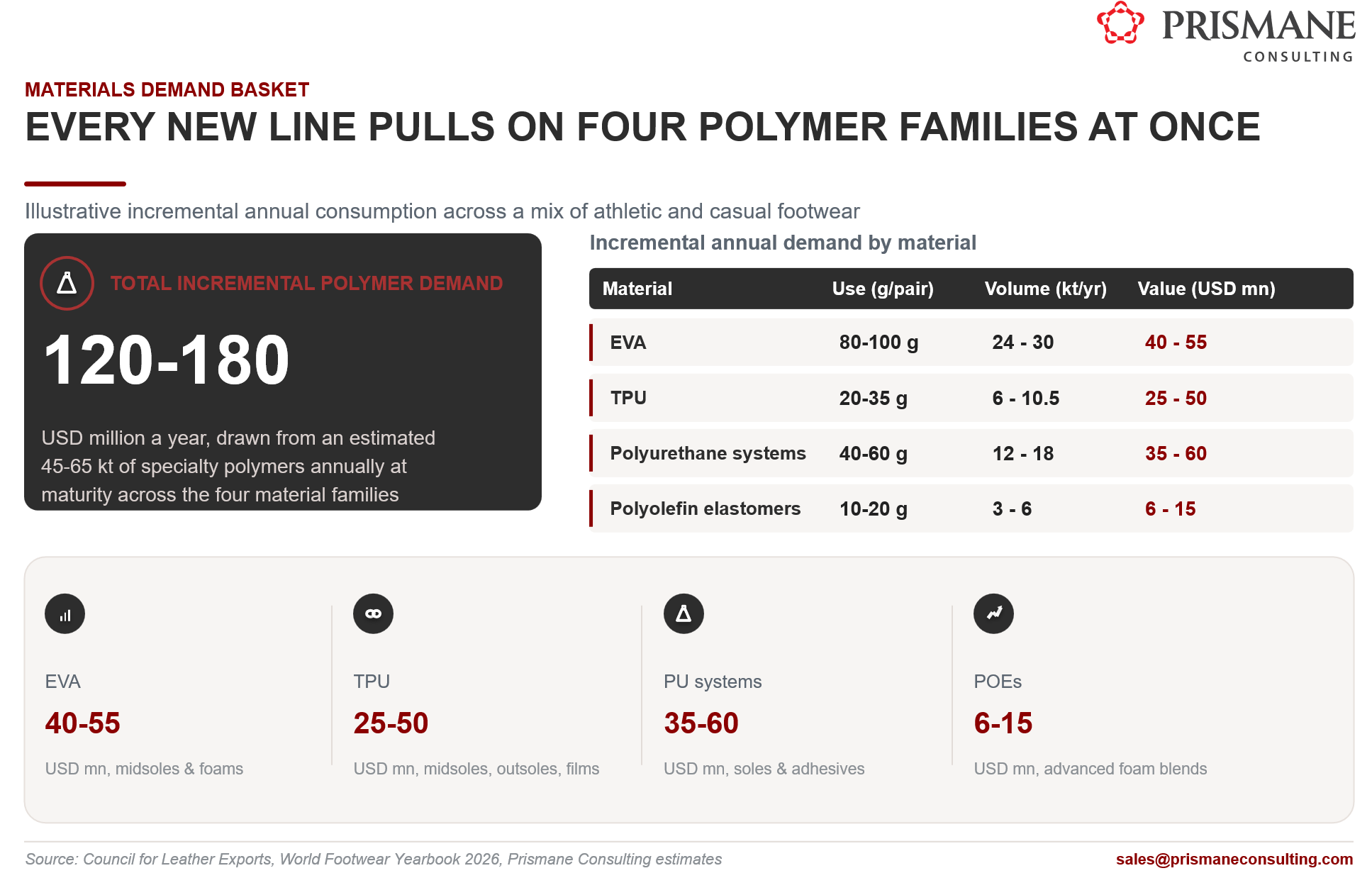
Applying representative material consumption for a mix of athletic and casual footwear, the incremental annual polymer pull looks approximately as follows:
Material | Illustrative use (g/pair) | Incremental demand (kt/yr) | Indicative value (USD mn) |
EVA | 80-100 | 24 - 30 | 40 - 55 |
TPU | 20-35 | 6 - 10.5 | 25 - 50 |
Polyurethane systems | 40-60 | 12 - 18 | 35 - 60 |
Polyolefin elastomers | 10-20 | 3 - 6 | 6 - 15 |
Total | 45 - 65 | ~120 - 180 |
Source: Council for Leather Exports, World Footwear Yearbook 2026, industry price benchmarks and Prismane Consulting estimates. Figures are illustrative scenario estimates, not forecasts; a single midsole typically uses one foam chemistry rather than all of them, so the basket reflects a blended production mix.
The central case lands near USD 150 million of incremental annual materials demand, drawn from tens of thousands of tonnes of specialty polymers. For a downstream industry rarely mentioned alongside EVs, batteries or advanced packaging, that is a meaningful, concentrated demand centre.
The real strategic question: who captures it?
Here the story diverges sharply from a straightforward growth note, and this is where the opportunity actually lies.
Unlike carbon black, where India is a net exporter with ample domestic capacity, India is structurally import-dependent for most of these footwear polymers. Reliance Industries is effectively the only domestic EVA producer, and local output has long trailed demand. TPU capacity is thin, leaving footwear-grade material to be imported from BASF, Lubrizol and Covestro, which lifts landed cost appreciably. Polyolefin elastomers are almost entirely imported. Even domestic PU system houses depend on imported base isocyanates and polyols.
In other words, if new footwear lines simply pull in imported resin, the USD 150 million flows largely to suppliers outside India, and the FTA does nothing to change that. The genuine opportunity is import substitution: building domestic compounding, foaming and systems capacity close to the Tamil Nadu clusters so that a growing share of this demand is captured onshore.
Policy is already pointing this way. The sector's Production-Linked Incentive framework offers a capital subsidy of around 15% for footwear resin investments, and schemes such as the Focus Product Scheme and IFLDP are designed to deepen the domestic value chain. For compounders, converters, adhesive formulators and specialty additive suppliers, footwear clusters represent exactly the kind of anchored, co-located demand that justifies local capacity.
Looking beyond the headline
Trade agreements are usually judged by the exporters of finished goods. The more valuable vantage point is one link upstream, at the industries that supply those exporters. The India - EU FTA, layered on top of the China-plus-one shift, is not only a footwear story. It is a manufacturing-competitiveness story, and for the chemical industry it may ultimately become a specialty polymers story, with the largest prize going to producers who localise ahead of the demand rather than after it.
At Prismane Consulting, we believe the most valuable market insights emerge not from headline announcements, but from understanding how policy decisions reshape entire value chains.
Interested in the India specialty polymers and footwear materials value chain? Reach out to us at sales@prismaneconsulting.com.