
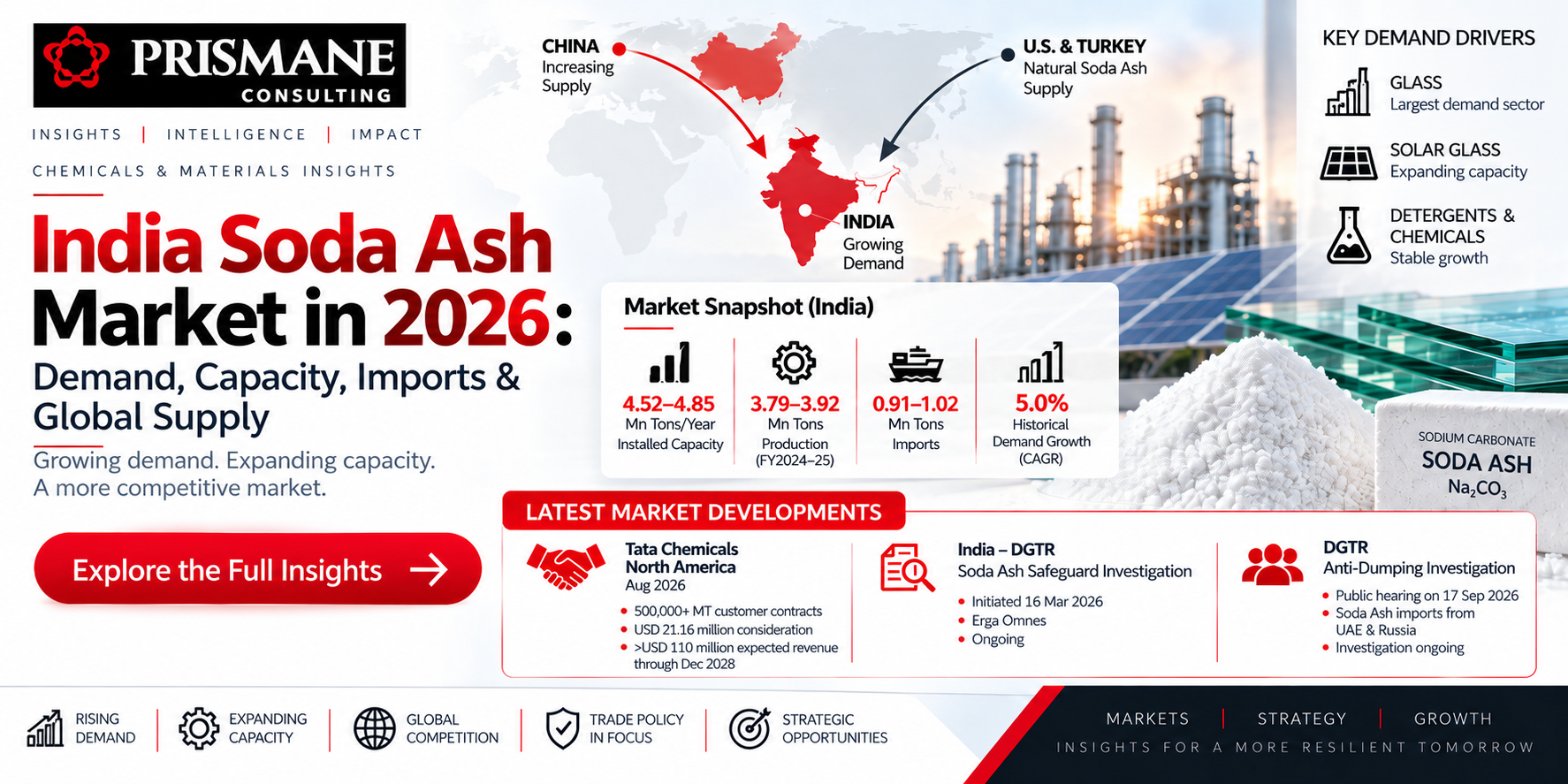
The India soda ash market is entering a more competitive phase in 2026 as domestic demand expands, production capacity increases and imports remain an important source of supply.
Demand continues to grow across glass, solar glass, detergents and chemicals. Domestic producers are adding capacity, while international supply—particularly from China and major natural soda ash producers—continues to influence India's import economics.
That creates the central paradox for the Indian soda ash industry: India needs more soda ash, but rising demand does not automatically translate into stronger pricing or margins for domestic producers.
The competitive equation is increasingly determined by three variables: domestic capacity, international supply and customer access.
The policy environment is also becoming more important. India's Directorate General of Trade Remedies (DGTR) initiated a safeguard investigation into soda ash imports on March 16, 2026, on an erga omnes basis. The investigation remains listed as ongoing.
At the global level, Tata Chemicals has also demonstrated the increasing importance of customer access. In August 2026, its North American subsidiary was selected to acquire soda ash customer contracts representing more than 500,000 metric tons of demand through December 2028, without acquiring the underlying production facility.
Together, these developments point toward a more competitive soda ash cycle in which capacity alone will not determine market position.
India Soda Ash Market in 2026: Key Indicators
Market Indicator | Facts/Figures |
Major demand sectors | Glass, solar glass, detergents & chemicals |
Key competitive sources | Domestic production, China and natural soda ash from the U.S. & Turkey |
Major 2026 policy development | DGTR safeguard investigation |
Key structural demand driver | Expansion of glass and solar glass |
Source: Secondary & Primary Research and Prismane Consulting Estimates
The numbers illustrate an important characteristic of the soda ash market in India. The country has a substantial domestic production base, but imports remain meaningful. Consequently, the domestic market remains connected to international supply and delivered-cost economics.
India Soda Ash Market Demand Is Still Growing
The Indian soda ash market is supported by several large downstream industries.
Glass remains the largest demand centre, while detergents, chemicals, sodium bicarbonate, silicates and other industrial applications provide additional consumption.
Glass is becoming particularly important because India's expansion of solar manufacturing is creating incremental demand for flat glass. Soda ash is a key raw material in glass production, meaning additional solar-glass capacity can be translated into additional soda ash consumption.
This is different from a purely consumer-led demand cycle.
When a new glass furnace or solar-glass production line is commissioned, it creates a structural requirement for soda ash. As India's domestic glass manufacturing base expands, the underlying requirement for soda ash should continue to increase.
India's soda ash demand has historically grown at approximately 5.0% annually, supported by glass, detergents, chemicals and other downstream applications. Solar glass adds another structural growth channel as India's photovoltaic manufacturing ecosystem develops.
The implication is important: underlying consumption can remain healthy even when the supply environment becomes more competitive.
Demand growth creates room for additional soda ash, but it does not automatically guarantee higher producer margins.
Solar Glass Is Creating a New Source of Soda Ash Demand in India
The expansion of India's solar manufacturing ecosystem is becoming an increasingly relevant factor for the India soda ash market.
The relationship is straightforward:
Solar manufacturing → solar glass capacity → flat-glass production → soda ash consumption
Solar photovoltaic modules require specialized glass, and India's efforts to expand domestic solar manufacturing are supporting investment across associated manufacturing value chains.
For soda ash producers, this creates a structural demand opportunity rather than a short-term consumption spike.
It also changes the composition of future glass demand. Conventional container and flat glass remain important, but solar glass can become an increasingly significant incremental consumer as domestic photovoltaic manufacturing expands.
This makes solar glass soda ash demand an important variable when assessing India's medium-term market balance.
Soda Ash Production in India: Capacity, Output and Imports
India has one of the world's largest soda ash markets and a substantial domestic production base.
Industry data indicates installed soda ash capacity of approximately 4.52 million tons per year as of March 2025, with production of around 3.79 million tons in FY2024–25. Capacity utilization was approximately 84.0%, while imports were around 1.02 million tons and exports approximately 0.30 million tons.
More recent industry estimates by Prismane Consulting place installed capacity closer to 4.85 million tons, with production around 3.92 million tons and imports of approximately 0.91 million tons.
Because the figures relate to different reporting periods and methodologies, they should not be treated as directly comparable. However, the broader market signal is consistent:
India has substantial soda ash production capacity, yet imports continue to represent a meaningful source of supply.
Why?
The answer is primarily commercial.
Imports provide downstream buyers with an alternative source of material and allow them to respond to differences in:
- Price
- Grade availability
- Freight
- Logistics
- Regional supply
- Contract terms
- Domestic producer availability
For a large glass manufacturer, the relevant question is not simply whether India has enough installed capacity.
It is whether the delivered cost and availability of domestic soda ash are competitive with imported material.
That distinction becomes increasingly important when global supply is abundant.
Chinese Soda Ash Supply Is Changing India's Competitive Equation
China remains central to the global soda ash supply landscape because of its large production base and role in Asian chemical and industrial trade.
For India, geography matters.
China is close enough to remain an important potential supply source for Asia-Pacific Soda Ash markets, while natural soda ash producers in the U.S. and Turkey retain important positions in international trade.
India therefore sits between different production models:
Domestic Indian production → Chinese synthetic soda ash → Natural soda ash from the U.S. and Turkey
These supply sources do not have identical cost structures.
Natural soda ash benefits from access to trona resources, while synthetic producers operate under different raw-material, energy and process economics.
This creates a more complex pricing environment for Indian buyers.
Indian soda ash demand can continue to grow while domestic producers simultaneously face pressure from imported material. These conditions are not contradictory.
If global supply grows faster than demand, international availability can constrain pricing even in a growing domestic market.
For India, the global supply curve increasingly matters almost as much as the country's own demand trajectory.
India Soda Ash Imports: 2026 Safeguard Investigation and Trade Remedies
The pressure surrounding imports has moved beyond commercial competition.
On March 16, 2026, India's DGTR initiated a safeguard investigation concerning soda ash imports into India. The case is designated Erga omnes, meaning it is not limited to one exporting country. The DGTR record subsequently lists questionnaires, interested-party registration and an oral-hearing process. The investigation remains classified as ongoing.
A safeguard investigation assesses whether increased imports are causing or threatening to cause serious injury to the domestic industry. It does not mean that a restriction has been imposed. Any eventual measure would depend on the findings and applicable procedures.
This introduces a major policy variable into the India soda ash market.
If trade restrictions are eventually introduced, domestic producers could gain additional room to utilize capacity and compete for domestic volumes.
For downstream consumers, however, the impact could be different.
Glass, detergents and chemical manufacturers would need to assess how any change in import availability affects their raw material costs and supply options.
The trade-remedy environment is also broader than the safeguard investigation. DGTR records show soda ash anti-dumping proceedings involving Turkey, Russia, the U.S. and Iran, while September 2026 public-hearing records also show proceedings involving soda ash from the UAE and Russia and other country combinations.
The result is a market where trade policy has become an important part of soda ash supply-chain strategy.
Soda Ash Capacity in India Is Set to Increase Further
Indian producers continue to invest in domestic manufacturing capacity.
The strategic rationale is clear.
India's glass industry is expanding. Solar glass provides an additional demand driver. Detergents and chemicals continue to provide a substantial consumption base.
Additional domestic capacity can therefore:
- Reduce dependence on imports
- Improve domestic supply security
- Support downstream manufacturing
- Increase producer scale
- Strengthen supply-chain resilience
But the timing of capacity additions matters.
If domestic demand grows at a healthy rate, new capacity can be absorbed without major disruption to market balance.
If capacity comes online faster than demand, producers may need to compete more aggressively for available volumes.
And if international material remains commercially attractive, imports may continue even as India's domestic capacity increases.
This means soda ash capacity in India cannot be assessed independently of the global supply curve.
Tata Chemicals and the Global Soda Ash Market: Why Customer Access Matters
Tata Chemicals latest North American transaction provides an interesting example of how the global soda ash industry is evolving.
Searles Valley Minerals, a U.S. natural soda ash producer, entered Chapter 11 bankruptcy proceedings. In August 2026, Tata Chemicals North America was declared the successful bidder for North American soda ash customer contracts representing more than 500,000 metric tons of demand to be serviced from September 2026 through December 2028.
The transaction involves USD 21.16 million in cash consideration, while the contracts are expected to generate more than USD 110 million in revenue over the contract period.
The significance extends beyond the transaction value.
Tata Chemicals is securing customer demand and commercial relationships rather than acquiring new production capacity.
That distinction matters in an increasingly competitive soda ash industry.
A new plant can add hundreds of thousands of tons of capacity, but those tons still require customers.
A producer with:
competitive costs + high utilization + secure customers
has a fundamentally different commercial position from a producer with capacity but insufficient demand.
Tata's transaction therefore illustrates a broader industry theme:
Customer access is becoming almost as important as production capacity.
The India Soda Ash Market Paradox Is Becoming Clearer
India is adding soda ash capacity because downstream industries need more material.
At the same time, international producers are competing for the same customers.
This creates a structural tension.
If domestic capacity expands faster than Indian demand, producers will need to compete more aggressively for available volumes.
If imports remain commercially attractive, domestic producers may face pressure even when the Indian market itself is growing.
If trade restrictions reduce imports, domestic utilization could increase, but downstream industries may face higher raw-material costs.
And if global oversupply persists, Indian buyers may continue to have access to internationally competitive material.
There is therefore no simple relationship between soda ash demand growth and producer profitability.
Soda Ash Cost Competitiveness Is Becoming More Important
Another important development is the growing differentiation between soda ash production routes.
Natural soda ash producers have access to trona resources and operate with a different cost structure from synthetic producers.
The U.S. and Turkey remain important natural soda ash supply centers, while China has developed a significant synthetic production base.
Indian producers operate within another cost structure and compete against both imported natural soda ash and international synthetic supply.
Consequently, the competitive equation includes:
- Energy costs
- Raw-material economics
- Plant efficiency
- Capacity utilization
- Freight
- Port logistics
- Product grade
- Customer location
- Contract structure
Headline capacity is therefore only one part of the equation.
The more relevant question is increasing:
Which supply sources can deliver soda ash to customers at the most competitive total cost?
India Soda Ash Market Outlook: Three Variables to Watch
Looking toward the next phase of the market, three variables will be particularly important.
Domestic Capacity Additions
India's ability to absorb additional soda ash capacity will depend on the pace of downstream demand growth, particularly in glass and solar glass.
Import and Trade-Remedy Policy
The outcome of India's safeguard investigation and ongoing trade-remedy proceedings could change the competitive relationship between domestic producers and imported soda ash. As of September 2026, safeguard investigation remains ongoing.
Global Soda Ash Supply and Export Economics
Chinese production and the competitiveness of natural soda ash from the U.S. and Europe Soda Ash (primarily Turkey) will continue to influence India's import economics.
The interaction between these three variables will determine the next stage of the India soda ash market more than demand growth alone.
Strategic Implications for Soda Ash Producers and Buyers
For Indian soda ash producers, the strategic priorities are increasingly linked to utilization, cost competitiveness, customer retention and downstream integration.
For downstream consumers, supply diversification and delivered-cost optimization become more important as domestic and imported sources compete.
For international suppliers, India remains an attractive market because of its structural demand growth, but market access increasingly needs to be evaluated alongside trade-policy developments.
For investors and strategic planners, capacity announcements should therefore be assessed against the broader supply-demand balance rather than viewed in isolation.
The relevant strategic framework is:
Demand growth → capacity additions → import competition → trade policy → delivered cost → customer access
That is the chain that will shape India's soda ash competitiveness.
Major Soda Ash Producers in India
India's soda ash production landscape includes established producers such as Tata Chemicals, GHCL, Nirma and DCW, alongside other participants across the broader chemicals ecosystem.
For market participants, however, company capacity alone is not sufficient to understand competitive positioning.
Important parameters include:
- Installed capacity
- Actual production
- Capacity utilization
- Product portfolio
- Production route
- Cost position
- Geographic footprint
- Customer mix
- Export exposure
- Expansion pipeline
This is particularly relevant in a market where additional capacity and international imports can simultaneously influence pricing.
Prismane Consulting Perspective
India does not simply need more soda ash.
It needs competitive, reliable and economically sustainable soda ash supply.
That distinction is becoming increasingly important in 2026.
India's downstream industries are expanding, solar glass is creating an additional source of structural demand and domestic producers are increasing capacity. Yet imports remain relevant, while global supply from China and natural soda ash producers in the U.S. and Turkey continues to influence market economics.
At the same time, India's trade-remedy environment is becoming more active. The ongoing safeguard investigation and other soda ash proceedings demonstrate how closely domestic production, imports and downstream competitiveness are becoming linked.
Tata Chemicals' North American transaction adds another dimension. Securing more than 500,000 metric tons of future customer demand without acquiring new production capacity highlights the growing value of customer access, demand visibility and commercial relationships in a globally competitive soda ash industry.
The next cycle will therefore not be defined simply by how much soda ash India produces.
It will be defined by who can supply it competitively, who can secure customers and how effectively producers navigate the interaction between domestic demand, global supply and trade policy.
For the India soda ash market, the strategic question is shifting from:
“How much capacity does India need?”
to:
“Which capacity will remain competitive as the market becomes increasingly global?”
Looking for a Deeper View of the Soda Ash Market?
Understanding the India soda ash market requires more than tracking demand growth or announced capacity.
Prismane Consulting's soda ash market intelligence combines demand and supply modelling, capacity tracking, trade-flow analysis, producer benchmarking, downstream demand assessment and regional market dynamics to evaluate how changes in India, China, the U.S., Turkey and other major markets can influence the competitive landscape.
Explore Prismane Consulting's Soda Ash Market Study for detailed market data, forecasts, capacity information, trade analysis and competitive insights.
For market sizing, competitive intelligence or strategic assessments of the India Soda Ash Market and related materials, contact sales@prismaneconsulting.com