
The MDI market and TDI market are entering a more complicated phase in September 2026. Prices are moving higher across major Asian and European markets, supported by higher raw material, energy, logistics and supply-chain costs. Yet the demand response remains much less convincing.
That distinction matters.
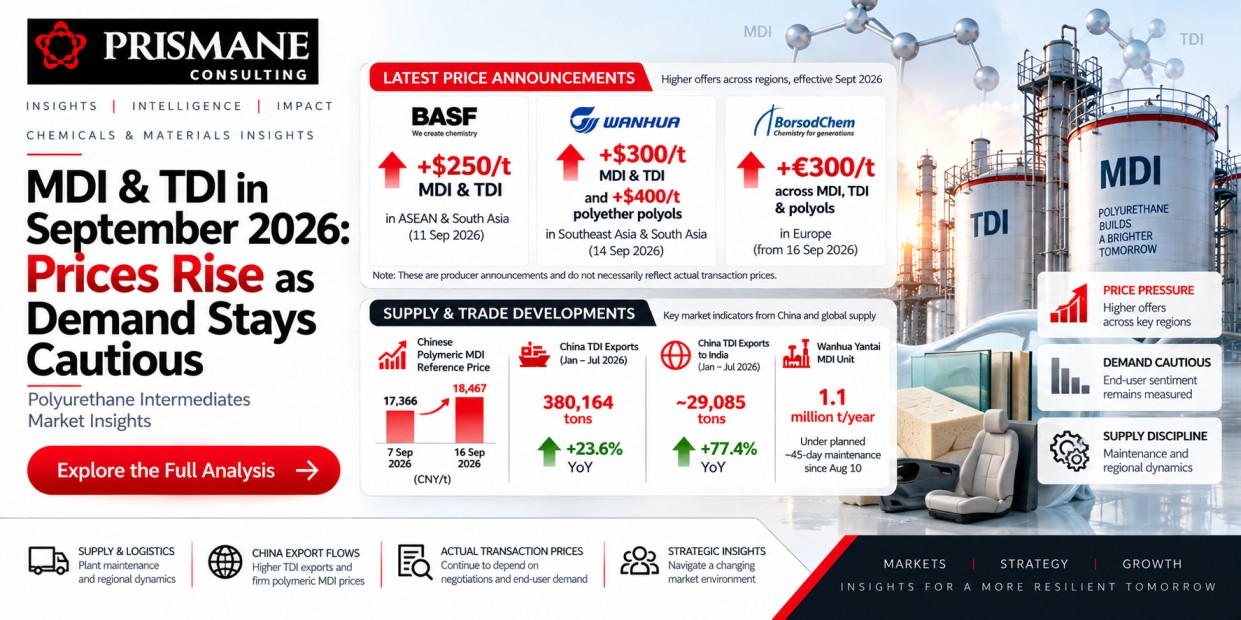
BASF announced a $250/ton increase for its Lupranate MDI and TDI products in ASEAN and South Asia on September 11. Wanhua Chemical followed on September 14 with increases of $300/ton for MDI and TDI and $400/ton for polyether polyols in Southeast Asia and South Asia. BorsodChem, Wanhua's Hungarian subsidiary, subsequently announced a €300/ton increase across its European MDI, TDI and polyol portfolio.
At the same time, Chinese domestic prices have also moved higher. Polymeric MDI reference prices increased from CNY 17,366/ton on September 7 to CNY 18,066/ton on September 11, before reaching around CNY 18,467/ton by September 16.
The result is a market where the MDI price cycle and TDI price cycle are clearly visible, but the demand-side confirmation is still limited.
MDI and TDI prices are rising across regions
The latest round of increases is notable because price movements are no longer confined to one producer or one geography.
In Asia, BASF's September 11 announcement raised MDI and TDI prices by $250/ton in ASEAN and South Asia. Wanhua followed three days later with a larger $300/ton increase for both MDI and TDI, alongside a $400/ton increase for polyether polyols.
Europe has also moved higher. BorsodChem announced a €300/ton increase across its MDI, TDI and polyol portfolio from September 16, citing higher raw material and energy costs.
This does not necessarily represent a uniform industry-wide increase in realised transaction prices. Producer announcements establish the direction of offers, but the extent to which those increases are absorbed by downstream customers depends on contract structures, inventory positions and actual purchasing requirements.
That distinction is increasingly important for understanding the MDI market in September 2026.
The cost base has changed, but demand has not moved at the same speed
The current isocyanate market is being supported primarily by the supply and cost side.
Higher energy costs, logistics disruption and feedstock uncertainty are increasing the replacement cost of MDI and TDI. Producers are therefore attempting to push those costs through the value chain.
The downstream response is different.
Market reporting through mid-September points to cautious enquiries and relatively small completed transactions in several Asian markets. Flexible foam buyers, for example, have faced sharply higher polyether polyol offers while actual transaction activity has remained less aggressive.
This creates an important distinction between a price-led market and a demand-led market.
A demand-led price increase normally comes with stronger restocking, improving order books and greater willingness among buyers to secure additional volumes. The current MDI demand and TDI demand picture does not yet show the same level of confirmation.
For buyers, this means that posted prices and actual transaction prices can diverge.
Hormuz disruption has become a broader supply-chain issue
The Strait of Hormuz remains an important part of the current MDI supply and TDI supply discussion, but the disruption is no longer simply a question of whether one shipping corridor is open or closed.
The market has moved through repeated periods of disruption and partial recovery, while risks have also extended towards other shipping routes. This has increased freight uncertainty and complicated the movement of feedstocks and finished chemicals from the Gulf into Asia and other consuming regions.
The significance for polyurethane raw materials is therefore broader than the physical volume directly lost through a particular route.
Even when material remains technically available, higher freight costs, longer transit times, insurance costs and uncertainty over future deliveries can change the economics of supplying a regional market.
That helps explain why producers are attempting to increase prices even when downstream demand remains cautious.
Northeast Asian maintenance is adding another layer of tightness
The shipping disruption is also coinciding with planned maintenance in Northeast Asia.
Wanhua's 1.1 million ton/year Yantai MDI unit has been undergoing a planned shutdown of roughly 45 days since August 10. Tosoh's 200,000 ton/year Japanese MDI unit has also been reported by market sources as entering a maintenance window in September, although the timing has not been independently confirmed by Tosoh.
Neither event is unusual in isolation.
The timing is what matters.
When maintenance overlaps with higher logistics costs and tighter Gulf-linked supply, the amount of material immediately available to the spot market becomes more important than headline annual capacity.
This is particularly relevant to the MDI market, where regional availability can change faster than annual capacity figures suggest.
Sadara adds a longer-term question to the Middle East supply picture
The situation around Sadara Chemical is introducing a separate structural question.
Reuters reported on September 9 that Dow is considering an exit from its $20 billion chemicals partnership with Saudi Aramco, with Aramco potentially buying Dow's 35% stake or other investors potentially participating. No final decision had been made at the time of the report.
Sadara's Jubail complex produces more than 3 million tons of chemicals and plastics annually, making its operating status strategically relevant to the broader Middle East chemicals supply chain.
An ownership change would not automatically change production volumes. The more immediate issue for the polyurethane market is how and when disrupted Middle East capacity returns to normal operations.
For MDI and TDI buyers, that timeline matters because additional Middle East supply could eventually ease some of the pressure currently supporting regional prices.
China is becoming an increasingly important variable in the TDI market
The TDI market has another important feature that is less visible in the MDI market: China's growing role as an export supplier.
China exported 380,164 tons of TDI during January to July 2026, up 23.6% year on year. Exports to India increased 77.4% to around 29,085 tons, while exports to the Philippines rose 48.5% to approximately 10,652 tons.
China's TDI capacity reached around 2.06 million tons/year in 2026, according to current market tracking.
This means China's domestic supply balance increasingly influences availability across the wider Asia-Pacific region.
When Chinese producers have sufficient export economics, additional material can move towards markets such as India and Southeast Asia. When freight spreads or regional price differentials change, those flows can shift again.
Consequently, annual capacity is becoming a less useful indicator of short-term availability than operating rates, export volumes, inventories and freight economics.
For buyers tracking TDI prices in Asia, Chinese export flows are therefore becoming an increasingly important market indicator.
What the current MDI and TDI price cycle actually tells us
The latest price increases should not automatically be interpreted as evidence of a broad-based demand recovery.
The more immediate explanation is a combination of:
- higher raw material and energy costs
- elevated logistics and freight costs
- geopolitical disruption affecting Gulf-linked supply chains
- planned maintenance in Northeast Asia
- tighter prompt availability in selected regional markets
- Chinese TDI exports reshaping the Asia-Pacific supply balance
- producer efforts to protect margins and pass through higher costs
The demand picture is more mixed.
Buyers are still purchasing. Foam, insulation, construction, automotive and other polyurethane applications continue to consume MDI and TDI. However, current market indications do not yet point to a widespread restocking wave strong enough to explain the latest price increases on its own.
That makes the current MDI and TDI price cycle different from a conventional demand-driven upswing.
South Korea's TDI supply base is set to contract
South Korea's TDI market is also set to lose one of its three major producers. OCI has announced that it will suspend its TDI manufacturing and sales business from 18 December 2026, removing around 50 KT/year of capacity from the Korean market.
South Korea currently has approximately 160 KT of TDI capacity at BASF, 150 KT at Hanwha Solutions and 50 KT at OCI. OCI therefore represents around 13.8% of the combined capacity of these three producers.
With TDI prices already under pressure, OCI's exit raises the question of whether the loss of Korean capacity will add another layer of upward pressure on prices or whether growing Chinese export availability will help absorb the impact.
What it means for the MDI and TDI market
The most important question for the remainder of September is no longer simply whether producers will announce another increase.
It is whether those increases will translate into sustained transaction prices.
If logistics disruption continues, Northeast Asian maintenance overlaps with constrained imports and producers maintain supply discipline, elevated MDI prices and TDI prices could remain supported even without a significant demand recovery.
The opposite scenario is also possible.
A sustained improvement in shipping conditions, the return of major production units, or an increase in Chinese export availability could change the regional supply balance quickly. If downstream buyers have maintained low inventories throughout the price increases, that could expose a gap between producer expectations and actual purchasing capacity.
That is why the next phase of the market needs to be watched through three indicators rather than price announcements alone:
plant availability, export flows and actual transaction volumes.
The price cycle is visible. The demand cycle is not yet.
For the MDI market and TDI market, that gap may be the defining feature of the remainder of 2026.
Prismane Consulting tracks the global MDI and TDI value chain, including plant-level capacity, operating status, regional supply-demand balances, trade flows, pricing and feedstock developments.
For the full plant-by-plant capacity breakdown, regional demand-supply analysis, explore Prismane Consulting's Global Market MDI Market Study & Global TDI Market Study or contact our Chemicals & Materials team at sales@prismaneconsulting.com.