
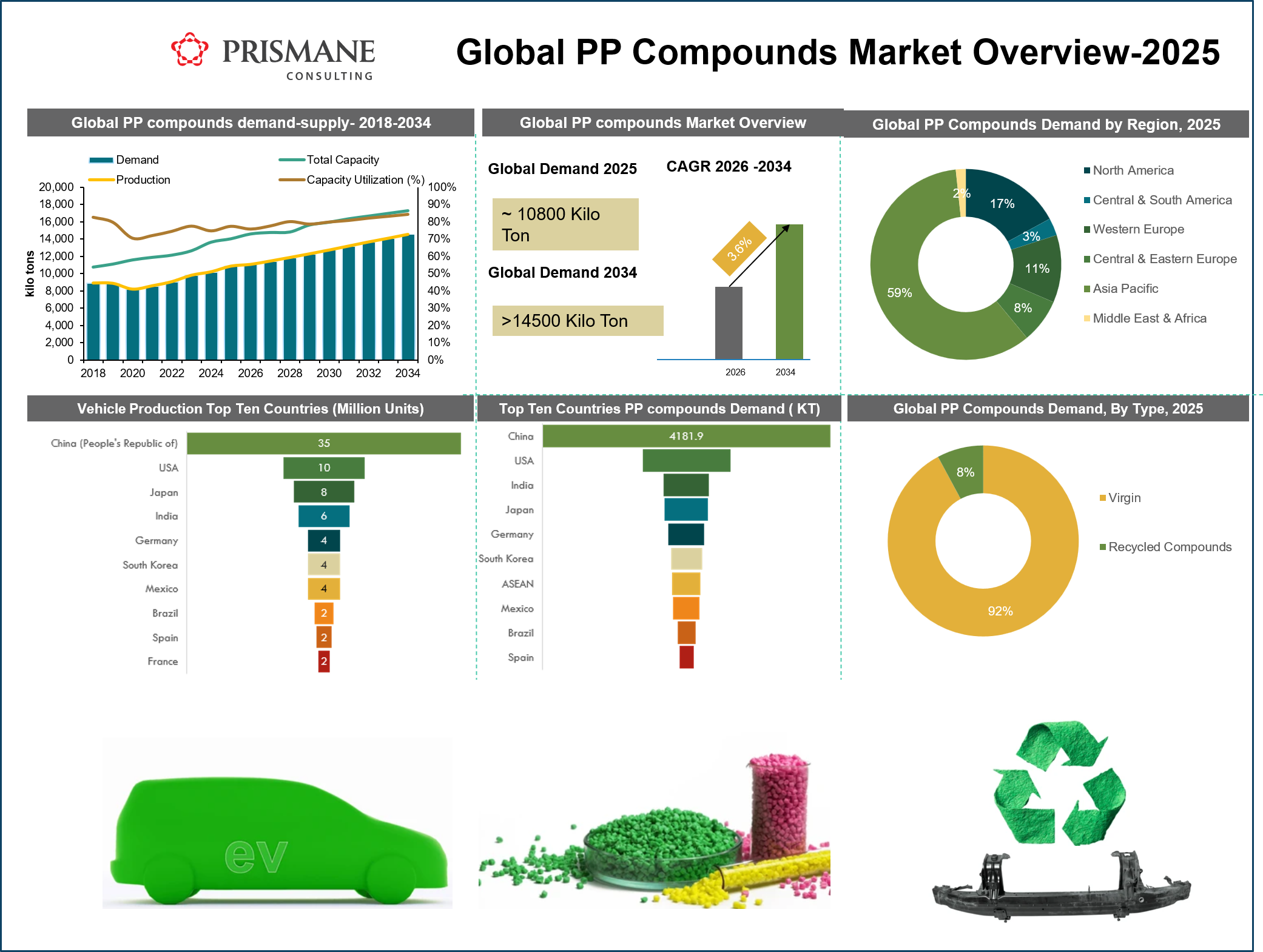
The global demand for polypropylene (PP) compounds was estimated at around 10,836 kilotons in 2025, reflecting a CAGR of 3.3% from 2015. By 2034, this market is projected to reach approximately 14,500 kilotons, growing at a rate of 3.6%. The expansion is driven primarily by developments across the automotive, consumer appliances, packaging, construction, and other industries. Notably, automotive applications dominate, accounting for 56% of the market, followed by advanced materials at 24%, consumer products and others at 14%, and infrastructure at 6%.

Growing Application Sectors
Automotive: The automotive industry remains the largest consumer of PP compounds globally. Rising vehicle production, especially in emerging markets like Asia and Latin America, coupled with technological innovations such as electric vehicles (EVs), hybrids, and autonomous driving, are fueling demand. Automakers are increasingly replacing metals and traditional plastics with lightweight, durable, and recyclable PP solutions-such as flame-retardant grades designed for EV battery housings that meet strict safety standards. Regulatory policies promoting EV adoption and stricter emission standards are also encouraging automakers to incorporate higher recycled content, further boosting the market.

Consumer and Home Appliances: Advancements in smart technology, IoT integration, and eco-friendly designs are driving growth in this sector. Rising disposable incomes and urbanization are increasing demand for appliances like washing machines, dishwashers, and microwaves. Consumers prefer models that are energy-efficient, easy to upgrade, and environmentally friendly many of which use recycled PP compounds due to their high heat resistance and processability.
Other Sectors: PP compounds are also extensively used in packaging, construction, and medical industries. They provide excellent barrier properties, chemical resistance, and sterilizability, making them ideal for bottles, pipes, fittings, and medical devices.
Shift Toward Metal Replacement and Sustainability
Polymers are increasingly replacing metals due to their resistance to corrosion, ease of processing, weight savings, and cost-effectiveness. Customizable with fillers and reinforcements, high-performance grades like biobased and recycled PP are aligning with global sustainability goals. Innovations include foamed PP, glass-reinforced, and bio-based variants, reducing the carbon footprint and supporting circular economy initiatives.

Market Opportunities and Challenges
Opportunities:
Growing focus on biodegradable and recyclable PP for medical, packaging, and consumer applications.
Rising demand for lightweight, high-performance materials in automotive and transportation sectors, especially EVs.
Expansion into construction and packaging markets due to PP’s durability and barrier properties.
Continuous R&D for advanced grades with improved impact resistance, heat stability, and recyclability.
Challenges:
Environmental concerns regarding plastic waste and the push for greener alternatives.
Recycling hurdles, including collection, sorting, and maintaining consistent quality.
Higher costs associated with specialized grades and performance limitations at elevated temperatures.
Recent developments in the polypropylene (PP) and recycled plastics industry highlight significant investments, strategic acquisitions, and market exits that are shaping the future landscape. Here are some of the notable recent updates:
Total Energies’ New Recycling Facility in France (2024): Total Energies is set to launch a state-of-the-art, flexible production line in Carling, France, scheduled for 2024. This facility will have a capacity of 15,000 tons per year dedicated to producing high-performance recycled PP (rPP) compounds containing up to 100% recycled materials. This development underscores the growing industry focus on sustainable production and circular economy initiatives, aiming to meet increasing demand for recycled plastics in automotive, packaging, and other sectors.
Ecobat’s Strategic Exit from the Italian Market: Ecobat, a global leader in battery recycling, announced the successful sale of its battery and polypropylene recycling business in Italy to Haiki + S.p.A. This transaction includes Ecobat’s facilities in Marcianise, Paderno Dugnano, and Bologna, marking Ecobat’s exit from the Italian market. This move reflects strategic portfolio adjustments within the recycling industry, possibly focusing resources on core markets or new growth areas.
LAPO Compounds’ Acquisition by Polyram Plastic Industries: Polyram Plastic Industries Ltd. has acquired a 51% stake in LAPO Compounds, an Italian-based company operating manufacturing sites in Naples, Italy, and Morocco. LAPO specializes in lightweight engineering thermoplastic compounds, including solutions based on recycled polypropylene. This acquisition strengthens Polyram’s footprint in recycled PP compounds and expands its capabilities in lightweight, sustainable solutions for automotive and industrial applications.
Polykemi’s Expansion Plans in North America: Polykemi, a key player in the North American market, currently operates two extruder lines with an annual output of approximately 7,000 tons. Based on current order forecasts, the company plans to add a third extruder by 2027, with installation potentially starting in 2026, increasing capacity by around 50%. This expansion indicates strong growth prospects driven by demand for high-quality PP compounds in various industries.
Sun Allomer’s Change in Ownership Structure (Asia Pacific):Showa Denko and JX Nippon Oil & Energy have agreed to acquire LyondellBasell’s 50% stake in the SunAllomer joint venture, which manufactures PP in Asia. Effective August 31, the Japanese companies will gain sole control through their shared investment vehicle, SDK Sunrise Investment (SSI). The joint venture will be merged into SunAllomer, with SDK owning 65% and JX Nippon 35%. This consolidation reflects strategic moves to strengthen market position and streamline operations in the region.
Supreme Petrochemical’s Acquisition of Xmold (Asia Pacific):Supreme Petrochem has received approval to acquire 100% of Xmold, a move aimed at expanding its polymer compounding presence in southern India. Xmold’s established customer base in the automotive and appliance segments, along with its advanced laboratory facilities, will enhance Supreme’s product offerings and market reach, supporting growth in high-performance and recycled PP solutions.

Future Outlook
The automotive industry’s emphasis on weight reduction and sustainability will continue to propel the market. With an average vehicle consuming around 65 kg of PP compounds, ongoing innovations aim to improve performance and recyclability. Governments, especially in Europe, are incentivizing higher recycled PP content, reinforcing a circular economy approach.
Companies like Kingfa and LyondellBasell are advancing biobased and recycled PP variants, supporting a shift toward sustainable solutions across sectors. The development of grades with enhanced impact, flame retardance, and electrical properties will further expand applications and market growth.

Request a Sample Report – https://prismaneconsulting.com/report-details/polypropylene-pp-compounds-market
Contact Us - https://prismaneconsulting.com/contact