
Sustainability is now the thing that shapes packaging decisions, and paper shows it most clearly. Plastic ran the show for decades. It was cheap, tough, and worked for almost anything. That is changing. Stringent regulations across the globe are tightening the rules, companies have made public sustainability promises, and shoppers increasingly want packaging they can recycle. Brand owners are switching to renewable, recyclable materials, and paper is usually the first plastic alternative.
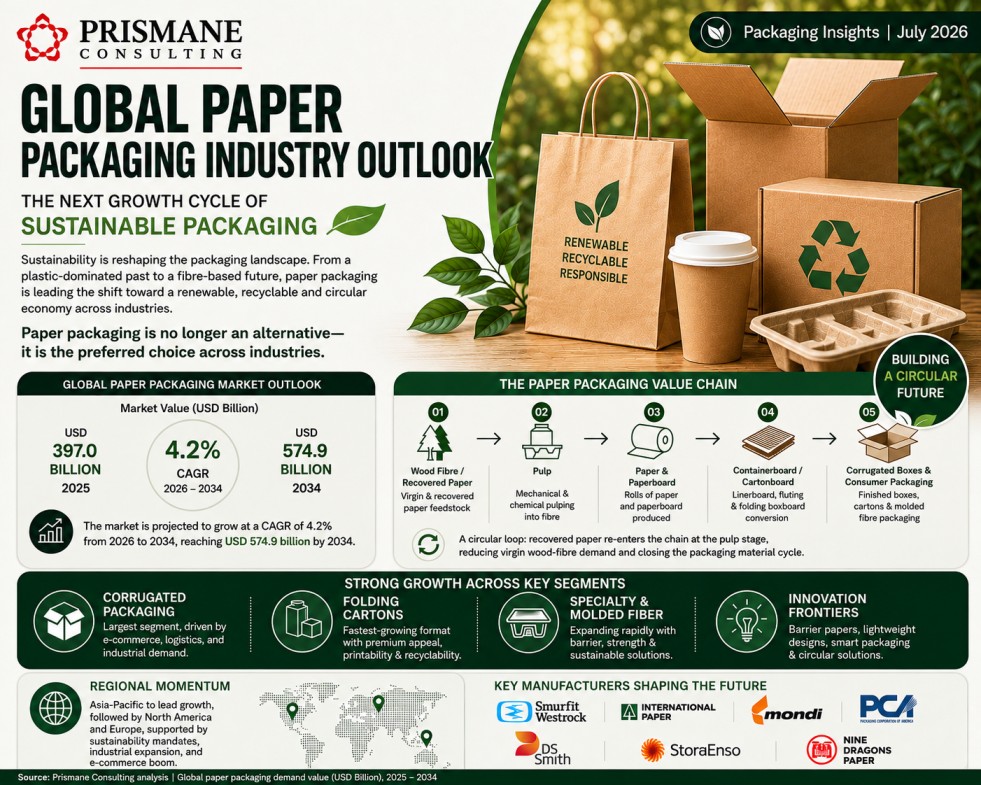
The global paper packaging market was worth USD 397.0 billion in 2025, and is expected to reach USD 574.9 billion by 2034 registering a CAGR of 4.2% from 2026 to 2034. Paper is not just a commodity product anymore. Companies use it to hit their environmental targets and to give eco-conscious buyers what they ask for. Heavy investment are going towards recycling infrastructure, sustainable forestry, and new packaging designs, so the paper packaging market should keep growing steadily throughout the forecast period. Look at what the big producers have done lately and you will see steadier pricing, healthier supply and demand, and more spending on higher-value products. That leaves real room for manufacturers, converters, retailers, and fibre suppliers to create huge opportunity.

So where is this going, and what will industry shape in the next ten years?
The Paper Packaging Value Chain
The industry runs on a tight value chain. It takes renewable raw materials at one end and turns them into packaging that has to perform for all kinds of uses at the other.

Investment is going in at every stage, which makes supply more secure and manufacturing cleaner. More recovered fibre, better recycling technology, and new containerboard capacity keep demand firm, in developed and emerging economies alike.
Corrugated Packaging
Corrugated packaging is expected to be the biggest product segment, and it brings in a large slice of industry revenue. It is strong for its weight, it recycles well, and it is cheap. That is why it is the default format anywhere shipping is heavy:
- E-commerce packaging
- Food & beverage distribution
- Industrial packaging
- Consumer goods
- Electronics
- Pharmaceuticals
E-commerce, brick & mortar shops, and better-organised logistics keep demand high, especially for shipping and protective packaging. Producers are putting money into light-board grades, right-sized boxes, designs that work with automation, and digital printing. The aim is to use less material, run more efficiently, and make the box look good on the doorstep. Each of those moves opens up new business.
Folding Cartons
Demand of folding cartons are rapidly increasing at a very fast pace. They print beautifully, they look premium on the shelf, and are recyclable. You will find them wrapped around food, healthcare products, cosmetics, household goods, and electronics. As brands push these products upmarket, they buy more value-added paperboard. Better barrier coatings and recyclable laminations let the carton do more without giving up recyclability. That is the direction of travel: replace plastic, and add function while you are at it.
Specialty and Molded Fiber Packaging
Specialty paper is gaining high attraction across the globe. New paper chemistry, coatings, and fibre engineering now block moisture, grease, oxygen, and aroma, stretch shelf life, and still take a sharp print, and all of it stays recyclable. Brands are swapping multilayer plastics for these fibre-based versions across food and beverage, healthcare, cosmetics, and e-commerce. Molded fiber stands out. It is biodegradable, it protects well, and it is taking share in protective packaging, foodservice, electronics, and healthcare.
The global molded fiber packaging market was $10.2 billion in 2025 and is expected to reach $17.1 billion by 2034, registering a CAGR of 5.9% from 2026-2034.

What's Driving Demand
- Sustainability and swapping out plastic. This is the biggest driver by far. Tougher single-use-plastic rules, higher recycling targets, Extended Producer Responsibility (EPR) schemes, carbon goals, and plain consumer preference all push demand toward paper food containers, fibre trays, wraps, and greener transport packaging.
- E-commerce growth. Online orders get handled a lot before they reach the door, so the packaging has to protect the goods without costing much to ship or to the planet. Corrugated packaging is gaining high traction due to its advantageous properties such as strong, light, recyclable, easy to customise. As online retail grows in mature and emerging markets alike, spending on digitally printed, right-sized, automation-ready boxes climbs with it, especially where retail and logistics are getting more organised.
- Consumer goods and packaged food. As incomes rise and more people move to cities, buying habits shift. People eat more processed and ready-to-eat food and buy more drinks, personal care, household goods, and medicines. Brand owners reach for premium paperboard to stand out and to look the part on sustainability, and modern retail keeps pulling in more recyclable secondary packaging. Emerging markets are the ones to watch here.
Supply-Side Dynamics: Capacity, Utilization and Pricing
This is a capital-heavy business. Whether a producer makes money comes down to how full its mills run, what fibre and energy cost, freight, and how well it recycles. Through 2024–25, a lot of producers were stuck with too much capacity, soft demand, inventory they had to work off, and weak containerboard prices. Since then they have closed or idled capacity and managed output more carefully, and the numbers look better. That is a good sign as demand recovers. The companies best set up to win are the integrated ones, the players with their own pulp, a spread of assets, and tight customer relationships.
Recovered paper holds the whole thing together. When recycling rates go up, there is more fibre to work with and less need for virgin material. How much you get depends on collection, recycling policy and infrastructure, trade flows, and how well fibre quality is managed. As those systems improve, mills will use more recovered fibre, which is exactly what circular-economy goals call for. One catch: fibre loses strength each time it is recycled, and keeping it strong is still a real problem.

Regional Outlook
North America is a mature market. The U.S. is one of the largest single contributors, helped by advanced recycling, heavy corrugated use, and strong industrial output.
Europe leads on sustainable packaging. Strict regulation, ambitious recycling targets, and investment in recyclable barrier and fibre-based flexible papers drive it.
Asia Pacific should stay the fastest-growing region. A growing population, more city living, more industry, and booming e-commerce are lifting paper packaging use across China, India, Indonesia, Vietnam, and the rest of Southeast Asia.
Latin America, the Middle East, and Africa hold strong long-term upside as organised retail, industry, and local paper manufacturing grow.
Consolidation and Competition
The big producers keep buying each other. They want wider geographic reach, fuller capacity, and greener products, and they are spending on recycling tech, lightweighting, high-performance coatings, digital printing, smart packaging, and automation. Bit by bit, this pulls the industry away from plain paper-making and toward full packaging solutions, and it hands more of the market to the strongest players.
Major industry participants include:
- Smurfit Westrock
- International Paper
- Mondi
- Packaging Corporation of America
- DS Smith
- Stora Enso
- Nine Dragons Paper
Trends Worth Watching
- Lightweight Packaging
Makers keep cutting the amount of material in each pack while holding its strength. Lighter packs cost less to ship and put out less carbon.
- Functional Barrier Papers
Water-based coatings and recyclable barrier layers now let paper stand in for ordinary plastic across foodservice and consumer products.
- Smart Packaging
Digital printing, QR codes, RFID tags, and traceability tools keep adding value on top of the pack itself.
Together they should make operations leaner and give brands a better link to their customers.
What to Expect
Paper packaging is turning from a commodity business into something built around sustainability, recycling, and reuse. Demand for greener packaging, the move away from plastic, e-commerce, better recycling, smarter coatings, and fibre-based ideas will carry growth through the next decade. All of it grows the market and opens places to invest along the chain. The winners will be the companies that pair innovation and scale with real sustainability know-how and a habit of building around what customers actually need.
Prismane Consulting covers the whole paper packaging value chain: demand and supply, capacity mapping, technology trends, regional detail, competitive benchmarking, pricing, and long-term growth. Want the full Global Paper Packaging Market Study? Write to us at sales@prismaneconsulting.com.