
Sustainable Aviation Fuel (SAF) is emerging as a vital solution in the quest to make air travel more environmentally friendly. Derived from renewable sources such as waste oils, agricultural residues, and other bio-based materials, SAF offers a promising pathway to significantly reduce the aviation industry’s carbon footprint. Unlike conventional jet fuels, SAF can be used directly in existing aircraft engines without modifications, enabling airlines to lower greenhouse gas emissions immediately and efficiently.
Production Processes and Technologies
The production of SAF involves several advanced processes. One of the most established methods is hydroprocessing, which produces Hydroprocessed Esters and Fatty Acids (HEFA) or Hydrotreated Vegetable Oil (HVO). This process begins with hydrotreatment, where feedstocks like vegetable oils or animal fats are processed under high temperatures and pressures in the presence of hydrogen and a catalyst. This step removes impurities, saturates unsaturated hydrocarbons, and transforms the feedstock into high-quality renewable diesel or HVO suitable for aviation.
Beyond hydrotreatment, alternative technologies are also gaining traction. Gasification followed by Fischer-Tropsch synthesis converts biomass or waste materials into syngas—a mixture of carbon monoxide and hydrogen—which is then catalytically transformed into synthetic paraffinic kerosene suitable for aircraft. Other methods include the alcohol-to-jet (ATJ) process, converting bioethanol or biobutanol into jet fuel, and pyrolysis, which thermally decomposes biomass into bio-oil that can be upgraded into aviation fuel.
The Rising Significance of Used Cooking Oil
Among various feedstocks, Used Cooking Oil (UCO) is rapidly becoming a preferred choice for SAF production. As a widely available waste product from food service industries, UCO offers multiple advantages. It helps divert waste from landfills, reduces greenhouse gas emissions compared to fossil fuels, and is cost-effective. UCO’s compatibility with existing hydrotreatment technologies makes it an ideal feedstock for current SAF manufacturing infrastructure. Supportive policies, incentives, and sustainability certifications further enhance its appeal, attracting airlines and fuel producers committed to decarbonization. Economically, UCO’s low cost as a waste product helps lower overall production expenses, encouraging industry investments and accelerating adoption. This positioning of UCO as a key feedstock underscores its role in scaling up sustainable aviation fuels.
Market Outlook and Future Trends
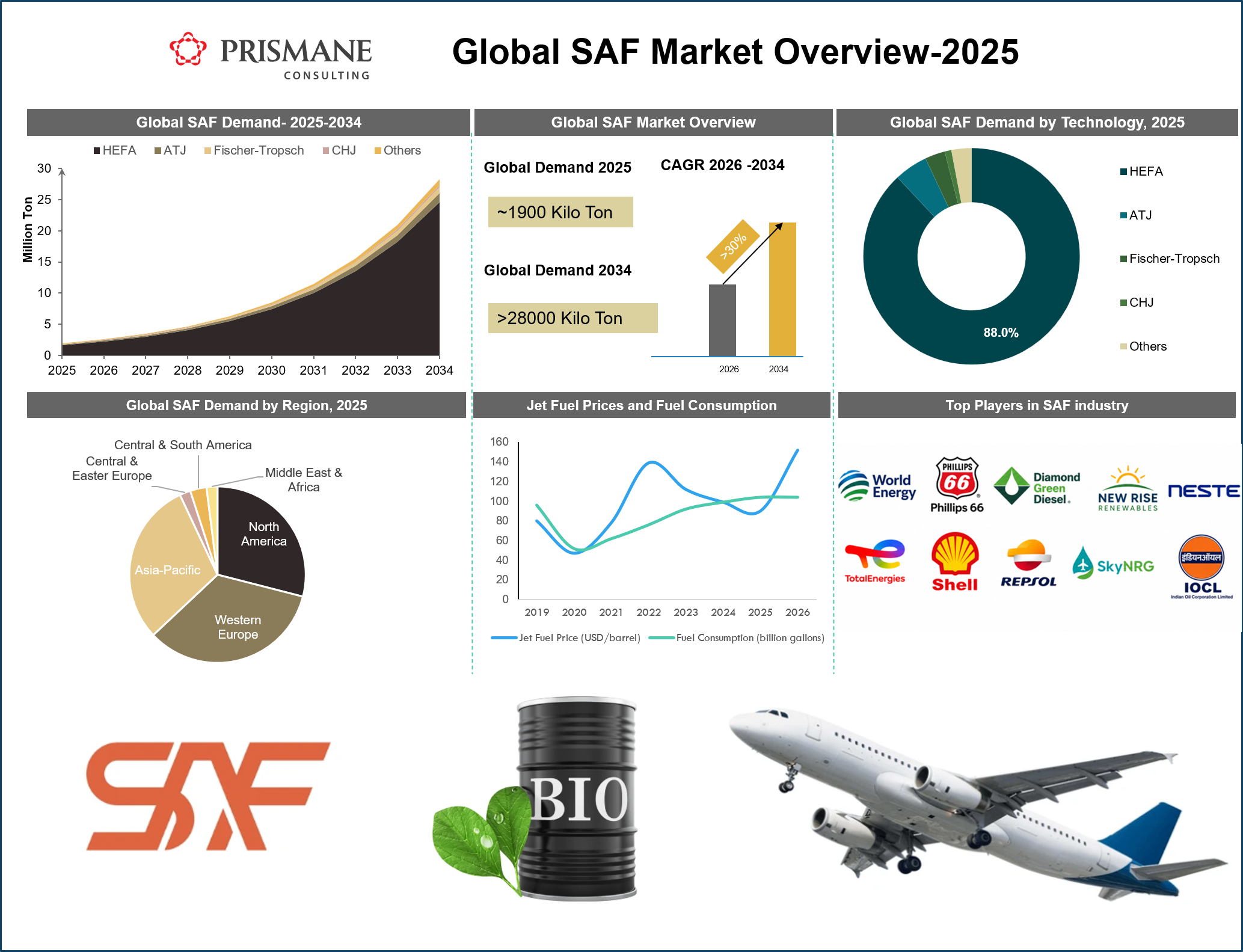
The global demand for SAF is set to surge in the coming years. Projections indicate that by 2025, the industry will require approximately 1.9 million metric tons of SAF, with a compound annual growth rate (CAGR) exceeding 30% anticipated through 2034. This rapid expansion reflects the aviation sector’s increasing commitment to sustainability and the growing adoption of alternative fuels.
Market segments for SAF include Hydroprocessed Esters and Fatty Acids (HEFA), Fischer-Tropsch synthetic kerosene (FT-SPK), alcohol-to-jet (ATJ), and Power-to-Liquid (PtL) fuels. Currently, HEFA remains the dominant segment due to its proven technology and compatibility with existing aircraft engines. However, newer technologies like FT-SPK and ATJ are gaining momentum as they mature and scale up, offering additional pathways for sustainable fuel production.
Regional Dynamics and Policy Support
Regionally, Europe currently leads the SAF market, driven by robust policy support, ambitious sustainability targets, and significant investments in green technologies. Regulatory mandates, carbon pricing, and incentives for renewable fuels further accelerate growth in this region. North America and the Asia-Pacific are also experiencing notable expansion, fueled by government initiatives, airline commitments to net-zero targets, and technological advancements. These regions are poised to play increasingly important roles in the global shift toward sustainable aviation.
Conclusion
As the aviation industry faces mounting pressure to reduce its environmental impact, sustainable aviation fuels stand out as a practical and scalable solution. Innovations in feedstock utilization, production technologies, and supportive policies are propelling SAF from niche to mainstream. With demand expected to grow exponentially, SAF will play a crucial role in transforming air travel into a more sustainable and environmentally responsible industry, helping to secure a greener future for the skies.