
A tractor, excavator or crane is not judged on how it looks in the showroom. It is judged on how it looks and performs after years of mud, UV exposure, chemical splash, vibration and repeated impact, often followed by a second or third owner.
That difference in time horizon makes agriculture, construction and earthmoving coatings, generally shortened to ACE coatings, a distinct category from automotive OEM or general industrial finishes, even when the underlying chemistry looks similar.
For ACE equipment, the coating is not simply protecting a new machine. It is helping protect an asset that may be leased, traded, financed, refurbished and resold several times during its useful life.
ACE coatings protect an asset that has to hold its value
Heavy equipment is built to work hard.
Tractors operate around fertilisers, pesticides, soil and moisture. Excavators, loaders and other construction machines face abrasion, stone impact, mud, dust and repeated mechanical abuse. Equipment can spend years outdoors, often in environments where corrosion and weathering are unavoidable.
This makes corrosion protection the starting point for ACE coatings, but it is not the complete requirement.
Colour retention, gloss retention, chemical resistance, UV durability, impact resistance and resistance to field damage all influence how the equipment looks and performs over time.
That has an economic consequence.
Visible corrosion, severe chalking, inconsistent colour or poorly matched repairs can reduce the perceived condition of used equipment even when the engine, hydraulics and mechanical systems remain sound.
The coating therefore has a longer economic life than the original paint warranty.
The customer is ultimately asking a different question from the one asked at the factory gate:
What Will This Machine Look Like When It Is Traded, Refinanced Or Sold?
Brand Colour Consistency is a Technical Constraint
Heavy equipment manufacturers often build their brands around highly recognisable colours.
Maintaining those colours across new production, replacement components, dealer touch-up paint and field repairs is considerably more difficult than it appears. Large equipment panels expose colour differences clearly, particularly under strong outdoor light.
This makes OEM equipment colour matching a genuine technical requirement.
The challenge is also increasingly global. A machine may be manufactured in one country, repaired in another and eventually resold into a third market. Maintaining consistent colour and finish across that network requires more than a paint formula.
It requires repeatable colour standards, technical support, formulation control and rapid access to matched products.
Colour matching in ACE is therefore less about aesthetics alone and more about maintaining a consistent brand identity throughout the equipment lifecycle.
ACE Coatings are Following Regional Equipment Cycles, Not One Global Cycle
The ACE coatings market is difficult to read through global economic indicators alone.
Agricultural equipment demand is linked to farm income, commodity cycles, mechanisation and investment. Construction equipment follows infrastructure spending, housing activity, interest rates and major project pipelines. Earthmoving equipment can respond differently again, depending on mining, infrastructure and regional construction activity.
Recent developments across the paints and coatings industry reflect this uneven environment. Growth opportunities are increasingly concentrated in regions where infrastructure investment, industrialisation and agricultural mechanisation are supporting equipment demand, while mature markets remain more exposed to financing costs and slower construction activity.
The implication is important.
ACE coatings demand is increasingly being shaped by where equipment is being manufactured and where machinery investment is occurring, rather than by a single global industrial cycle.
Asia ACE coatings market remains strategically important because of industrialisation, infrastructure development and expanding equipment manufacturing. The Middle East also presents opportunities where large construction and infrastructure projects are supporting heavy equipment demand.
This makes regional technical support and local production capability increasingly important to coatings suppliers.
Edge Coverage is One of ACE's Hardest Technical Problems
ACE equipment structures are often fundamentally different from automotive body panels.
Large, welded steel assemblies can contain sharp edges, weld seams, deep recesses, box sections and complex geometries. These features make achieving consistent coating thickness considerably more difficult.
The problem is not cosmetic.
A coating that performs well across a broad flat surface can still leave vulnerable areas at edges, welds or difficult-to-reach sections. Once corrosion starts at these locations, damage can spread beneath the coating system.
That is why edge coverage and corrosion resistance remain central performance requirements for heavy equipment coatings.
It also helps explain why ACE manufacturers continue to use multiple coating technologies rather than converging on one universal system.
Electrocoat (E-Coat), liquid and powder coating technologies each have roles depending on the substrate, component geometry, film-build requirement and production process.
Powder and Electrocoat are Gaining Ground, But Solvent-Borne Technology Still Matters
The ACE market is moving towards lower-VOC and more efficient coating technologies, but the transition is not a simple replacement of solvent-borne coatings with powder or waterborne systems.
For the harshest operating environments, solvent-borne systems continue to provide combinations of durability, chemical resistance and weatherability that can be difficult to reproduce economically across every ACE application.
At the same time, technology substitution is clearly taking place.
Powder coatings are well suited to many fabricated metal components and can provide high transfer efficiency, low VOC emissions and strong corrosion and weathering performance. Electrocoat (E-Coat) can provide consistent protection across complex metal components where the production process supports it. Waterborne and high-solids systems are also expanding where manufacturers can achieve the required performance with lower solvent emissions.
The direction of travel is therefore towards a broader technology mix, rather than the disappearance of solvent-borne coatings.
Current product development reflects this shift, with new high-solids industrial topcoats being positioned for agricultural and construction machinery, while powder-coating portfolios increasingly combine durability with lower environmental impact.
Sustainability as Moving Closer to the Production Process
The sustainability transition in ACE coatings is becoming more practical.
Equipment manufacturers are increasingly looking at VOC emissions, energy consumption, material utilisation, overspray, waste and raw-material carbon footprint alongside the durability of the final finish.
This makes coating efficiency economically relevant as well as environmentally relevant.
A low-VOC coating that requires substantially more energy to cure may not deliver the expected lifecycle benefit. Likewise, a powder coating that improves transfer efficiency and reduces waste can create value directly on the production line.
The most interesting developments are therefore those that combine environmental improvement with manufacturing performance.
Low-bake technologies are one example. By reducing curing temperatures or processing requirements, they can potentially lower energy consumption while improving production economics. Recycled-content powder coatings are another, particularly where recycled raw materials can be introduced without compromising weatherability, colour retention or corrosion protection.
The sustainability transition is consequently becoming less about replacing one chemistry with another and more about improving the total coating process.
Production-Line Efficiency is Becoming Part of the Coating Specification
The coating process itself is becoming a competitive variable.
ACE manufacturers are looking for higher first-pass yield, lower rework, shorter cycle times, improved transfer efficiency and reduced paint consumption.
These requirements are particularly important for large equipment because the surface area being coated can be substantial and rework can consume significant labour and production capacity.
Coating technologies that improve edge coverage, reduce touch-ups or shorten curing requirements can therefore create measurable value before the machine even leaves the factory.
This is where the distinction between a coating supplier and a coating technology partner becomes increasingly important.
The supplier that understands the entire finishing process can potentially deliver more value than one competing only on coating price per kilogram.
Electrification Will Create New Ace Coating Requirements
The next phase of equipment development is also changing the technical opportunity.
Agricultural and construction equipment is gradually becoming more automated and electrified. Battery systems, electrical components, new enclosures and redesigned structures can introduce different requirements for corrosion protection, chemical resistance, thermal performance and durability.
Electrification will not eliminate the traditional coating requirements of ACE equipment.
Instead, it adds new ones.
This could create opportunities for coating technologies and resin systems that were previously less important within conventional diesel-powered machinery.
The result is likely to be greater formulation diversity rather than a simple shift from one coating technology to another.
The Coating is Becoming Part of the Equipment's Total Ownership Economics
This is where ACE coatings differ most clearly from many other coatings markets.
For a consumer product, appearance can be heavily front-loaded towards the point of sale. For automotive coatings, durability is obviously important, but the ownership cycle and repair ecosystem are relatively structured.
Heavy equipment operates differently.
Machines are expected to work for years, often in harsh environments, before being traded, refurbished or sold into another application or geography.
The coating therefore has to preserve both functional performance and perceived asset condition.
That changes the value proposition.
A coating supplier that can improve corrosion resistance, maintain colour consistency, reduce production defects and lower application costs is contributing directly to the economics of the equipment manufacturer and, indirectly, to the residual value of the machine.
What it Means
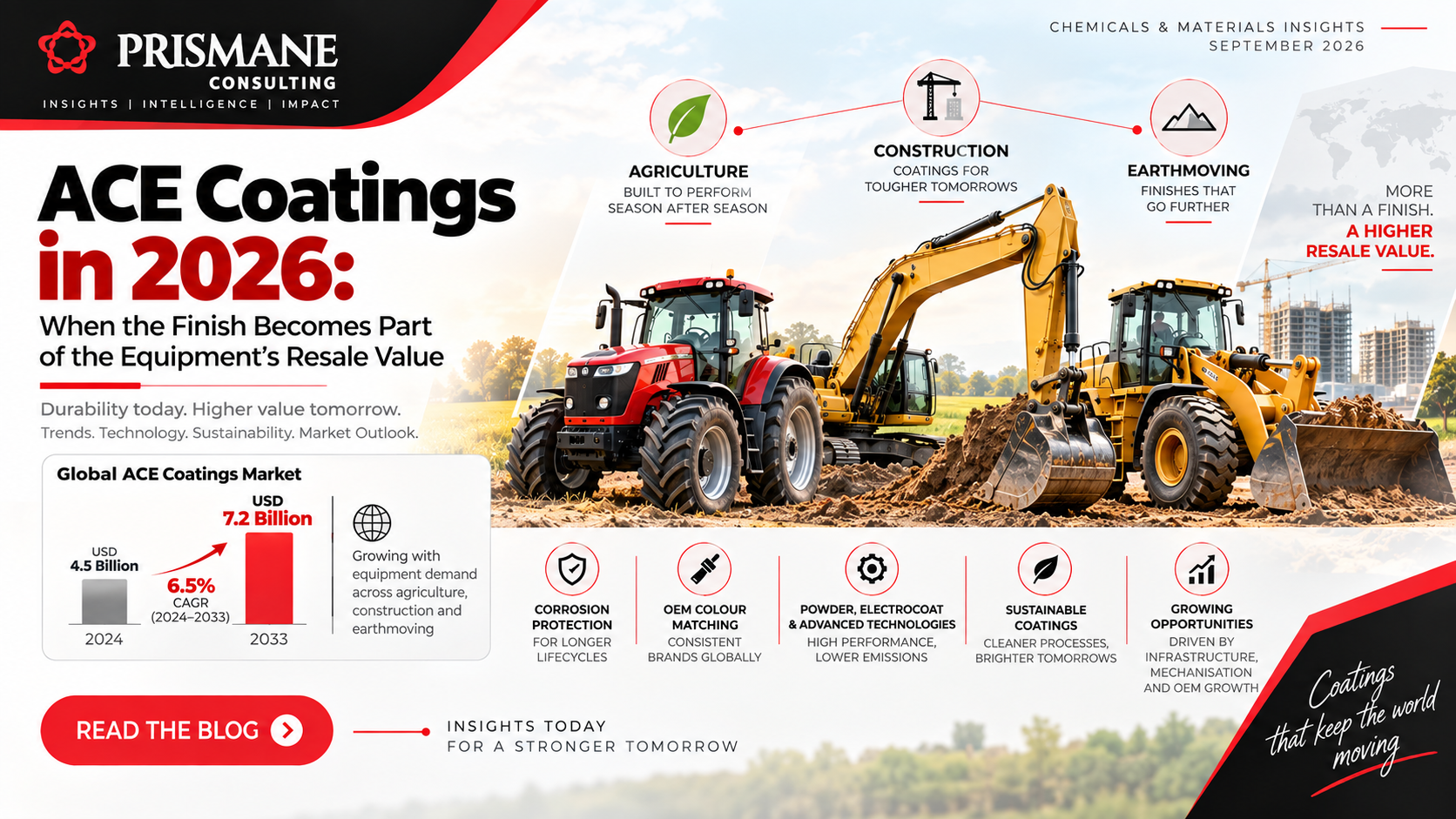
Prismane Consulting estimates the global ACE coatings market at approximately USD 4.5 billion in 2024, growing to around USD 7.2 billion by 2033, representing a CAGR of roughly 6.5% from 2025-2033.
The more important structural point, however, is not the market size.
ACE coatings are being purchased against a longer economic horizon than many industrial finishes. The coating must survive the operating environment, support the manufacturer's production process and help preserve the appearance and condition of equipment throughout its service life.
That is changing what suppliers compete on.
Corrosion protection remains fundamental, but colour consistency, edge coverage, application efficiency, lower-VOC technology, recycled content and lifecycle durability are becoming increasingly important differentiators.
The sustainability transition will also remain more application-driven than regulatory-driven. Waterborne and powder technologies will continue gaining ground, particularly where they can provide equivalent performance and improve production economics. But solvent-borne systems will remain relevant in applications where harsh operating conditions demand their performance advantages.
For ACE manufacturers, the coating is therefore becoming more than a finishing material.
It is becoming part of the equipment's durability strategy, manufacturing economics and resale value.
That is likely to define the next phase of the ACE coatings market.
Prismane Consulting tracks the global ACE coatings value chain, including demand by equipment segment, regional investment cycles, competitive positioning and coating technology adoption, through its Chemicals & Materials practice. For insights or further information on Paints & Coatings Markets, write to us at sales@prismaneconsulting.com.