
Aseptic packaging is no longer simply a packaging format. It is increasingly becoming a technology platform connecting product preservation, packaging materials, filling systems and supply-chain economics.
In food and beverage applications, aseptic packaging combines commercially sterile products with sterilized packaging and controlled aseptic filling to support extended shelf life under appropriate distribution conditions. By reducing dependence on continuous refrigeration for suitable products, technology can influence not only product protection but also inventory management, logistics, market reach and food-loss reduction.
This is changing how the aseptic packaging market should be evaluated.
The value of an aseptic package extends beyond the cost of paperboard, polymer or aluminum foil. Its economic contribution depends on how effectively the package protects the product, maintains sterility, withstands filling and distribution, and extends the period during which the product remains commercially usable.
From a strategic perspective, this makes aseptic packaging a cross-functional technology spanning packaging materials, food processing, filling equipment, logistics and recycling infrastructure.
At the same time, the industry faces a structural challenge. Conventional aseptic packaging structures have historically relied on multilayer combinations of paper & paperboard, polymer and aluminum foil to achieve the required barrier and functional performance. Sustainability targets, recycling initiatives and evolving packaging regulations are now encouraging simpler structures, improved recyclability, lower material complexity and greater use of recycled content where technically feasible.
The next generation of aseptic packaging must therefore achieve two objectives simultaneously: protect the product and improve the package's end-of-life profile.
Shelf Life Is Becoming a Supply-Chain Asset
One of the most important benefits of aseptic packaging is not the package itself. It is the additional shelf life and distribution flexibility that the packaging system can create.
Extended shelf life can help reduce product losses, simplify inventory management and support distribution across wider geographic areas. Where ambient distribution is technically appropriate, it can also reduce dependence on continuous refrigeration across selected stages of the supply chain.
This makes shelf life increasingly relevant to supply-chain design.
Food and beverage manufacturers can potentially operate centralized production facilities while serving broader regional markets. Longer product usability can provide greater flexibility in inventory planning, warehousing and transportation, particularly in markets where cold-chain infrastructure is expensive or unevenly developed.
Consequently, aseptic packaging demand is linked not only to packaging consumption but also to the economics of distribution.
Where longer shelf life creates measurable value through lower product losses, wider geographic reach or reduced refrigeration requirements, the strategic value of the packaging system increases.
Barrier Technology Is at the Center of Aseptic Packaging Innovation
Barrier performance remains one of the defining technological requirements of the aseptic packaging industry.
Oxygen can accelerate deterioration in sensitive products, moisture can affect product quality and package integrity, while light exposure can trigger chemical, nutritional or sensory changes in certain applications.
Aseptic packaging structures therefore need to provide controlled protection against multiple external factors while maintaining mechanical strength and processing compatibility.
Historically, aluminum foil packaging has played an important role in high-barrier aseptic carton structures because it provides strong protection against oxygen and light using a very thin material layer.
However, sustainability considerations are changing how barrier systems are evaluated.
The objective is increasingly to maintain high protection while reducing incompatible materials, lowering structural complexity and exploring thinner functional layers or alternative barrier technologies.
This creates a significant engineering challenge. A barrier layer may represent only a small proportion of total package mass while contributing disproportionately to package performance. Removing or replacing it may appear attractive from a material perspective but can create significant challenges related to shelf life, food safety, sterilization, package integrity and processing.
The future of aseptic packaging technology will therefore depend on achieving the right balance between barrier performance and circularity.
Aseptic Filling Technology and Packaging Must Evolve Together
A defining characteristic of the aseptic packaging market is the close relationship between packaging structures and filling technology.
Packaging materials must withstand sterilization treatments and remain compatible with high-speed filling equipment. Changes in material thickness, stiffness, sealing characteristics or thermal behavior can influence package formation, sealing windows, dimensional stability and machine efficiency.
This makes material qualification critical.
A new structure can demonstrate strong barrier performance in laboratory testing and still face commercial adoption challenges if it requires major modifications to established filling systems or reduces production-line productivity.
For packaging suppliers, the implication is clear: material innovation cannot be developed independently of processing technology.
The most commercially viable aseptic packaging solutions are likely to emerge through greater collaboration between material suppliers, packaging converters, filling-equipment manufacturers and food & beverage producers.
This will become particularly important as companies attempt to introduce recyclable or lower-complexity packaging structures without compromising filling speeds and operational efficiency.
Recyclability Is Becoming a Structural Design Challenge
The sustainability challenge in aseptic packaging recycling is not simply about replacing one material with another. It is fundamentally a structural-design problem.
Aseptic packages combine several materials because each performs a specific function. Paperboard provides structural rigidity, polymer layers support sealing and moisture protection, while barrier layers protect against oxygen and light.
The package achieves material efficiency precisely because these components perform complementary functions.
The challenge is therefore to preserve those functions while making the overall material system easier and more economically viable to recover.
This is shifting the sustainability discussion from material substitution toward system optimization.
Potential pathways include:
- Reduced material complexity
- Thinner functional and barrier layers
- Alternative barrier technologies
- Improved material separation
- Optimized polymer structures
- More efficient paperboard utilization
- Improved collection and recycling systems
- Increased recycled content where technical and regulatory requirements permit
The future of sustainable aseptic packaging will consequently depend not only on material selection but also on the development of collection, sorting and recycling infrastructure.
The Aluminum Foil Question
Aluminum foil remains an important component of high-barrier packaging because it provides exceptional protection against oxygen and light with a very thin material layer.
Its challenge is therefore less about performance and more about system compatibility and end-of-life recovery.
When aluminum foil is incorporated into multilayer aseptic structures, recovering the different materials economically can become difficult. This is driving interest in polymer-based barriers, coatings and other functional technologies that could provide sufficient protection without conventional foil structures.
However, aluminum foil substitution is unlikely to be universal.
Any alternative barrier must maintain product quality, package integrity and shelf life while surviving industrial sterilization, filling, transportation and distribution.
As a result, foil replacement is likely to remain application-specific, particularly in applications with demanding product-protection requirements.
Aseptic Packaging Is Expanding Beyond Conventional Cartons
The competitive landscape is also becoming broader.
Aseptic applications are no longer limited to conventional carton architectures. Depending on product and processing requirements, flexible pouches, polymer-based containers, bottles and other rigid formats can support aseptic or extended-shelf-life applications.
This means competition is increasingly occurring between packaging architectures, rather than simply between individual materials.
Aseptic cartons can offer material efficiency, stacking advantages and established filling ecosystems. Polymer containers may provide different handling, processing or recycling characteristics, while flexible formats can reduce packaging weight but introduce their own barrier and end-of-life considerations.
There is therefore no universal winning format.
The optimal solution depends on the interaction between:
Product sensitivity + required shelf life + barrier performance + filling technology + logistics + end-of-life infrastructure.
This system-level approach is likely to become increasingly important in packaging procurement and product-development decisions.
The Cold Chain Is Part of the Packaging Equation
Refrigeration is often treated as a separate logistics issue. For aseptic packaging, it is part of the overall value proposition.
Where ambient distribution is appropriate, extended shelf life can potentially alter the logistics model by reducing refrigeration requirements across selected warehousing and transportation stages.
This can influence distribution costs, market accessibility and supply-chain design.
However, the benefit should not be assumed automatically.
Environmental and economic outcomes depend on the product, processing conditions, distribution distance, local energy mix and actual cold-chain requirements.
This reinforces an important principle for the aseptic packaging market: packaging should be evaluated within the supply chain it enables rather than as an isolated material or format.
Regional Infrastructure Will Shape Aseptic Packaging Adoption
The economics of aseptic packaging vary significantly across markets.
Regions with established food-processing capabilities, modern filling infrastructure and broad retail networks can capture the shelf-life and distribution advantages of aseptic formats more readily.
At the same time, technology can present significant opportunities in markets where refrigeration infrastructure remains limited beyond major urban centers.
But this creates an important contradiction.
Aseptic technology can address a distribution challenge while simultaneously creating an end-of-life challenge if collection and recycling infrastructure do not develop at a comparable pace.
Therefore, the long-term aseptic packaging market opportunity depends on more than consumption growth. It also depends on the parallel development of:
Packaging systems → Collection infrastructure → Sorting capabilities → Recycling capacity → End-market demand for recovered materials
The strength of this ecosystem will increasingly influence regional adoption.
Sustainability Is Moving From Material Replacement to System Design
The next phase of sustainable aseptic packaging is unlikely to be defined by eliminating a single material.
Instead, it will focus on reducing unnecessary complexity while preserving the functions that justify the package.
Potential innovation pathways include thinner barrier layers, alternative barrier technologies, improved polymer structures, optimized paperboard utilization, better package geometry and stronger recovery systems.
Recycled content can also become increasingly relevant where food-contact, technical and regulatory requirements permit.
However, food packaging introduces additional constraints. Recovered materials must meet stringent safety and quality requirements, while suitable recycled feedstock must be available at the required scale.
This means the future of sustainable aseptic packaging technology will depend as much on the broader recycling ecosystem as on material innovation.
What Will Define the Winners?
From a market-strategy perspective, the most competitive aseptic packaging systems will need to balance four requirements:
- Reliable product protection
- Efficient high-speed filling
- Lower material intensity
- A credible recovery pathway
For converters, this means developing packaging structures alongside sterilization and filling requirements.
For material suppliers, it means improving barrier performance without adding unnecessary structural complexity.
For food and beverage producers, it means evaluating packaging alongside shelf life, logistics and product-loss economics rather than treating it simply as a procurement category.
For recyclers, it means developing economically viable pathways capable of recovering value from increasingly sophisticated packaging structures.
The winners will therefore be companies capable of optimizing the entire aseptic packaging ecosystem, rather than a single component.
Aseptic Packaging Market Outlook to 2034
The aseptic packaging market forecast is fundamentally tied to the continuing value of extended shelf life, product protection and distribution flexibility.
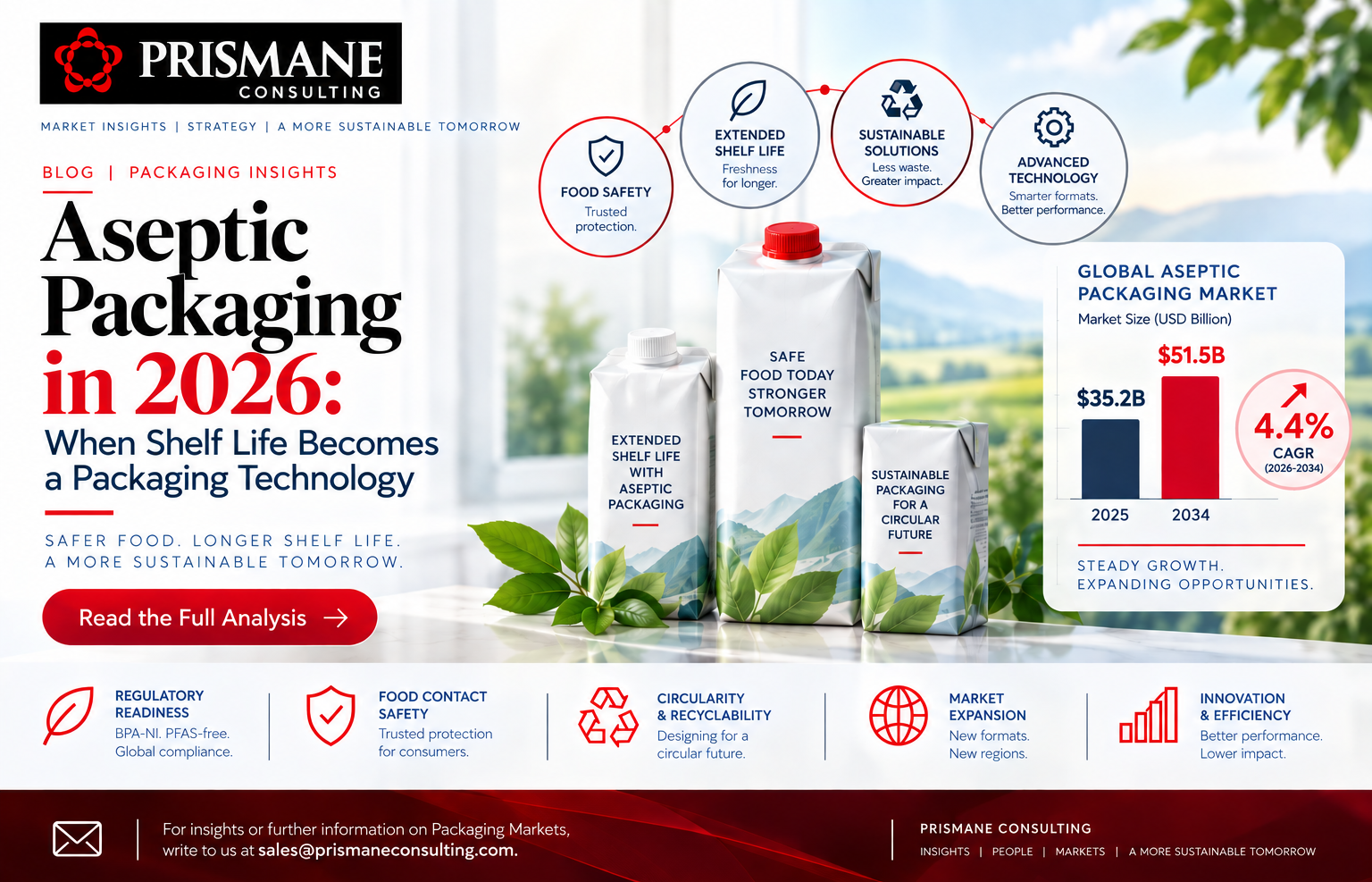
Based on analysis conducted by Prismane Consulting, the global aseptic packaging market was valued at USD 35.2 billion in 2025 and is anticipated to reach USD 51.5 billion by 2034, advancing at a CAGR of 4.4% during 2026–2034.
This growth reflects the continuing importance of shelf life, product safety, convenience and distribution efficiency across food and beverage applications.
However, the competitive environment is changing.
Conventional combinations of paperboard, polymer and aluminum foil will face increasing pressure from structures designed around recyclability, reduced material complexity and resource efficiency.
The transition will not be uniform. Applications with demanding product-protection requirements are likely to move more gradually because sustainability improvements cannot come at the expense of food safety, product quality or shelf life.
The broader direction, however, is clear.
By 2034, the most competitive aseptic packaging solutions are likely to be those that optimize shelf life, barrier performance, filling efficiency, logistics and circularity as a single system.
Prismane Consulting Perspective
From our perspective at Prismane Consulting, the future of the aseptic packaging market will not be determined by a single material, format or technology.
The competitive advantage will come from integration.
Some of the leading players in aseptic packaging market includes Tetra Laval International S.A., Amcor, UFlex Limited, Liquibox, Goglio S.p.A., Smurfit Westrock, Hansin Packing, , Greatview Aseptic Packaging Co., Ltd., IMA Group, Schott Glass India Pvt. Ltd., , Elopak Group, SIG Combibloc Group Ltd., Printpack, and Sealed Air Corporation are some of the major aseptic packaging manufacturers.
Packaging developers will need to balance barrier performance with material complexity, recyclability with food-contact requirements and sustainability with high-speed processing.
At the same time, food and beverage producers will increasingly evaluate packaging based on its contribution to shelf life, logistics efficiency, distribution reach and product-loss reduction.
This makes aseptic packaging less of a container decision and more of a system-level performance decision.
Our packaging practice supports clients with market sizing, supply-demand analysis, competitive intelligence, company benchmarking, value-chain assessment, technology analysis and strategic market insights across packaging and related industries.
For further information on aseptic packaging markets, contact Prismane Consulting at sales@prismaneconsulting.com