
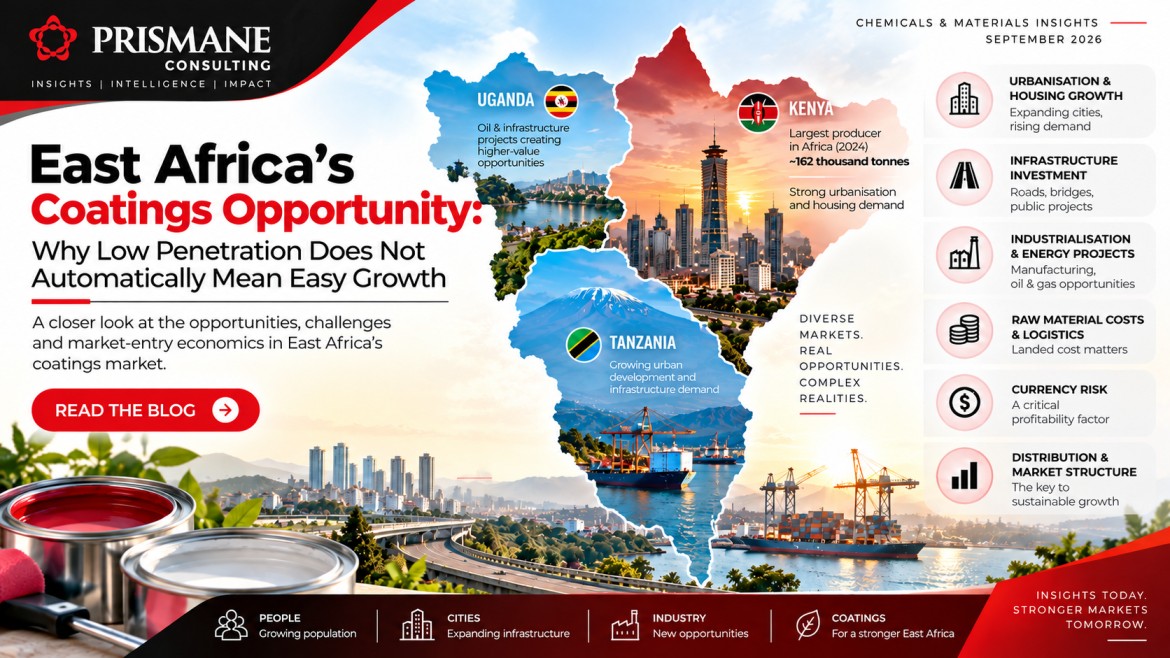
East Africa is attracting increasing attention from coatings manufacturers, and at first glance the investment case looks straightforward. The region has a growing population, rapid urbanization, housing requirements and significant infrastructure needs. More buildings should mean more paint. More infrastructure should mean more protective coatings. More vehicles should mean more automotive refinishing. That logic misses the investment question that matters most. A growing coatings market is not necessarily an easy coatings market. The real question is whether that growth can be converted into sustainable margins once raw material costs, logistics, foreign exchange, distribution and local competitive dynamics are taken into account. We would therefore treat East Africa as a market-entry economics opportunity first, and a high-growth coatings market second.
Construction Creates the Headline Opportunity, but Not Automatically
The strongest near-term demand driver is construction. Housing programmes, commercial development and infrastructure investment are expanding the addressable market for architectural coatings, while industrial development creates additional opportunities for protective and specialized coatings. Kenya, Tanzania and Uganda are particularly important markets because each combines urbanization with ongoing investment in residential, commercial, public and industrial infrastructure. But construction spending should not be translated directly into coatings demand. The conversion depends on the type of construction, specification level, local application practices and the share of projects that use formal branded coating systems rather than informal or unbranded alternatives. Residential construction pulls through interior and exterior decorative paints. Commercial buildings create demand for higher-performance finishes. Infrastructure projects generate demand for protective coatings, while industrial development can support powder coatings and other specialized systems. Each of these demand pools behave differently. Treating them as one market is where coatings market sizing can begin to go wrong.
Current African paints and varnishes data reinforces the importance of looking beyond a single regional growth number. In 2025, Kenya and Uganda were among Africa's largest paint and varnish consumption markets, while Kenya was also the continent's largest producer by volume.
Kenya Offers the Strongest Platform, but Not an Open Field
Kenya has many of the characteristics that make a regional coatings hub attractive: a relatively developed commercial ecosystem, a large urban population, an established coatings industry and continued investment in housing and infrastructure. What it does not have is white space. Established manufacturers and regional brands already hold relationships with distributors, contractors, dealers and painters that influence which products reach the customer.
This leaves a new entrant with one unavoidable question: why would a distributor, contractor or painter switch?
Price alone rarely holds up as an answer for long. A stronger proposition tends to combine coverage, durability, color consistency, drying performance, technical support and a margin structure that the channel actually wants to sell, rather than simply a lower price that the channel has to compete away. This is particularly important because Kenya is not simply an import market waiting to be served. It has an established domestic production base.
Current market data indicates that Kenya produced approximately 162 thousand tons of paints and varnishes in 2024, making it one of Africa's largest production centers. For a new entrant, therefore, the challenge is not simply entering the Kenyan coatings market. It is displacing or bypassing an existing supply chain.
Distribution can Determine Market Share on its Own
Architectural coatings live or die on distribution in a way that many industrial coatings do not. Industrial coatings can be sold directly to a relatively small number of customers. Decorative paint must move through extensive dealer networks, and the retailer, distributor, contractor and painter can all influence what the end customer buys. That makes brand visibility and availability almost as important as formulation quality. A manufacturer with a technically superior product but weaker distribution can still lose share to a competitor whose product is good enough and whose network consistently puts it on the right shelf and into the right painter's hands. This is why route-to-market design should be one of the first decisions an international coatings company makes about East Africa.
The strategic question is not simply how good the product is. It is who controls the path from the factory to the painter. That question becomes particularly important in price-sensitive decorative paints, where the ability to maintain stock availability and channel margins can matter as much as incremental formulation performance.
Tanzania is a Logistics Problem Before it is a Growth Story
Tanzania's coatings opportunity is real and is linked to urban development and continued investment in transport, public infrastructure and industrial activity. But the market is geographically dispersed, which makes the economics of moving finished product across a large territory a first-order question rather than an afterthought. Importing finished paint can be a sensible way to enter because it keeps initial capital requirements low. But the economics change as volume builds. At some point, local production, local blending or regional manufacturing can become more competitive than shipping finished tins across the country.
The question worth asking about Tanzania is therefore not simply whether the market is growing. It is at what volume and margin structure local manufacturing becomes economically justified. Getting that threshold wrong in either direction can be expensive. Build capacity too early and capital remains underutilized. Wait too long and logistics costs can constrain competitiveness while an established competitor builds the channel. This is why the Tanzania coatings market should be assessed through delivered-cost economics rather than market growth alone.
Uganda Adds an Industrial Dimension
Uganda's opportunity is different again. Industrialization, infrastructure development and energy investment can create demand for coatings beyond conventional architectural paint. The country's oil development adds another layer. Uganda is preparing for commercial crude production by the end of 2026, with production linked to the East African Crude Oil Pipeline running to Tanzania's port of Tanga. In September 2026, Uganda's recoverable oil reserves are estimated at 1.65 billion barrels and that the project is expected to reach peak production of around 230,000 barrels per day. Projects of this scale can create demand for protective coatings across pipelines, storage facilities, processing infrastructure and associated industrial assets. That represents a potentially higher-value opportunity than conventional decorative paint. But it also comes with a different competitive model. Infrastructure and energy projects typically involve technical specifications, approved-product requirements, application standards and qualification processes. The commercial team selling decorative paint is therefore not necessarily the same capability required to win an industrial protective-coatings project. Uganda's opportunity is consequently less about selling more paint and more about accessing higher-value specifications.
Landed Cost Matters More Than Factory-Gate Cost
The raw material equation is where an apparently attractive East African coatings market can quietly become an unprofitable one. Paint formulations depend on resins, titanium dioxide, solvents, pigments, and additives. Where a significant share of these materials is imported, the manufacturer is exposed simultaneously to international raw material prices, freight rates, port costs, currency movements, import duties, lead times and inventory financing. A manufacturer selling imported finished paint carries another layer of logistics cost on top. The number that determines whether a market is profitable is therefore landed cost, not factory-gate manufacturing cost.
This distinction is particularly important when comparing local production with imports. A local plant may appear structurally cheaper because it avoids some finished-product freight. But if the plant still depends heavily on imported resins, pigments and additives, part of that advantage can disappear. Conversely, an imported finished product may remain competitive if its formulation, scale and sourcing economics compensate for the additional logistics. The right comparison is therefore not local manufacturing cost versus import price. It is fully loaded delivered cost versus achievable market price and margin.
Currency Risk Changes Who Wins on Price
Foreign exchange compounds the raw material problem. A manufacturer buying inputs in U.S. dollars and selling paint in local currency can see margins compress quickly when the local currency depreciates. The problem is most acute in price-sensitive architectural coatings. Increasing prices protects margin but risks losing volume. Absorbing the increase protects market share but damages profitability. There is no clean solution to that trade-off except reducing the exposure itself. That is what makes local and regional sourcing strategically valuable. The more input that can be sourced regionally, the less exposed the business may be to international freight and currency movements. But sourcing locally for the sake of it is not a strategy. The local material still needs to meet the required quality, consistency and cost specification. For coatings manufacturers, procurement localization should therefore be treated as an economic optimization exercise rather than a simple import-substitution objective.
Local Manufacturing is not Automatically the Answer
It is tempting to treat local production as the natural end-state for any emerging coatings market. We would resist that instinct. A new plant requires capital expenditure, skilled labor, quality control, utilities, working capital and, critically, enough volume to justify utilization. A company entering a market that is still small may achieve better returns by importing finished product or using contract manufacturing until the volume case is proven. A more disciplined sequence can therefore begin with importing and establishing distribution, followed by local blending or toll manufacturing once the channel is working, and eventually regional manufacturing once volume and margin genuinely justify the capital. This staged approach may be slower, but it reduces the risk of committing capital against a demand curve that has not yet been demonstrated. The objective is not to maximize local production. It is to maximize return on invested capital. That distinction matters.
Protective Coatings Could Offer Better Economics, Not Better Volume
Architectural coatings will remain an important volume opportunity, but industrial and protective coatings may offer the more attractive value pool. Infrastructure projects demand corrosion resistance, weatherability and long service life, making them more specification-driven than conventional decorative paints. And specification is where genuine differentiation becomes possible. The trade-off is that qualification cycles can be longer and project pipelines less predictable. The commercial model must change accordingly. Instead of relying primarily on retail distribution, suppliers may need relationships with engineering firms, contractors, infrastructure developers, project owners and technical specifiers. That creates a smaller addressable customer base, but potentially a more defensible position. This is an important distinction for investors: the highest-volume segment is not necessarily the highest-value segment.
East Africa is Not One Market, and Should Not be Run as One
This is the point we would emphasize most. Kenya, Tanzania and Uganda have different industrial structures, infrastructure pipelines, distribution networks, manufacturing bases and competitive landscapes. A regional strategy can create genuine efficiencies, but only if the commercial model still reflects local conditions rather than papering over them. One structure might use Kenya as a regional technical and distribution hub while serving neighboring markets through distributors. Another might establish local manufacturing where volume is sufficiently high and export to surrounding countries from that base. The correct answer depends on the product. Architectural paints, industrial coatings and automotive refinish products may each require a different route to market. Forcing all three through the same structure is an avoidable strategic mistake.
The Real Opportunity is Segmentation, Not Market Share
We would not chase the entire East African coatings market. We would identify the segments where a specific set of capabilities creates a genuine advantage. Affordable architectural coatings can provide volume, but with significant price sensitivity. Premium architectural paints can offer greater scope for brand and performance differentiation, although the addressable volume is smaller. Infrastructure coatings can provide a more specification-driven and potentially higher-margin opportunity. Industrial coatings become attractive wherever manufacturing investment is expanding, while energy infrastructure coatings represent a smaller but technically demanding and potentially high-value niche. Automotive refinish provides another opportunity as vehicle activity grows and professional repair networks develop. The objective should not be to capture the largest possible share of every segment. It should be to identify where the combination of product capability, route to market and supply-chain economics creates defensible margins.
Supply-Chain Resilience is a Competitive Advantage, Not a Cost Line
The global coatings industry has experienced repeated supply-chain disruptions, and East African producers can be particularly exposed where imported materials account for a meaningful share of the cost base. Supply-chain design therefore needs to be part of the market-entry decision from day one, not something added after the plant or distribution network has already been established. Multiple sourcing options, regional inventory capability and flexible procurement can help manufacturers maintain service when a competitor's supply chain is disrupted. This matters because availability itself can become a competitive advantage. A distributor cannot sell a brand that is not in stock. A contractor cannot complete a project while waiting for a delayed shipment. And a painter who repeatedly cannot find a preferred product will eventually switch. In an emerging coatings market, supply reliability can become part of the brand proposition.
Prismane Consulting Perspective: Growth is Not the Investment Case
We would frame the investment question differently from how most entrants frame it. The question is not simply how fast the East African coatings market is growing. It is how much of that growth can be converted into profitable, defensible market share once construction activity, product mix, distribution, raw material sourcing, logistics, currency and local manufacturing economics are all netted against each other.
That distinction matters because a market can grow at an attractive headline rate and still deliver poor returns to a company with the wrong product positioning or supply-chain structure. Conversely, a company with strong distribution, local technical capability and an efficient sourcing model can build an attractive position even in a market that looks relatively small on paper.
External market benchmarks illustrate why country-level analysis matters. Current African paints and varnishes data shows Kenya and Uganda among the continent's leading consumption markets, with Kenya also the largest producer by volume in 2024. Tanzania represents another significant market within the region. We would use such figures as directional benchmarks rather than simply applying a historical regional CAGR to the entire East African market. That is particularly important when building a 2026 to 2034 East Africa coatings market forecast. Prismane's approach would instead build the outlook from country-level demand, construction activity, product mix, trade flows, pricing, distribution economics, competitive capacity and local manufacturing. The objective is not to produce a larger headline number. It is to determine where attractive margins can be sustained through 2034.
The winners in the East African coatings market will not necessarily be the companies that arrive first. They will be the companies that understand where the value sits, how the product actually reaches the customer, what the delivered cost looks like at every stage of the chain, and which segments justify the capital required to compete. In East Africa, market growth creates the opportunity. Market architecture determines who captures it.
Prismane Consulting tracks the East African paints and coatings value chain, including market sizing, demand by application, competitive landscape, trade flows, distribution economics, raw material sourcing, local manufacturing and market-entry strategy, through its Chemicals & Materials practice. For the full East Africa Coatings Market Study, visit prismaneconsulting.com, or write to us at sales@prismaneconsulting.com.