
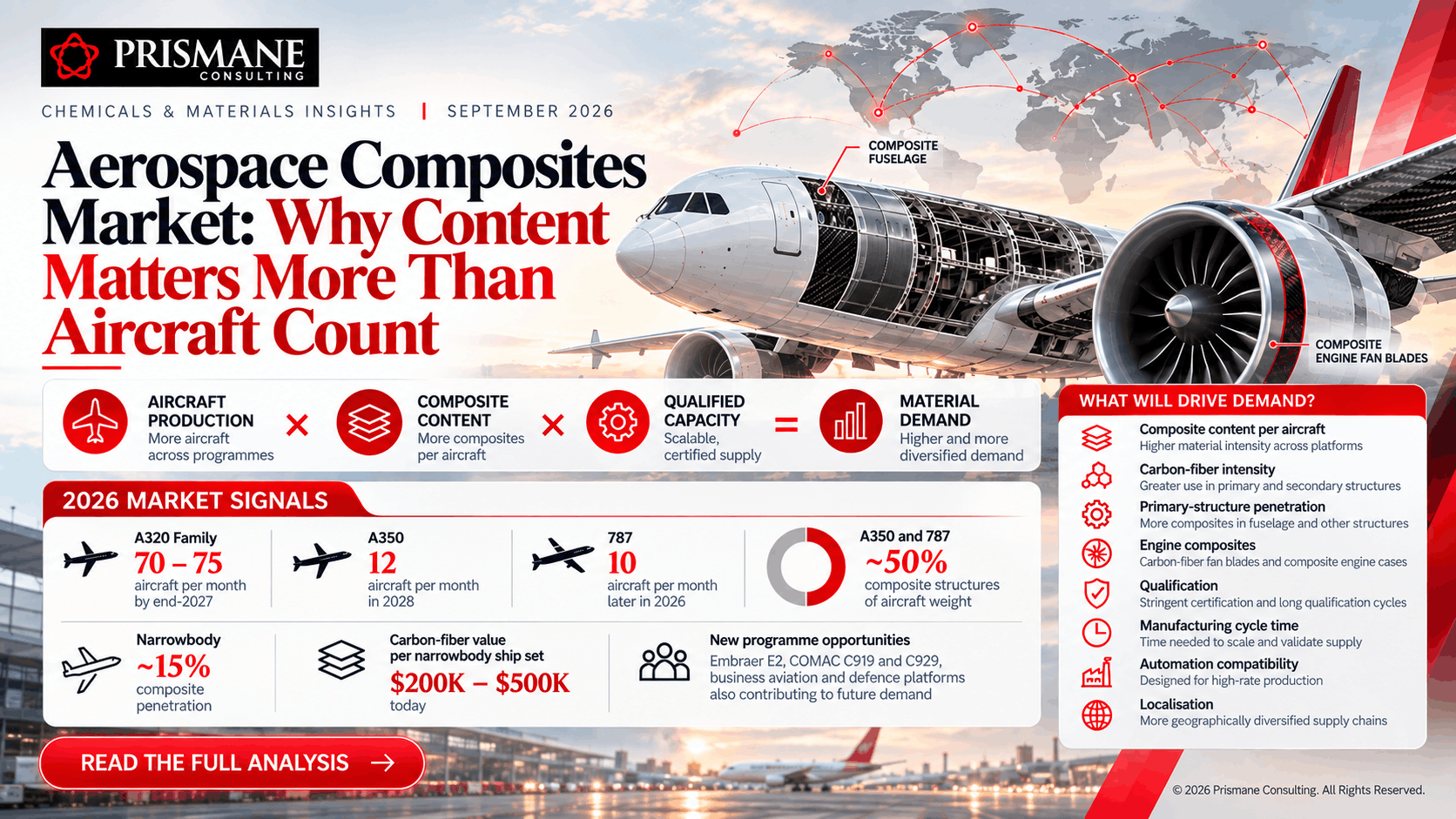
The recovery in commercial aircraft production is becoming increasingly visible. Airbus is ramping up the A320 Family towards 70 to 75 aircraft per month by the end of 2027 and is targeting an A350 production rate of 12 aircraft per month in 2028, while Boeing is working towards a 787 rate of 10 aircraft per month later in 2026. But Airbus and Boeing are not the only aircraft programmes shaping the future aerospace composites market. Embraer's E2 family, COMAC's C919 and C929 programmes, business aviation platforms from manufacturers such as Bombardier and Gulfstream, and defence aircraft from companies such as Lockheed Martin are also relevant to the longer-term material demand picture. For the aerospace composites market, aircraft production is only one part of the demand equation. The more important question is how much composite material will sit inside each aircraft, and whether the next growth cycle will be driven less by building more aircraft and more by building each one with substantially more composite material. Six shifts explain why that question now matters as much as the delivery schedule.
Production recovery is real, but it is only half the story
The commercial aerospace supply chain is moving through a genuine production recovery after several years of disruption. Airbus continues to build towards higher single-aisle rates, the A350 widebody programme is also ramping up, and Boeing is working to lift 787 output. However, the recovery extends beyond the two largest Western commercial aircraft manufacturers. Embraer and Strata Manufacturing signed an agreement in July 2026 to evaluate the potential supply of advanced composite aerostructures for the Embraer E2 family and other commercial aircraft programmes. The agreement covers technical, commercial and contractual evaluation of potential composite work packages, showing how future aerospace composites demand can develop before a programme reaches mature production.
COMAC is also becoming increasingly relevant to the long-term aerospace composites market. The C919 is now part of China's commercial aircraft production ecosystem, while the C929 is expanding the potential future widebody opportunity. The emergence of additional commercial aircraft programmes means that aerospace composites demand is gradually becoming more geographically diversified rather than being determined solely by Airbus and Boeing production rates.
This is already feeding through to composite material suppliers: Hexcel reported an 18.3% year on year increase in commercial aerospace sales in the second quarter of 2026, led by the A350 and 787, with additional growth from the 737 MAX, A320neo and A220, while Syensqo's Composite Materials business grew 18% over the same quarter. These figures provide a solid near term foundation for the aerospace composites market, yet production rates alone can obscure a second, more structural shift that is becoming increasingly important across the aerospace supply chain.
Composite content per aircraft is becoming the next demand lever
The aircraft of the future does not need to be dramatically larger to consume far more composite material. It simply needs to contain more of it. The A350 and 787 established the commercial case for extensive composite use, with composite structures accounting for roughly half of aircraft weight, yet composite penetration in the narrowbody segment remains materially lower, at around 15%. If future single-aisle programmes move towards substantially higher composite content in wings, fuselage sections and other primary structures, material demand per aircraft could rise even if annual production grows only modestly.
This is where aerospace composites demand becomes more closely linked to material intensity. A commercial aircraft, a regional jet, a large business aircraft and a defence platform can all generate very different amounts of composite demand even when their production volumes are relatively similar. The relevant question for the aerospace composites market is therefore not simply how many aircraft will be delivered, but how much composite material is required to build a single aircraft.
The same principle extends beyond the airframe. Composite fan blades are becoming an important aerospace composite application in advanced aero-engines. GE Aerospace's GE9X uses carbon fiber composite fan blades, while Rolls-Royce's UltraFan architecture incorporates carbon composite fan blades and a composite fan case. This means aerospace composites demand can increase not only through greater composite content in wings, fuselage and other aircraft structures, but also through the adoption of composite components within the propulsion system.
That metric links aircraft production directly to carbon fiber, resin and finished composite material demand. It also explains why a relatively modest increase in composite penetration can have a disproportionately large impact on aerospace composites demand over the life of an aircraft programme.
Value per ship set could reshape the economics of the aerospace composites market
Higher composite penetration also changes the value pool available to material suppliers. Today's narrowbody aircraft carry an estimated $200,000 to $500,000 of carbon fiber value per ship set, depending on structure, material grade and conversion route. A future aircraft with substantially greater composite content could push that figure towards $1.5 million to $2 million per ship set under illustrative assumptions.
These numbers should not be read as a market wide forecast, but they show how sensitive aerospace composites demand is to material content rather than volume alone. A programme building 500 aircraft a year with materially higher composite content creates a very different demand profile from one building the same number of aircraft with today's material architecture.
The same principle applies beyond commercial aviation. A lower-volume business jet or defence aircraft can generate significant value per aircraft where composite content, material specifications and qualified structures are high. Engine components such as composite fan blades provide another example of how high-value composite applications can increase aerospace composites demand without requiring a proportional increase in aircraft production.
For the aerospace composites market, this makes value per ship set and material intensity important alongside aircraft delivery volumes. The second mechanism, material intensity rather than aircraft count, could therefore become the more important driver as the industry approaches its next generation of aircraft.
The next aircraft cycle could reshape long term demand
Airbus and Boeing are both evaluating the technologies and architectures that will underpin future single-aisle aircraft, and although timing, configuration and certification decisions remain open, the direction of travel is clear: weight reduction, aerodynamic efficiency, manufacturing productivity and lifecycle economics remain central to future aircraft development.
But the next aircraft cycle will not come from two OEMs alone. Embraer's E2 family provides another commercial aircraft platform where advanced composite aerostructures are being evaluated. COMAC is developing the C929 as a new widebody platform while continuing to build the C919 programme. These programmes matter to aerospace composites demand because they introduce additional aircraft architectures, production locations and supply chains into the future material equation. Embraer's 2026 collaboration with Strata specifically covers the potential supply of advanced composite aerostructures for its commercial aircraft programmes.
Business aviation adds another dimension. Bombardier's Global family and Gulfstream's large-cabin aircraft provide higher-value but lower-volume sources of aerospace composites demand. Composite structures and advanced manufacturing processes are increasingly relevant to business aviation because weight, range, cabin size and production efficiency all influence aircraft economics.
Defence adds another layer. Lockheed Martin's aircraft programmes demonstrate how composite structures can support high-performance military platforms, where lightweighting, structural performance and manufacturing repeatability are important considerations. This means that aerospace composites demand cannot be assessed solely through commercial aircraft delivery forecasts.
The opportunity also extends into the engine. As new propulsion architectures adopt composite fan blades, fan cases and other lightweight components, the aerospace composites market can capture additional material demand from the same aircraft production cycle. The GE9X and Rolls-Royce UltraFan programmes illustrate how composite adoption is extending from airframes into propulsion systems.
A future composite wing could materially increase composite content compared with today's narrowbody platforms, while more extensive composite fuselage structures could push material penetration closer to levels already demonstrated on widebody aircraft. The next growth cycle for the aerospace composites market could therefore be defined less by adding aircraft to the global fleet and more by changing the material composition of the aircraft and engines the industry already expects to build.
Qualification, not simply fiber capacity, is a critical supply constraint
Higher aerospace composites demand does not automatically translate into immediate volume growth, because aerospace materials must qualify against demanding structural, processing and durability requirements, and switching a supplier or material system once it is designed into a programme is difficult and time consuming.
Carbon fiber suppliers such as Toray, Teijin and Hexcel have long established positions across aerospace applications, and in 2026 Toray and Syensqo signed a five-year global agreement covering high strength and intermediate modulus carbon fibers for Syensqo's composite portfolio across commercial and defence aerospace programmes.
The significance goes beyond a single agreement. Long qualification cycles mean future material volumes can become visible years before an aircraft enters large scale production, which makes qualification pipelines, supplier relationships and programme positions useful leading indicators for the aerospace composites market.
This also creates an important distinction between capacity and qualified capacity. A producer may have the physical ability to manufacture carbon fiber or composite materials, but that does not necessarily mean the material can immediately enter a major aircraft programme. For aerospace composites demand, qualification status can therefore be as important as installed capacity when assessing future supply.
The same principle applies to composite fan blades. Engine components operate under demanding aerodynamic, structural, foreign-object-impact and durability requirements, meaning the qualification pathway can be as important as the underlying carbon fiber technology. GE Aerospace's experience with carbon fiber composite fan blades stretches back decades, with the GE9X representing a further evolution of the technology.
Manufacturing speed now matters as much as material performance
Material performance alone is no longer enough for aircraft manufacturers, who need composite materials that can be processed faster, automated more easily and integrated into high-rate production, particularly on narrowbody lines.
A lighter composite technology that requires a manufacturing cycle incompatible with high-rate output may struggle to scale, while materials that combine structural performance with faster curing and automated placement can remove one of the key barriers to higher composite penetration.
This is visible across both thermoset and thermoplastic systems. Thermoplastics are gaining attention for shorter processing cycles, welding potential and improved recyclability, while thermoset systems continue to evolve through faster cure chemistry and out of autoclave processing.
The competitive question is therefore shifting from which material is lightest to which material can deliver the required performance at the rate an aircraft programme actually needs. That shift could influence material selection as much as incremental gains in mechanical properties.
Composite fan blades provide another example of the importance of manufacturing technology. Rolls-Royce's UltraFan development combines carbon composite fan blades with automated manufacturing processes, demonstrating how composite adoption in propulsion depends not only on material performance but also on repeatable, scalable production.
For aerospace composites demand, manufacturing productivity is particularly important because the largest potential material opportunities are often associated with aircraft and engine programmes that must achieve higher production rates than earlier composite-intensive platforms.
What it means for the aerospace composites market
The aerospace composites market is entering a phase where aircraft production rates remain important, but they are no longer sufficient to explain the full demand opportunity. The more important variables are becoming:
- aircraft production rates
- composite content per aircraft
- carbon fiber intensity per ship set
- composite fan blade adoption
- penetration into primary structures
- qualification of new material systems
- manufacturing cycle time
- automation compatibility
- commercial, regional and business aircraft programmes
- defence and space applications
- localisation of aerospace material supply chains
- sustainability requirements
Splitting aerospace composites demand into its underlying drivers changes the emphasis. The cyclical component, driven by A350, 787 and A320 Family production rates, is real but bounded because it tracks known delivery schedules and will eventually stabilise as established programmes reach steady state output.
The structural component is broader. It includes rising composite content on next generation narrowbodies, new commercial aircraft programmes from manufacturers such as Embraer and COMAC, advanced business aviation platforms, defence aircraft, space systems, composite fan blades and the development of local aerospace composite supply chains.
That diversification is already visible outside the largest commercial aircraft programmes. Embraer's E2 platform is being linked to new advanced composite aerostructure opportunities, while GE Aerospace and Rolls-Royce demonstrate how carbon fiber composites are also becoming part of advanced engine architectures. GE Aerospace's GE9X uses carbon fiber composite fan blades, while Rolls-Royce's UltraFan programme incorporates carbon composite fan blades and a composite casing.
Geographic diversification is also becoming relevant. The development of the MC-21 demonstrates how aircraft production, composite content and domestic material supply can become closely connected. UAC has highlighted the integration of domestically produced composite materials into load-bearing MC-21 structures, illustrating how localisation can create additional demand for qualified aerospace composite materials.
Sustainability is another emerging variable. Recycled carbon fiber, recyclable thermoplastic systems and lower-carbon feedstocks are beginning to influence material development and selection, although the qualification requirements of aerospace mean that adoption is likely to remain evolutionary rather than immediate.
For material suppliers, the key issue is therefore not simply how much fiber capacity is added. It is whether that capacity is connected to qualified materials, aircraft programmes, engine programmes, customer relationships and manufacturing technologies capable of supporting future production rates. For the aerospace composites market, that distinction is becoming increasingly important.
The real question in 2026 is therefore not how many aircraft left the factory this year. It is “how much of each aircraft, and increasingly each engine, a decade from now will not be metal at all”.
Prismane Consulting tracks the global aerospace composites value chain across fiber types, resin systems, applications, regions and aircraft programmes through its Chemicals & Materials practice. For the full Global Aerospace Composites Market Study, or related research on the Global Carbon Fiber Market and the Global Composites Market, write to us at sales@prismaneconsulting.com.