
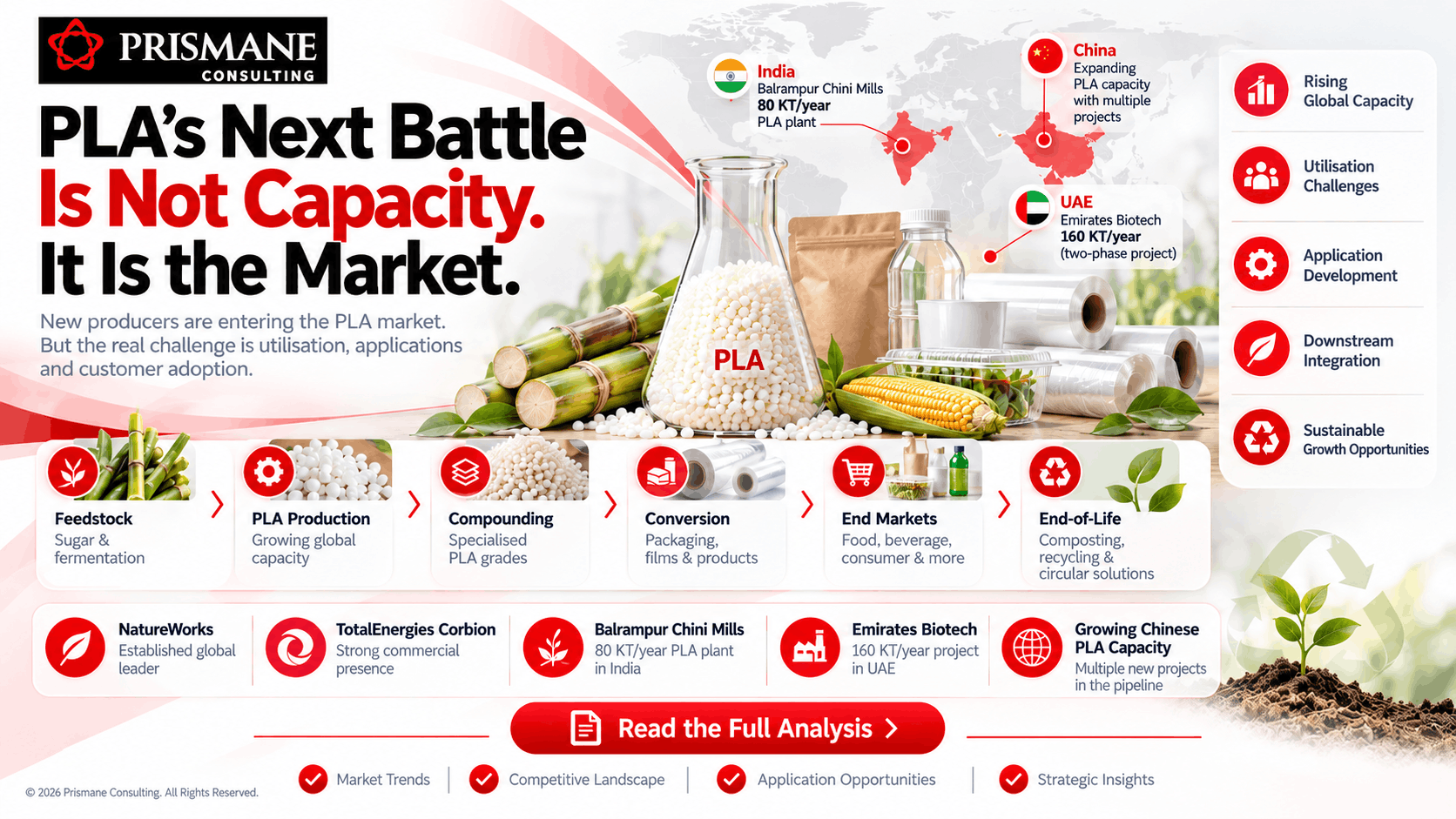
The global PLA market is entering a new phase.
For years, the industry was shaped by a relatively small group of established producers, with NatureWorks and TotalEnergies Corbion among the best-known names. That landscape is now changing. India's Balrampur Chini Mills is moving towards commercial-scale PLA production, while UAE-based Emirates Biotech is developing a two-phase 160 KT/year project. At the same time, China is building a much larger domestic PLA manufacturing base, with a substantial pipeline of additional projects.
The result could be a significant increase in global PLA production capacity over the next few years.
But the more important variable may not be capacity. It may be utilisation.
A PLA plant can be technically successful and still struggle commercially if customers are not ready to absorb the resin at the required price and volume. This is one of the broader lessons from the difficulties experienced by bioplastics producers in recent years.
The companies entering the PLA market are therefore trying to do more than build production capacity. They are increasingly working on applications, customer qualification, downstream conversion and end-of-life solutions before their plants reach full utilisation.
Danimer is a warning about utilisation, not about PLA
Danimer Scientific's Chapter 11 filing in March 2025 is relevant to the PLA discussion, although its core business was PHA rather than PLA.
The company had developed fermentation-based bioplastics and invested heavily in expanding production capacity, but customer adoption and commercial commitments did not develop quickly enough to support the level of investment made in the business.
The lesson is broader than any individual polymer.
Bioplastics markets can take time to develop. Converters need to qualify materials, brand owners need to validate products, and consumers do not necessarily pay a sufficient premium simply because a material has better environmental credentials.
PLA is on firmer commercial ground than many emerging biopolymers because NatureWorks and TotalEnergies Corbion have already established large-scale plants, customer relationships and applications. Nevertheless, every new producer faces the same basic challenge: fixed production costs begin accumulating before the producer controls the pace at which customers adopt the material.
This makes utilisation particularly important for the new entrants.
Balrampur is building demand alongside capacity
Balrampur Chini Mills is developing an 80 KT/year integrated PLA facility in Uttar Pradesh. The project benefits from the company's existing position in the sugar and fermentation industries and is designed around domestic feedstock and downstream opportunities.
Importantly, Balrampur is already beginning to build a route to market.
Balrampur Bioyug has secured an institutional order from the Lucknow Cantonment Board covering compostable garbage bags, bottles, 3D-printed pens and folders. The volume is small relative to the eventual production capacity, but its significance lies elsewhere. A new PLA producer needs reference customers and real-world applications as much as it needs a production plant.
The company has also indicated a relatively gradual utilisation ramp. Its guidance of around 40% average utilisation during the first year of commercial operations reflects the reality that a new plant will not immediately operate at full capacity.
That is strategically important.
The objective is not simply to commission 80 KT/year of PLA capacity, but to develop enough applications and customers to progressively absorb that capacity.
Balrampur is also investing in technical capability. In 2026, the company received a ₹75 crore BioE3 grant from the Government of India for a 100 TPA pilot-scale PLA and co-polymer R&D facility. The facility is intended to support development of specialised PLA grades and co-polymers, process know-how and product validation.
This could become increasingly important as competition intensifies. Standard PLA grades are likely to become more competitive as additional capacity enters the market, making specialised applications and differentiated grades more attractive.
Balrampur has also moved further downstream through its investment in Konspec, a specialty polymer and biopolymer compounder and converter. This gives the company exposure to the conversion side of the value chain and could help connect domestic PLA production with commercially viable applications.
The company's initial commercial project remains 80 KT/year. Management has indicated that the PLA business could eventually become significantly larger, but a 100 KT/year expansion has not been formally confirmed and should not be treated as committed capacity.
Feedstock integration could become Balrampur's key advantage
One of Balrampur's strongest potential advantages is integration.
The company can leverage its existing sugar and fermentation infrastructure while developing domestic production of lactic acid for the PLA project. This creates a different cost structure from producers that need to purchase key intermediates from the merchant market.
Capital economics also matter.
Balrampur has benefited from policy support for its bioplastics investment, although the project cost has increased during execution. The company has subsequently strengthened its funding position through a preferential equity issue.
The company is also developing a lactogypsum facility that could monetise a process by-product.
These factors do not guarantee low-cost PLA. But they could give Balrampur greater flexibility during the initial utilisation ramp, particularly if imported PLA prices remain under pressure.
This could become one of the company's most important competitive advantages in India: not simply having local PLA production, but having an integrated cost base that allows it to compete with imported material while the domestic market develops.
Emirates Biotech is taking a different route
Emirates Biotech is pursuing a different model from Abu Dhabi.
Its Falcon PLA Project is planned in two phases of 80 KT/year each, giving potential total capacity of 160 KT/year at KEZAD. Sulzer is the technology partner and Samsung E&A has been selected as the EPC contractor.
The project is targeting commercial production from the latter part of the decade, although its development timeline has moved as the project has progressed. The company is also planning an on-site recycling component as part of its broader strategy.
Unlike Balrampur, Emirates Biotech does not initially have the same level of upstream integration into lactic acid production. This means that its economics will be more exposed to the merchant lactic acid market.
That makes the company's market-building strategy particularly important.
Emirates Biotech has partnered with UAE University on PLA applications and end-of-life solutions and has joined the CIRCLE consortium, which is investigating circular PLA systems and the use of food-waste-derived feedstocks.
The company has also been working on waste valorisation and composting initiatives in the UAE.
These initiatives could help Emirates Biotech address one of the biggest challenges facing the PLA industry: creating a regional ecosystem around the polymer rather than simply producing resin.
If successful, the UAE could develop into a regional hub serving the Middle East, Africa and other export markets.
China could change the economics
The biggest supply-side wildcard may be China.
China has already developed a significant PLA production base and has announced a substantial pipeline of additional projects. Prismane has tracked a number of these projects, but announced capacity should not be treated as equivalent to operating capacity. Projects can be delayed, modified or cancelled before commercial production.
Nevertheless, the direction is clear. China is attempting to build PLA production at a scale that could materially influence the global supply-demand balance.
This matters because PLA producers entering the market at the same time as a large wave of Chinese capacity could face greater pressure on prices and utilisation.
The challenge for new producers is therefore not simply to compete against established Western suppliers. They may also have to compete with increasingly competitive Asian supply.
For India and the UAE, local production can offer advantages in freight, lead times and regional customer support. But those advantages will be less powerful if the price gap with imported Chinese PLA becomes sufficiently large.
This is where product differentiation and customer relationships become important.
The incumbents will be flanked, not displaced
NatureWorks and TotalEnergies Corbion still have a significant head start.
NatureWorks' Ingeo platform is supported by decades of application development and customer relationships, while its integrated Thailand facility strengthens its position in Asia.
TotalEnergies Corbion has also operated an integrated 75 KT/year PLA facility in Thailand since 2018 and has developed products including high-heat PLA and PDLA.
These companies bring something that new capacity cannot immediately replicate: a long history of customer qualification, processing knowledge, grade development and global distribution.
The first battleground for Balrampur and Emirates Biotech is therefore likely to be standard PLA grades where local supply, freight economics and shorter lead times can provide an advantage.
Specialty grades could be more difficult.
High-heat applications, fibres and technically demanding applications require deeper application knowledge and longer customer qualification cycles. Established suppliers therefore have a stronger defensive position in these segments.
The new entrants will need to demonstrate not only that they can produce PLA, but that their material performs consistently in the customer's process.
The bottleneck could move downstream
If PLA production expands faster than demand, the constraint on the market could move downstream.
India has considerable potential for greater PLA adoption across flexible packaging, thermoformed products, food-service applications, injection moulding and 3D printing.
But resin availability alone will not create these markets.
Converters need appropriate processing conditions and technical support. Brand owners need to qualify products. Customers need confidence in supply continuity. Waste-management systems need to handle the resulting products appropriately.
The same challenge applies to the UAE.
A 160 KT/year production platform would be significant, but its commercial success will ultimately depend on how quickly regional applications and customers develop around that capacity.
This is why Emirates Biotech's work on applications, circularity and waste utilisation is strategically relevant.
PLA is becoming a regional competition
The global PLA market could increasingly develop around different regional strengths.
India has the potential to build a domestic PLA ecosystem based on agricultural feedstock, integrated production and a large packaging market.
The UAE could develop a regional production and export platform serving the Middle East and Africa, while using its logistics infrastructure to reach international customers.
China could become an increasingly important source of global PLA supply as new projects are commissioned.
Meanwhile, NatureWorks and TotalEnergies Corbion will continue to compete through established technologies, product portfolios, customer relationships and application expertise.
These strategies will increasingly overlap.
The result could be a PLA market where production cost remains important, but where customer proximity, application development and downstream integration become equally significant.
Capacity is easy to announce. Demand is not.
The next few years could bring a substantial increase in PLA production capacity.
But the commercial winners will not necessarily be the companies with the largest plants.
They will be the companies that can build demand around those plants.
Balrampur is already working on this through domestic customers, R&D, specialised grades and downstream conversion. Its feedstock integration could also provide greater flexibility during the initial utilisation ramp.
Emirates Biotech is pursuing a different route, using partnerships in applications, circularity and waste utilisation to develop a regional market around its planned production capacity.
China's expansion could make the market more competitive still, particularly if a significant share of announced projects reaches commercial operation.
And the established producers will continue to benefit from years of customer qualification and application development.
The strategic question for every producer is therefore becoming more demanding: not whether it can produce PLA, but whether it can secure enough customers, applications and commercial demand to keep the plant running competitively.
At Prismane Consulting, we see the PLA market entering a phase where utilisation, feedstock integration, downstream conversion, application development, pricing and end-of-life infrastructure will increasingly determine the success of new capacity. The next competitive advantage in PLA may not be another production plant. It may be the ability to create enough demand to keep that plant running.