
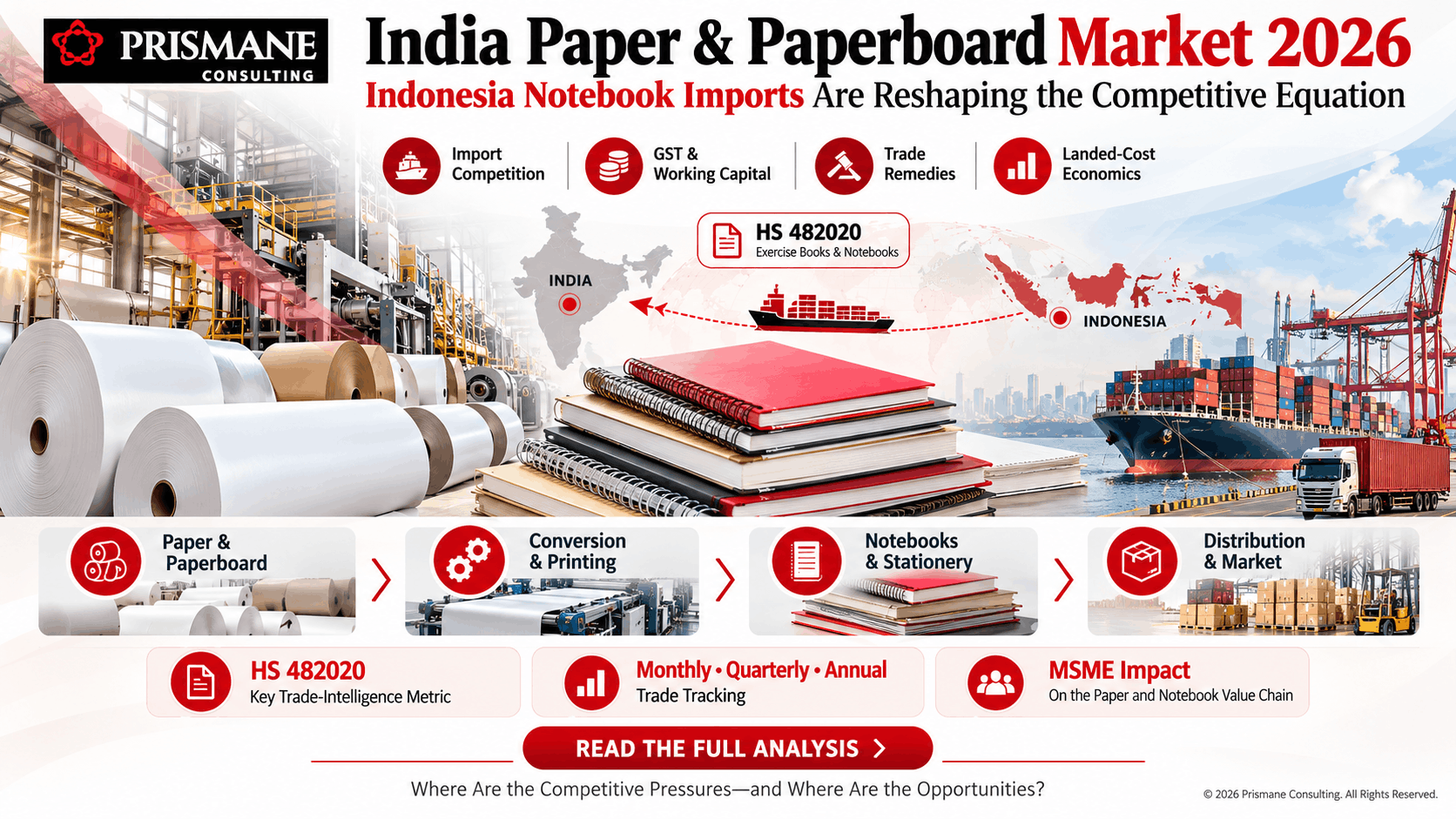
India's Paper and Notebook Value Chain Is Entering a New Competitive Phase
India's paper and paperboard industry is entering a more complex competitive environment. Prismane Consulting's market assessment, supported by primary interactions with paper mills, paperboard producers, converters and notebook manufacturers, indicates that the industry's competitive equation is increasingly being shaped by factors beyond production cost.
Import economics, trade agreements, GST treatment, raw-material prices, freight, working capital and manufacturing scale are increasingly interconnected. This is particularly relevant for the notebook value chain.
Domestic notebook manufacturers procure paper, paperboard, printing materials, adhesives and packaging inputs, while finished notebooks are currently nil rated under the GST framework. At the same time, qualifying imports from ASEAN markets can benefit from preferential tariff treatment. September 2025 GST rationalization reduced GST on exercise books, graph books, laboratory notebooks and notebooks from 12% to nil. Specified uncoated paper and paperboard used for these products were also reduced from 12% to nil. This creates a structural difference between manufacturing a notebook in India and importing a finished notebook into India. The competitive question is therefore moving beyond paper pricing. It is becoming a full value-chain economics question.
Indonesia Is Becoming a Critical Competitive Variable in India's Notebook Market
Indonesia has become an increasingly important reference point in India's notebook trade and competitive landscape, which covers exercise books. Prismane's assessment indicates that the Indonesia-to-India trade flow deserves to be monitored as a specific competitive indicator rather than being viewed only within aggregate stationery imports.
The competitive significance has increased since late 2025 as the domestic notebook industry has raised concerns over preferential ASEAN imports and the economics of finished notebooks entering India. In September 2026, the All India Notebook Manufacturers Association (AINMA) sought a Minimum Import Price on finished notebooks and requested an anti-dumping investigation into imports from Indonesia.
For manufacturers, the key point is not simply the absolute volume of Indonesian imports. The more important question is whether the monthly trade flow is showing sustained increases, whether Indonesia's share of India's notebook imports is expanding, and whether imported pricing is creating measurable pressure on domestic manufacturers. This makes an important trade-intelligence metric for the Indian paper and notebook value chain.
This frequency matters because annual data can conceal an emerging shift in competitive dynamics. A pattern of higher monthly imports, followed by sustained quarterly growth and a rising annual share, would provide a stronger indication of structural market penetration than a single year-on-year comparison.
Trade Policy Is Becoming a Direct Variable in Notebook Manufacturing Economics
One of the most important developments shaping the notebook market is the economics of imported finished products. Analysis conducted by Prismane Consulting indicates that ASEAN trade arrangements can create a significant landed-cost advantage for qualifying finished notebook imports from countries such as Indonesia, particularly when combined with the current GST treatment of notebooks.
For Indian manufacturers, the cost structure is different. Paper, paperboard, adhesives, packaging and other production inputs can attract GST, while the finished notebook is nil-rated. This can create a working-capital burden because the tax paid on inputs cannot always be recovered through the conventional input-tax-credit mechanism. The result is important: Tax architecture can influence manufacturing competitiveness even when two manufacturers have similar plant-level production costs.
For notebook manufacturers, procurement, inventory, tax incidence, financing and selling price therefore need to be evaluated as one integrated cost structure. For paper manufacturers, the implication is equally important. If downstream notebook producers face greater margin pressure, their ability to absorb increases in paper prices may weaken.
Indonesia's Integrated Manufacturing Model Creates a Different Competitive Benchmark
Indonesia's relevance extends beyond its tariff relationship with India. The country's paper industry has significant integrated manufacturing capabilities, while Indonesian producers also serve multiple international markets.
For Indian manufacturers, the relevant benchmark is therefore not simply “Indian notebook factory versus Indonesian notebook factory.” It is increasingly “Indian domestic value chain versus Indonesian integrated supply chain.”
The Indonesian competitive model can potentially combine fiber sourcing, pulp integration, paper manufacturing, energy, large-scale production, procurement, converting, logistics, export infrastructure and downstream manufacturing. This means that scale can become a value-chain advantage, rather than simply a production-capacity advantage. For Indian paper and paperboard manufacturers, benchmarking only against domestic competitors may therefore provide an incomplete picture.

The Paper-to-Notebook Value Chain Is Becoming More Important
The domestic value chain can broadly be represented as:

Each stage adds cost, working capital and operational complexity. When imported finished notebooks enter the market under preferential trade conditions, however, the competitive comparison changes. The domestic manufacturer is effectively competing against a completed international value chain. This means notebook manufacturers need visibility across paper procurement, printing, binding, labor, energy, packaging, inventory, financing, freight, distribution and taxation.
At the same time, paper manufacturers need to understand the economics of their downstream customers. A paper mill may remain competitive at the mill gate while its downstream customer becomes uncompetitive in the finished product market. This is an increasingly important distinction for strategic planning.
Impact on Micro, Small and Medium Enterprises (MSME’s) Across the Paper, Paperboard and Notebook Value Chain
The impact of increasing import competition is particularly important for India's MSME-oriented notebook and stationery manufacturing base. Smaller manufacturers generally have less flexibility in procurement, financing, freight negotiation and capacity utilization than large integrated producers. Competitive pressure can operate through several channels.
• Cost Pressure: When imported notebooks are available at competitive landed prices, domestic MSMEs may have limited ability to pass higher paper, labor, energy or financing costs to customers.
• Working-Capital Pressure: Inventory financing, receivables and tax-related cash flows can become more important when margins are compressed.
• Scale Disadvantage: Large international producers can potentially spread procurement, manufacturing and logistics costs across higher volumes, creating a structural cost advantage over smaller manufacturers.
• Capacity-Utilization Pressure: If imported notebooks gain market share, smaller domestic manufacturers could face pressure on order books and capacity utilization, particularly in price-sensitive segments.
• Investment Pressure: Where visibility on future demand and margins weakens, MSMEs may prioritize liquidity preservation and debt management over new capacity investments.
The impact can therefore extend beyond notebook manufacturers. Paper mills → converters → printers → notebook manufacturers → distributors remain economically interconnected.
MIP Protection Does Not Automatically Protect the Downstream Value Chain
India's Minimum Import Price framework for specified virgin multi-layer paperboard has been an important element of the paperboard trade environment. The distinction between upstream paperboard protection and downstream finished-product competition remains critical. This creates a different competitive scenario:
Imported paperboard → domestic conversion → domestic notebook
versus
Imported finished notebook → Indian market
The second model bypasses several stages of the domestic manufacturing chain. Our assessment is that manufacturers therefore need to evaluate trade policy not simply at the HS-code or raw-material level, but across the entire value chain.The strategic question is: What is the landed cost of the imported finished product compared with the fully loaded cost of manufacturing the equivalent product in India? That calculation needs to incorporate raw materials, GST, financing, freight, manufacturing efficiency, inventory and distribution.
Anti-Dumping Developments Need to Be Viewed Across the Value Chain
India's current trade-remedy environment contains two separate developments that should not be conflated.
Finished Notebooks from Indonesia
AINMA has requested an anti-dumping investigation into notebook imports from Indonesia. As of the latest information, this represents an industry request; it should not be described as an anti-dumping duty already imposed on notebooks.
Virgin Multi-layer Paperboard from Indonesia
A separate DGTR investigation concerns Virgin Multi-layer Paperboard from Indonesia. DGTR initiated the investigation in June 2025 and published its final finding on 25 June 2026. This is a paperboard trade-remedy case rather than a finished notebook case. Therefore, any anti-dumping measure affecting Indonesian virgin multi-layer paperboard should be analyzed separately from the competitive dynamics of Indonesian notebook imports.
This distinction is critical for manufacturers. A paperboard trade remedy can affect:
Paperboard landed cost → domestic paperboard competitiveness → downstream conversion economics while a notebook trade remedy would affect
finished notebook landed cost → domestic notebook competitiveness. These are different transmission mechanisms.
Paperboard Trade Remedies Are Creating an Additional Layer of Market Uncertainty
DGTR is also conducting a countervailing-duty/anti-subsidy investigation concerning multi-layer paperboard originating in or exported from China and Indonesia. The investigation was initiated in March 2026, with the oral hearing rescheduled to 29 September 2026. For paper and paperboard manufacturers, the trade-policy environment therefore needs to be monitored across:
MIP → Anti-dumping → Countervailing measures
Each mechanism can influence landed-cost economics differently. For notebook manufacturers, the impact needs to be evaluated separately because higher paperboard costs can affect domestic production economics even while finished notebooks continue to face import competition. This reinforces the need for value-chain-level trade analysis.
GST Is Becoming a Working-Capital Issue, Not Just a Tax Issue
The September 2025 GST reform changed the economics of the notebook value chain. GST on exercise books, graph books, laboratory notebooks and notebooks were reduced from 12% to nil. Specified uncoated paper and paperboard used for these products were also reduced from 12% to nil.
The broader input basket, however, can still contain taxable materials. AINMA has sought changes to GST rules to address working-capital constraints and refund mechanisms for the notebook industry. The key analytical issue is therefore not simply the GST rate on notebooks. It is:
Input Tax Structure → ITC Availability → Working Capital → Manufacturing Cost → Finished-Product Competitiveness
This chain needs to be incorporated into manufacturer benchmarking.
Raw-Material Inflation Can Amplify Margin Pressure
Raw-material volatility remains another important variable. For paper and notebook manufacturers, cost exposure extends across pulp, recovered fiber, chemicals, coatings, adhesives, printing materials, packaging, energy and transportation
The impact is particularly significant when manufacturers operate in markets where price increases cannot immediately be passed through to customers.
• For paper mills, this can compress operating margins.
• For notebook manufacturers, the impact can be greater because the finished product is simultaneously competing with imported products.
This creates a potential margin squeeze: Higher input costs + limited pricing flexibility + import competition. For manufacturers, monitoring raw-material prices alone is therefore insufficient. The more relevant metric is raw-material movement relative to achievable selling-price movement.
Freight Is Becoming Part of the Competitive Equation
Freight economics are increasingly relevant to India's paper and notebook markets. Large international producers can potentially leverage high shipment volumes and long-term logistics contracts to achieve greater freight-cost predictability than smaller manufacturers. For imported products, landed cost can therefore be influenced by:
Product Price + Ocean Freight + Inland Transportation + Duties/Taxes + Inventory Financing
This means an apparently low-cost international supplier may not always remain competitive after logistics and tax considerations. Conversely, a temporary decline in freight rates can improve the competitiveness of imported finished products without any change in the supplier's factory economics. For Indian manufacturers, freight should therefore be incorporated directly into competitive benchmarking rather than treated as a separate logistics variable.
What Does This Mean for Paper & Paperboard Manufacturers?
Our assessment identifies several strategic priorities for paper and paperboard producers.
1. Understand Downstream Exposure: Paper demand needs to be evaluated across notebooks, publishing, education, stationery, packaging and other downstream applications. Understanding who consumes the paper can become as important as understanding the paper grade itself.
2. Move Beyond Commodity Competition: Higher-value paper grades, coated products, specialty paper and application-specific paperboard can provide greater differentiation than commodity grades.
3. Improve Cost and Scale Economics: Manufacturing efficiency, energy consumption, fiber sourcing, machine utilization and logistics will remain fundamental competitiveness variables.
4. Strengthen Export Competitiveness: Export-oriented producers need to continuously evaluate landed costs, freight, currency movements and regional competition.
5. Evaluate Downstream Integration: Selected paper producers may increasingly evaluate opportunities in converting, stationery or other downstream applications where integration can create additional value.
Impact on Paper & Paperboard Manufacturers From Notebook Imports
The impact of Indonesian notebook imports should not be evaluated only at the stationery level. If imported finished notebooks gain market share, domestic demand for paper and paperboard used in notebook production could also be affected. This creates indirect exposure for paper manufacturers through notebook production volumes, paper procurement, capacity utilization, order visibility, domestic pricing, inventory, receivables and product mix.
The risk is therefore asymmetric: domestic paper producers may face competition from imported paperboard in some grades while simultaneously facing weaker downstream demand if finished notebooks are increasingly imported. This makes downstream customer exposure an increasingly important component of paper-mill strategy.
What Does This Mean for Notebook Manufacturers?
For notebook manufacturers, the strategic agenda is broader.
1. Procurement: Paper procurement needs to be evaluated alongside GST, freight, inventory financing and alternative import sources.
2. Manufacturing Efficiency: Paper utilization, printing productivity, labor efficiency, automation and binding productivity become increasingly important as pricing pressure intensifies.
3. Product Differentiation: Potential areas include premium notebooks, institutional stationery, customized notebooks, branded stationery, special-purpose products, sustainable stationery and export-oriented products
4. Working Capital: Inventory, receivables, supplier credit and tax-related cash flows should be assessed together.
5. Market Diversification: Manufacturers can potentially reduce exposure to commodity-style competition by developing differentiated and customized products.
The Competitive Benchmark Is Shifting From Factory Cost to Landed-Cost Economics
This is perhaps the most important strategic change we see in India's paper and notebook industry and India’s corrugated packaging industry too. The traditional comparison has been Indian factory cost v/s international factory cost. The more relevant comparison is becoming domestic end-to-end value-chain economics vs. imported landed-cost economics. This includes raw materials, manufacturing scale, capacity utilization, energy, freight, taxes, working capital, financing, distribution, product positioning and customer relationships
For Indonesia-specific benchmarking, the analysis should additionally incorporate ASEAN preferential access, integrated production economics, export logistics and supplier scale. This approach can reveal competitive gaps that plant-level cost analysis alone may not capture.

India Paper & Notebook Industry Outlook Through 2027
Our outlook indicates that five variables will be particularly important for the industry:
• Trade policy will influence imported paperboard and finished-product economics.
• GST treatment will influence the working-capital economics of domestic notebook manufacturing.
• Raw material prices will determine the ability of manufacturers to protect margins.
• Freight rates will influence the competitiveness of imported products.
• Scale and integration will determine how effectively domestic companies can compete with large international supply chains.
A sustained pattern of increasing monthly imports, rising quarterly volumes and increasing annual Indonesia share would be materially more significant than an isolated shipment or one-year increase. This approach allows manufacturers to distinguish between temporary import volatility and structural import penetration.
Prismane Consulting Perspective
At Prismane Consulting, we view the current developments as part of a broader structural change in India's paper and paperboard industry. The competitive landscape is increasingly defined by the interaction between:
Capacity + Cost + Trade + Taxation + Logistics + Integration + Downstream Demand
The Indonesia notebook case illustrates why market intelligence needs to move beyond conventional market sizing. A paper mill needs to know not only how much paper India consumes, but which downstream segments are becoming vulnerable to imports.
A notebook manufacturer needs to know not only its own production cost, but how Indonesian landed costs are changing month by month. A converter needs to understand changing customer procurement patterns. An investor needs visibility into capacity, utilization, trade flows and competitive positioning. This requires a continuous trade-intelligence framework combining HS-code data, country-level trade flows, monthly import monitoring, quarterly trend analysis, annual benchmarking and primary industry interactions. This is where market research moves beyond market sizing. It becomes a decision-support system for capacity planning, competitive strategy, market entry, investment and growth.
Conclusion: India's Paper Competition Is Becoming a Value-Chain Question
India's paper and notebook industries are entering a period in which competitiveness will increasingly depend on more than manufacturing cost. Trade agreements, taxation, freight, raw materials, manufacturing scale and downstream integration are interacting to reshape the economics of the industry.
The growing relevance of Indonesia-origin notebook imports adds a new dimension to this competitive landscape. For manufacturers, the critical question is not simply whether imports are increasing, but whether the increase is becoming persistent across monthly, quarterly and annual trade cycles.
For paper and paperboard manufacturers, understanding downstream demand and competitive international structures will become increasingly important. For notebook manufacturers, the challenge is broader still: managing input costs, working capital and manufacturing efficiency while competing with imported finished products.
For MSMEs, the ability to manage procurement, liquidity, capacity utilization and product differentiation will become increasingly important. The companies navigating this environment will require visibility across the entire paper-to-notebook value chain.
For Prismane Consulting, this is where market intelligence creates value; not simply identifying where the paper market is growing, but understanding where capacity, trade flows, margins and competitive advantage are moving across the supply chain.
Explore India's Paper & Paperboard Market Opportunity
Are you a paper mill, paperboard manufacturer, converter, notebook manufacturer, stationery producer, raw-material supplier or investor evaluating the Indian market?
Prismane Consulting supports strategic decision-making through market sizing and forecasting, paper and paperboard demand analysis, manufacturer benchmarking, capacity and production analysis, monthly, quarterly and annual import/export tracking, HS-code and country-level trade analysis, Indonesia-to-India notebook trade analysis, competitive landscape assessment, raw-material and cost analysis, trade-remedy assessment, downstream opportunity analysis, notebook and stationery market assessment, regional opportunity analysis, market-entry strategy and investment and M&A analysis.
For market-specific analysis and customized consulting related to paper & paperboard packaging market can be reviewed at https://prismaneconsulting.com/report-details/paper-paperboard-packaging-market or reach us at sales@prismaneconsulting.com