
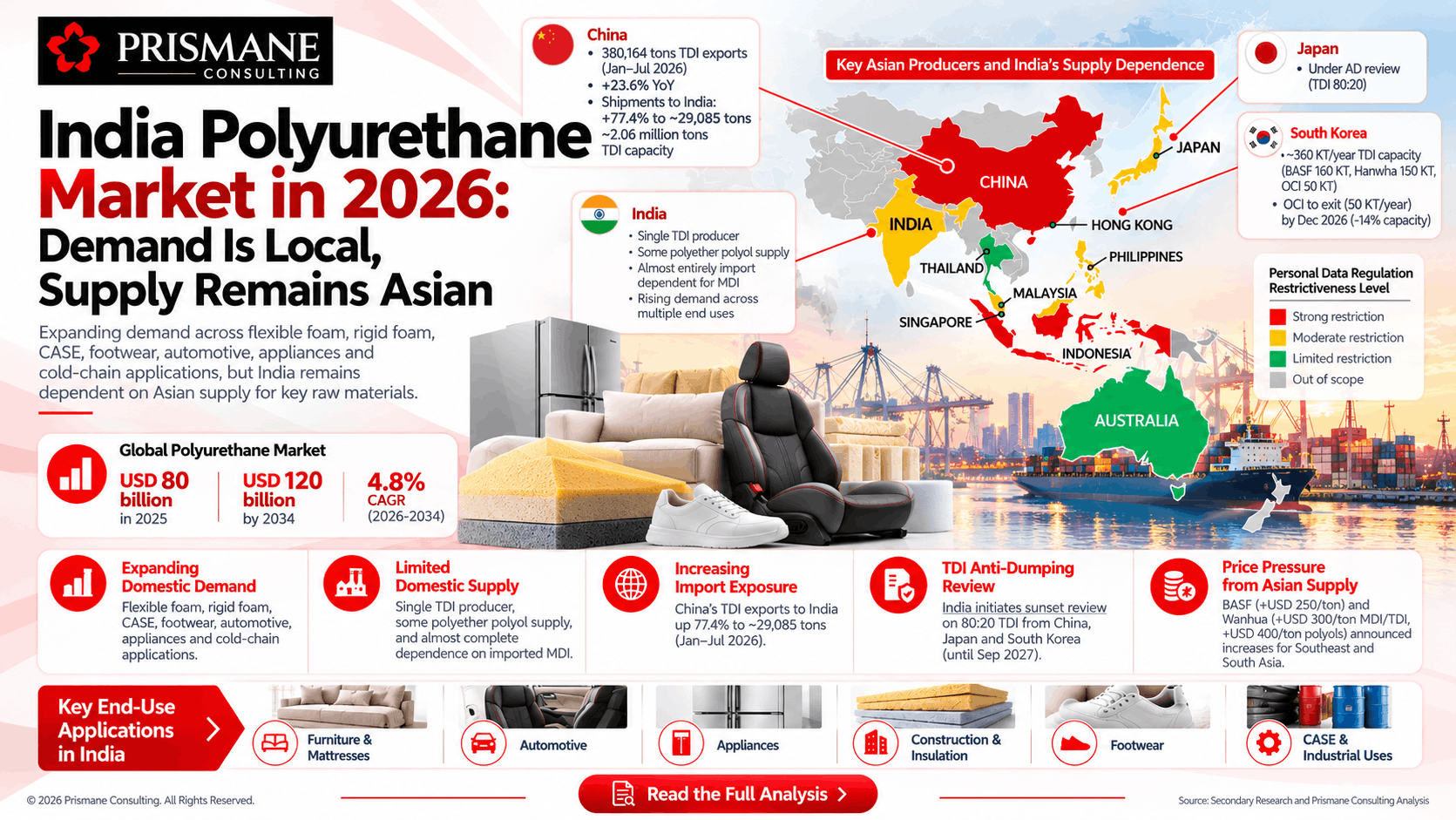
India's polyurethane market is expanding across flexible foam, rigid foam, CASE, footwear, automotive, appliances and cold-chain applications. However, the supply of key polyurethane raw materials has not expanded at the same pace as downstream demand.
India has a single domestic TDI producer, some local polyether polyol supply, and depends almost entirely on imports for MDI. This makes the India polyurethane market increasingly influenced by Asian production capacity, export availability, freight economics and trade policy.
The result is a market where demand is increasingly local, but supply remains largely Asian.
Five developments are particularly important for understanding the polyurethane market in India and how its raw-material supply could evolve.
India Polyurethane Market: Demand Is Expanding Across Key End Uses
Polyurethane demand in India is supported by a broadening range of applications. Flexible foam remains important for furniture, mattresses and automotive seating, while rigid foam is increasingly relevant to insulation, refrigeration and cold-chain applications.
CASE applications, footwear, appliances and other industrial uses further broaden the demand base.
Prismane values the global polyurethane market at around USD 80 billion in 2025, with the market projected to reach around USD 120 billion by 2034 at a CAGR of 4.8%. India's exposure across flexible foam, rigid foam, CASE, footwear and appliances places the country within this broader demand expansion.
The issue is therefore not whether India's polyurethane demand can grow. The more important question is whether the domestic raw-material supply base can keep pace.
BASF's Dahej MDI Project Could Reshape India's Polyurethane Supply
In September 2026, BASF said it is in the advanced stages of a feasibility study for a potential MDI production complex at Dahej, Gujarat, and has secured an industrial land parcel through BASF India Polyurethanes Private Limited.
No final investment decision, investment amount or capacity figure has been announced. The potential project should therefore not be treated as confirmed capacity in any India MDI market balance.
What matters is the starting point. BASF already operates an MDI splitter and polyurethane production facilities at Dahej, giving the company an established presence in India's polyurethane value chain.
If the project proceeds, it could strengthen domestic MDI availability and reduce part of India's dependence on imported material. However, MDI would represent only one component of the country's polyurethane raw-material requirement.
TDI, polyols and other intermediates would continue to require a combination of domestic and imported supply.
The significance of the announcement is therefore less about immediate capacity and more about what it indicates about the long-term scale of India's polyurethane opportunity.
China's TDI Exports Are Increasing India's Import Exposure
China remains a critical variable for the India TDI market.
China exported 380,164 tons of TDI during January-July 2026, up 23.6% year on year. Shipments to India increased 77.4% to around 29,085 tons, representing just under 8% of China's TDI exports.
With Chinese TDI capacity at around 2.06 million tons per year, the material reaching India depends not only on Indian demand, but also on Chinese operating rates, export economics and freight spreads.
When these variables change, trade flows can redirect quickly.
For Indian buyers, this makes annual nameplate capacity a weaker indicator of near-term availability than actual export flows, producer operating rates and inventories.
This is particularly important for the polyurethane raw materials market in India, where imported supply can have a direct influence on pricing and purchasing decisions.
India's TDI Anti-Dumping Review Could Change Import Economics
On 30 September 2026, India's Directorate General of Trade Remedies initiated a sunset review of anti-dumping duties on 80:20 TDI from China, Japan and South Korea, following an application from Gujarat Narmada Valley Fertilizers & Chemicals, India's sole TDI producer.
The duties, continued in 2022 at USD 0.15 to 0.44 per kg depending on origin and producer, remain in force until 20 September 2027 unless revoked earlier.
The applicant's case, which the authority found sufficient on a prima facie basis to initiate the review, is that imports from the three origins have increased and that Chinese capacity continues to expand.
Prismane's trade data points in the same direction for China. Shipments to India increased 77.4% even with the duties in place, showing that trade measures have not eliminated imports.
The outcome of the review will therefore be important for the future competitive relationship between domestic TDI production and imported material.
For Indian buyers, the question is not simply whether TDI imports are available. It is how the relative economics of domestic and imported TDI evolve under the next phase of the trade regime.
South Korea's TDI Capacity Is Declining
South Korea is another important variable for the India polyurethane market.
OCI will suspend its TDI manufacturing and sales from 18 December 2026, removing around 50 KT/year from South Korea's production base.
The country's three producers currently represent around 360 KT/year of combined capacity: BASF at 160 KT, Hanwha Solutions at 150 KT and OCI at 50 KT. OCI's exit therefore represents approximately 14% of existing Korean TDI capacity.
South Korea is one of the three origins covered by India's TDI trade-remedy review.
The timing is noteworthy.
Less Korean capacity, alongside rising Chinese exports, could alter the origin mix of TDI supplied to India regardless of the eventual outcome of the sunset review.
For Indian buyers, this makes supplier diversification increasingly important.
Polyurethane Prices in India Face Pressure From Asian Supply
Price announcements from major producers have also become an important indicator for the polyurethane industry in India, although announced increases should not automatically be treated as realised transaction prices.
BASF announced a USD 250/ton increase for MDI and TDI in ASEAN and South Asia on 11 September. Wanhua followed on 14 September with increases of USD 300/ton for MDI and TDI and USD 400/ton for polyether polyols in Southeast and South Asia.
However, announced increases do not automatically become transaction prices.
Enquiries have remained cautious and completed transactions relatively small. For Indian foam buyers, a posted price is an opening position. What actually clears depends on inventory, contract structures, customer requirements and whether another origin can fill the requirement at a different cost.
This is why the indicators worth watching are not only producer announcements.
Plant availability, export flows, inventory levels and actual transaction volumes provide a better indication of where the market is clearing.
What the Supply Outlook Means for India's Polyurethane Market
India does not have a demand problem.
The country's polyurethane market is supported by multiple downstream sectors, while global polyurethane consumption continues to expand. The challenge is that India's raw-material supply base has not expanded at the same pace.
The more important question is who supplies that demand.
Domestic capacity alone is unlikely to eliminate India's dependence on overseas raw-material supply in the near term. BASF's potential Dahej investment, if it proceeds, could improve MDI supply security, but TDI will remain subject to a more complex balance between domestic production, imports and trade policy.
At the same time, Asian supply will continue to influence Indian market conditions.
China's export availability, South Korea's shrinking TDI base, producer operating rates, freight economics and buyer inventories will all influence what Indian customers actually pay and where they source material.
This means India's polyurethane market is becoming increasingly important not just as a consumption story, but as a supply-chain strategy story.
For buyers, multi-origin sourcing and visibility into plant-level availability can reduce exposure to sudden supply disruptions. For producers and investors, understanding the interaction between domestic capacity, imports, trade measures and downstream demand will be critical to assessing the India polyurethane market outlook.
India's polyurethane market is not short of demand. It remains exposed to supply decisions made outside the country, and that balance is now beginning to change.
Prismane Consulting
Prismane Consulting tracks the global polyurethane value chain, including plant-level MDI and TDI capacity, trade flows, pricing and regional supply-demand balances, through its Chemicals & Materials practice.
Looking to understand India's polyurethane market beyond the headline numbers?
Explore our Polyurethane Market Study at https://prismaneconsulting.com/report-details/polyurethane-market or contact our team at sales@prismaneconsulting.com