
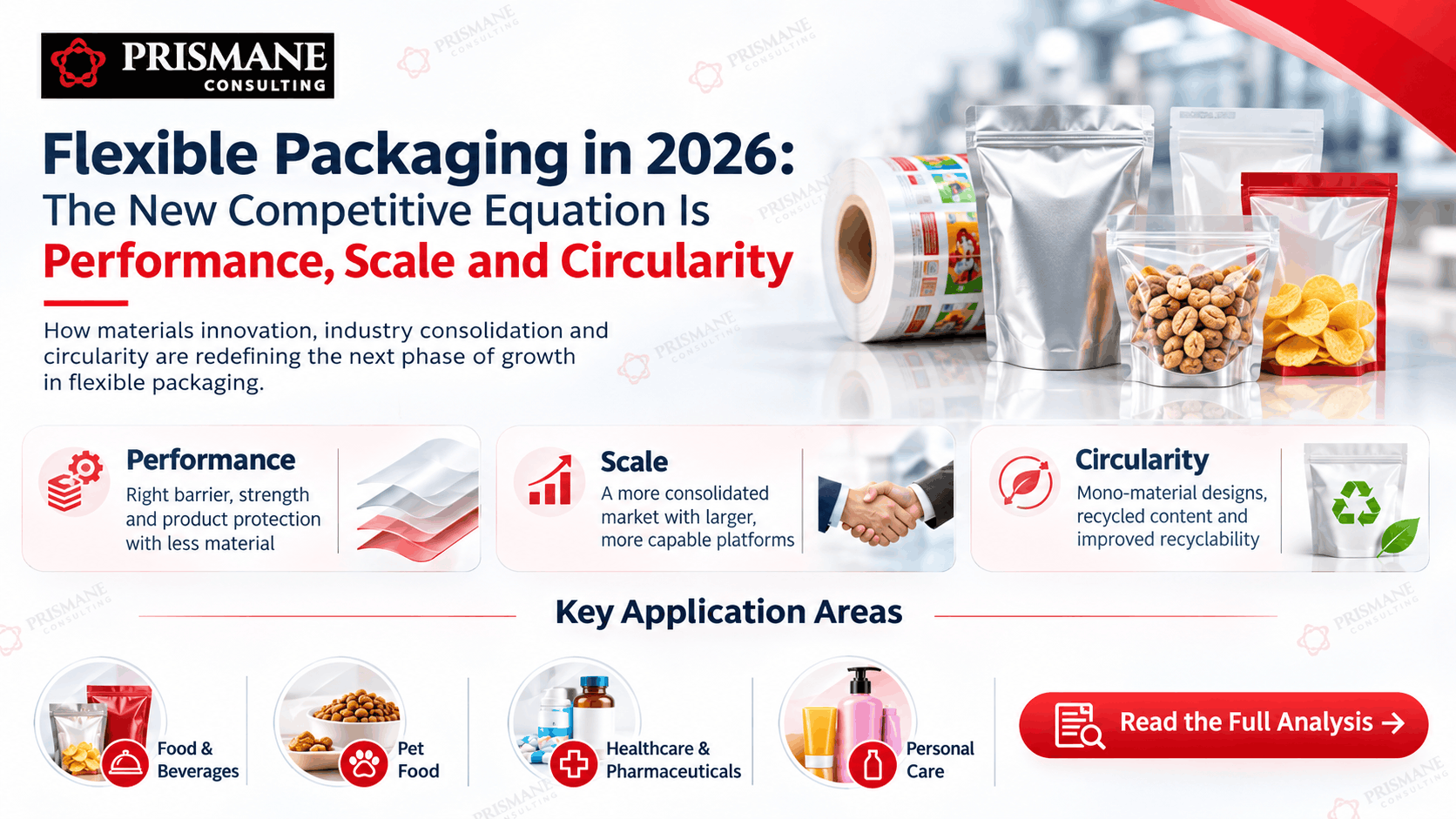
Flexible packaging is entering a more demanding phase. Pouches, bags, films and wraps continue to benefit from lightweighting, convenience and the expansion of packaged food, pet food, personal care and healthcare applications. Yet volume growth alone is no longer enough to define competitive advantage.
In 2026, packaging producers face a dual challenge. They must engineer structures that use less material, protect products, incorporate more circular design principles and run efficiently on commercial equipment. At the same time, major acquisitions are changing the competitive landscape, creating larger platforms with broader portfolios, geographic reach and innovation resources.
These developments are connected. As customers seek fewer, more capable suppliers and packaging structures become more technically demanding, scale, application expertise and materials innovation increasingly reinforce one another.

Flexible packaging is becoming an application-engineered market
There is no single growth or technology pathway across flexible packaging. Food applications prioritize shelf life, moisture and oxygen protection, sealing and material efficiency. Pet food requires puncture resistance, strong seals and reliable barrier performance; wet pet food can add retort-processing requirements. Healthcare and pharmaceutical applications place greater weight on contamination control, sterilization compatibility and qualification. Personal care places emphasis on appearance, dispensing, convenience and premiumization.
The implication is that material selection increasingly starts with the product and process requirement—not simply the package format. A structure that works for a snack pouch may not be suitable for a retort pouch or a pharmaceutical application. Suppliers that can match material architecture to end-use performance are better positioned than those competing only on film price.
Mono-material structures are advancing, but performance remains decisive
Traditional flexible packs often combine polymers, coatings, adhesives and sometimes Aluminum to achieve barrier, strength, stiffness and sealing performance. These combinations can be difficult to recover through conventional recycling systems. This is driving development of PE- and PP-based structures designed to perform multiple functions within a more compatible polymer family.
PE is evolving beyond its traditional role as a sealing layer. Advances in blown film, cast film, coextrusion and machine-direction orientation are improving stiffness, puncture resistance and processing performance. This creates opportunities in pouches, bags and flow wraps where PE-based structures may replace selected conventional laminates.
PP offers a different balance of stiffness, heat resistance and dimensional stability. High-barrier mono-PP structures are therefore being developed for applications where these properties matter. PET, meanwhile, remains relevant where printability, dimensional stability and mechanical performance are difficult to replace.
Mono-material packaging is not a simple layer-removal exercise. A viable structure must retain oxygen and moisture barrier, puncture resistance, seal strength, heat resistance, printability, machinability and product protection. Where these requirements cannot be met, multilayer structures will remain necessary. The likely transition is gradual and application-specific, not an immediate elimination of complex laminates.
Barrier performance, lightweighting and recycled content are converging
Barrier performance remains one of the main technical constraints on packaging redesign. Oxygen and moisture ingress can affect flavor, shelf life, product quality and safety. The industry is therefore combining polymer selection with coatings, metallization, EVOH and specialty barrier technologies to achieve the minimum material architecture that still protects the product.
Lightweighting remains a core advantage of flexible formats, but reducing gauge too aggressively can weaken puncture resistance, seal strength, stiffness, drop performance and machinability. The next phase depends less on simply making films thinner and more on orientation, polymer selection, multilayer optimization and barrier coatings that reduce material use without compromising performance.
Recycled content adds another layer of complexity. Recyclability concerns the package’s end-of-life pathway; recycled content concerns the feedstock used to manufacture it. Availability of high-quality recycled PE and PP varies by region and application. Food-contact, pet food, pharmaceutical and healthcare uses face more demanding safety and qualification requirements than many non-contact applications. As a result, recycled-content adoption will be uneven and may involve combinations of mechanically recycled, advanced-recycled and virgin polymers.
Pet food is an important proving ground because it combines demanding protection requirements with opportunities for recycle-ready structures. Successful commercialization in these applications could support adoption in other high-performance food segments.

Converting capability determines whether innovation scales
A technically promising film must also run reliably on commercial equipment. Machine-direction orientation, blown-film extrusion, coating, lamination, printing and pouch-making all influence the economics of a new structure. A recyclable pack that requires slower line speeds, generates higher scrap or demands extensive equipment modification may struggle to compete.
This makes material suppliers, converters, machinery providers and brand owners increasingly interdependent. The commercial test is not simply whether a film can be manufactured; it is whether the complete structure can be produced consistently, efficiently and at the required scale.
Consolidation is reshaping the competitive map
The technology transition is taking place alongside a significant wave of portfolio consolidation. Amcor completed its all-stock combination with Berry Global on 30 April 2025. The transaction was valued at approximately US$10.4 billion in equity consideration, excluding approximately US$5.2 billion of Berry debt assumed by Amcor. The combined company highlighted a broader consumer and healthcare packaging portfolio, global scale and expanded material-science and innovation capabilities. At announcement, Amcor identified a total pre-tax synergy opportunity of approximately US$650 million by the end of fiscal 2028, including a US$260 million target for fiscal 2026. Amcor subsequently reported US$285 million in synergies for fiscal 2026, ahead of that initial target.
Separately, TOPPAN completed its acquisition of Sonoco’s Thermoformed & Flexibles Packaging business on 1 April 2025 for approximately US$1.8 billion, on a cash-free and debt-free basis subject to customary adjustments. TOPPAN described the business as complementary to its global packaging operations, combining customer relationships and solution-development capabilities with its own technical and manufacturing platform.
Together, these transactions indicate that strategic buyers see value in scale, geographic reach, technical capabilities and broader customer offerings, not only in cost reduction. The transaction values should not be treated as directly comparable because the deal structures and businesses included differ.

What consolidation means for converters, customers and suppliers
Larger packaging groups may be better positioned to serve multinational customers across formats and regions, invest in R&D and support complex sustainability roadmaps. For brand owners, broader portfolios can simplify supplier relationships, although greater concentration may also change negotiation dynamics and reduce the number of independent large-scale alternatives.
For mid-sized converters, competing solely on price against larger platforms is likely to become more difficult. Strategic responses include specializing in defensible applications, developing proprietary material or converting capabilities, building regional customer intimacy, forming partnerships with scaled suppliers, or evaluating selective M&A. Rigid and fiber-based packaging companies are also expanding into adjacent flexible and hybrid formats, making the competitive boundary broader than traditional film converters alone.
The opportunity is not limited to becoming larger. It is to become more difficult to replace—through application knowledge, reliable quality, speed, customization, sustainable structures or specialized barrier performance.
Strategic priorities through 2034
Five priorities stand out for flexible packaging manufacturers:
- Design around application performance: Qualify structures against the real barrier, sealing, handling and shelf-life needs of each end use.
- Build mono-material capability selectively: Prioritize applications where PE- or PP-based structures can meet performance and recycling requirements without an unacceptable cost penalty.
- Secure circular feedstocks: Assess the availability, quality, traceability and economics of recycled polymers by grade and application.
- Integrate materials with converting: Validate line speed, scrap, sealing windows and equipment compatibility before scaling a new structure.
- Choose a clear competitive position: Pursue scale where it creates customer value, or specialize where technical differentiation and service can defend margins.
Regional adoption will differ. Europe’s regulatory and recycling context is accelerating redesign, while North America has significant opportunities in food, pet food and healthcare. Asia-Pacific remains a major manufacturing and consumption center, with India and Southeast Asia balancing rising packaged-product demand with strong cost sensitivity. The commercially successful structure in each region must reconcile sustainability ambitions with local infrastructure and economics.
Prismane Consulting Perspective
The next advantage is system performance. Flexible packaging in 2026 is being reshaped by the interaction of material engineering and industry consolidation. Mono-material structures, barrier technologies, recycled feedstocks and lightweighting are changing what a package must deliver. Meanwhile, acquisitions such as Amcor–Berry and TOPPAN–Sonoco are changing who can deliver those solutions at scale.
The next competitive advantage will not come from volume, scale or sustainability claims in isolation. It will come from combining product protection, material efficiency, converting performance, circularity and total system economics. Companies that solve these requirements together will be better positioned to win customers and sustain margins as the industry evolves.
Prismane Consulting’s Packaging Intelligence practice tracks flexible packaging materials, technologies, competitive developments and strategic investment themes. For a deeper assessment of market opportunities, competitive positioning or application-specific material trends, contact sales@prismaneconsulting.com or visit www.prismaneconsulting.com