
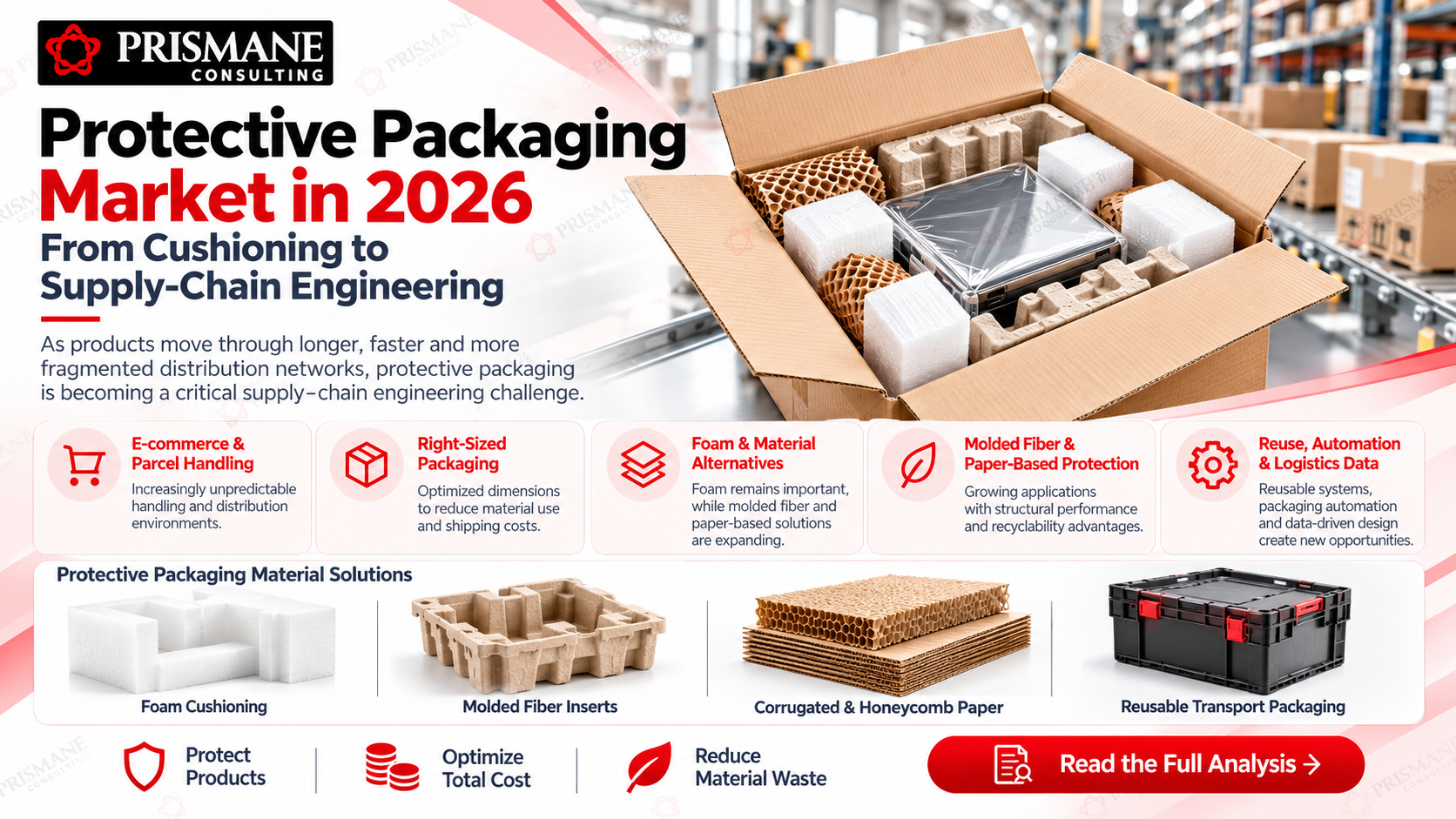
The Protective Packaging Market Is Moving Beyond Cushioning
Protective packaging has traditionally been treated as a secondary component of product experience. Its primary purpose was straightforward: prevent damage during storage, handling and transportation. That role is becoming considerably more complex.
As products move through longer, faster and more fragmented distribution networks, protective packaging must absorb shocks, control vibration, prevent abrasion, manage moisture and withstand repeated handling. At the same time, manufacturers and brands are under pressure to reduce packaging consumption, improve recyclability and manage logistics costs.
E-commerce has accelerated this transformation, but the underlying change extends across industrial components, consumer electronics, appliances, healthcare products and other high-value goods. Products that are once moved through relatively predictable distribution systems are increasingly exposed to automated sorting, parcel networks, mixed loads, repeated transfers and direct-to-consumer delivery. These conditions create new requirements for cushioning materials, package geometry and structural performance.
The result is a fundamental change in how the protective packaging market should be evaluated. The cheapest protective material is not necessarily the lowest-cost solution if it increases product damage, returns, reverse logistics or customer complaints. Conversely, excessive packaging can increase material consumption, freight costs and disposal requirements without providing meaningful additional protection. Protective packaging is becoming a performance-optimization problem rather than simply a material-selection exercise.
For manufacturers, converters and packaging suppliers, the commercial opportunity lies in delivering the required level of product protection with the right combination of material, structure, package dimensions and distribution performance.
Key Takeaways
- Supply-chain economics are becoming central: Protective packaging must be evaluated against product damage, freight, returns and total system cost not material price alone.
- E-commerce is changing performance requirements: Unpredictable handling and parcel distribution are increasing the importance of cushioning, right-sizing and package durability.
- Material substitution remains application-specific: Foam, molded fiber, corrugated structures and paper-based cushioning each have different performance and cost advantages.
- Engineering creates differentiation: Product-specific testing, structural design and distribution data can help suppliers improve protection while reducing unnecessary material.
- Sustainability requires a balanced approach: The objective is to reduce environmental impact without compromising the protection of the packaged product
The Economics of Protective Packaging: Why Product Protection Has a Cost
Protective packaging involves two interconnected cost categories. The first is the direct cost of producing the package, including raw materials, converting, assembly and transportation. The second is the cost associated with packaging failure, which can include damaged products, replacement shipments, reverse logistics, warranty claims and reputational damage. For electronics, appliances, medical devices and industrial components, the financial consequences of inadequate protection can substantially exceed the savings achieved through material reduction. This changes the way packaging specifications should be developed.
A reduction in packaging weight may appear commercially attractive when evaluated in isolation. However, if the change increases damage rates or returns volumes, the overall economics can deteriorate. The more appropriate approach is to evaluate protective packaging through a total-system-cost framework. This framework considers packaging material and conversion costs, transportation efficiency and dimensional shipping charges, product damage and replacement rates, reverse logistics and warranty expenses, packaging handling and automation requirements, end-of-life management and material recovery.
The objective is not necessarily to produce the lightest package. It is to identify the most cost-effective packaging configuration that delivers the required protection throughout the product's distribution journey. For packaging manufacturers, this creates an opportunity to move beyond commodity cushioning products and compete through engineering expertise, application knowledge and measurable performance improvements.
E-Commerce Is Reshaping Protective Packaging Requirements
Traditional distribution systems often rely on predictable palletization, consolidated shipments and relatively controlled handling. Parcel distribution introduces greater variability.
Packages may pass through automated sorting equipment, conveyor systems, delivery vehicles and multiple transfer points before reaching the customer. They may also be handled individually rather than remaining within a stable pallet load. These conditions can expose products to variable shock, vibration, compression and impact.
As a result, protective packaging solutions increasingly need to reflect the actual distribution environment rather than being designed solely around product dimensions or material specifications. This is driving interest in improved cushioning, structural protection, right-sized packaging and formats that can withstand repeated handling.
The implications differ by product category. A lightweight consumer product may benefit from compact packaging and carefully positioned cushioning, while a heavy industrial component may require load-bearing structures and more substantial impact protection.
For converters, understanding the relationship between product characteristics, distribution conditions and packaging performance can become an important source of competitive differentiation.
Rightsizing Is Becoming a Major Protective Packaging Strategy
Oversized packaging creates several avoidable costs. Larger boxes consume more corrugated material, increase dimensional shipping costs and leave additional space around the product. That empty space often requires void fill or additional cushioning to prevent movement during transit.
Rightsizing addresses these issues by matching package dimensions more closely to product geometry and protection requirements. Digital packaging design, automated box-making systems and improved product data are making it increasingly feasible to develop packaging configurations tailored to individual products or shipment profiles.
The opportunity is particularly relevant to e-commerce and high-volume distribution, where relatively small improvements across large shipment volumes can generate meaningful material and freight savings. However, right-sizing should not be confused with simply reducing box dimensions.
A smaller package must still accommodate the required cushioning, maintain structural integrity and protect the product under expected distribution conditions. Poorly designed reductions can transfer costs from packaging to product damage. The next stage of protective packaging development will therefore combine dimensional optimization with performance validation.
Instead of selecting cushioning material first and designing the outer package around it, manufacturers can increasingly design the complete packaging system around product dimensions, fragility, weight and distribution exposure.
Foam Remains Important Despite the Search for Alternatives
Foam continues to play an important role in protective packaging because of its cushioning efficiency, low weight and ability to absorb impact energy. Depending on its composition and structure, foam can also provide vibration control, insulation and surface protection. These characteristics make it difficult to replace in applications with demanding performance requirements.
At the same time, pressure to improve recyclability and reduce reliance on conventional plastic packaging is encouraging the development of alternative protective materials. The transition is unlikely to involve a universal replacement of foam with paper-based materials. Different materials offer different combinations of cushioning efficiency, compression resistance, weight, cost and end-of-life characteristics.
For example
- Foam cushioning can be suitable where impact absorption, low weight and product-specific protection are critical.
- Corrugated structures can provide structural support and engineered impact zones.
- Molded fiber components can offer shaped protective inserts for selected applications.
- Paper-based honeycomb and formed structures can provide compression resistance and load distribution.
The commercial question is whether an alternative can achieve the required level of protection at a competitive total cost. For material suppliers, this creates opportunities to develop application-specific products rather than positioning every alternative as a direct substitute for foam.
Molded Fiber Protective Packaging Is Expanding Its Application Potential
Molded fiber has traditionally been associated with relatively simple protective components. Improvements in fiber forming, tooling and surface quality are expanding its potential across a broader range of packaging applications. Consumer electronics, appliances, cosmetics and other products may offer opportunities where shaped cushioning, structural support and fiber-based material recovery align with customer requirements.
For brands, molded fiber can support efforts to reduce selected plastic-based protective components. For converters, it offers opportunities to develop application-specific structures with differentiated geometry and performance. However, molded fiber is not suitable for every application.
Moisture sensitivity, cushioning performance, density, dimensional consistency, tooling requirements and production economics can influence its competitiveness. Its adoption also depends on whether the packaging can meet product-protection requirements without increasing overall material use or creating additional logistics costs. The strongest opportunities will emerge where the technical characteristics of molded fiber align with the product's protection needs and the customer's sustainability objectives.
For investors and packaging manufacturers, the key consideration is not simply whether molded fiber can replace plastic. It is where the material can deliver a commercially viable combination of performance, manufacturability and end-of-life benefits.
Reusable Protective Packaging Depends on Logistics Economics
Reusable protective packaging operates under a different economic model from single-use packaging. Rather than minimizing the cost of one package, the objective is to maximize the number of successful uses from a more durable packaging asset.
This can be attractive in closed or semi-closed distribution networks where return flows are predictable and packaging can be inspected, cleaned or refurbished before reuse. Automotive components, industrial parts and selected returnable transport packaging systems can offer suitable conditions.
The economics become more difficult when packaging is distributed directly to consumers without an efficient return mechanism. Reverse transportation, collection rates, cleaning requirements and asset losses can offset the benefits of repeated use. Consequently, reuse is not simply a material-selection decision. It is a logistics and operating-model decision.
The viability of a reusable protective packaging system depends on several variables such as number of successful reuse cycles, return rates and asset-loss levels, transportation distances and reverse-logistics costs, cleaning, inspection and refurbishment requirements, durability under repeated handling, cost relative to the single-use alternative.
For suppliers, the opportunity may extend beyond manufacturing the package itself to providing returnable packaging systems, tracking solutions and lifecycle-management services.
Protective Packaging Design Is Becoming Product-Specific
A glass bottle, television, appliance, pharmaceutical device and automotive component have different failure modes. Their protective packaging requirements cannot be optimized through a single generic specification. Product mass, centre of gravity, fragility, surface sensitivity, geometry and the expected distribution environment all influence packaging design.
This is increasing the importance of engineering-led packaging development. Drop testing, compression testing, vibration analysis and distribution simulation can help determine where protection is necessary and where additional material may provide little incremental benefit. Rather than surrounding the entire product with more cushioning, packaging designers can focus protection on areas where damage is most likely to occur.
This can improve material efficiency while maintaining the required level of protection. For converters, this creates a stronger role for technical collaboration with customers. Suppliers that understand product failure modes and distribution conditions may be better positioned to develop packaging configurations tailored to specific applications.
Engineered Cushioning: Geometry Can Matter as Much as Material
The performance of protective packaging depends not only on the material used but also on how the structure responds to impact and load. When a package experiences an impact, the objective is to manage the energy transferred to the product.
Different materials and geometries behave differently under these conditions. Foams can deform progressively, corrugated structures can buckle, molded fiber can create compression zones, and honeycomb structures can distribute loads across a larger area.
This creates opportunities to engineer protective packaging around the product's actual vulnerabilities rather than relying on material thickness alone. Structural design can influence impact absorption, compression resistance, dimensional stability and material consumption.
The implication for packaging manufacturers is significant: material innovation and structural engineering should increasingly be developed together. Suppliers that can combine material knowledge, tooling capabilities and application testing may be able to deliver better-performing solutions than those competing primarily on price per unit.
Sustainability Is Changing the Definition of Adequate Protection
Sustainability initiatives have placed packaging material consumption and end-of-life management under greater scrutiny. Protective packaging is therefore under pressure to use less material, improve recyclability and explore alternative materials. However, reducing packaging material without considering product protection can produce unintended consequences.
A damaged product may require replacement manufacturing, additional transportation and disposal of the original item. For products with substantial embedded material and energy, these impacts can be significant. The appropriate objective is therefore not to minimize packaging weight at any cost. It is to optimize protection while reducing unnecessary material and environmental impact.
This requires a balanced assessment of packaging quantity and material efficiency, product damage and replacement rates, recyclability and practical recovery infrastructure, transportation and reverse logistics requirements, reuse potential and actual return performance and product-specific protection requirements.
The most suitable solution will differ by application and market. Foam, molded fiber, corrugated packaging and reusable systems can each offer advantages under the right conditions. For brands and suppliers, sustainability performance is most meaningful when it is evaluated alongside functional performance and the realities of the distribution system.
Automation Is Increasing the Importance of Material Consistency
Packaging automation is changing how protective packaging materials are specified and selected. Manual operations can accommodate some variation in package dimensions and material behavior. Automated systems require greater consistency in material properties, dimensional accuracy and package formation.
Protective components may need to be inserted, erected, folded, sealed or positioned reliably at production speed. This creates opportunities for packaging systems designed around repeatable manufacturing and automated handling.
It also introduces new requirements for material suppliers. A cushioning product that performs well in a manual packing operation may be less competitive if it cannot run consistently through an automated process. Material properties, converting quality, package geometry and equipment compatibility therefore need to be considered together.
For packaging converters, the ability to deliver consistent quality and reliable machine performance can become as important as the cushioning material's standalone characteristics.
Logistics Data Is Becoming Part of Protective Packaging Design
Protective packaging development is increasingly supported by information about product damage, shipping routes, packaging configurations and distribution channels. By examining damage rates across different products and routes, companies can identify where packaging is over-engineered and where it provides insufficient protection.
This supports a shift from standardized packaging specifications toward data-driven optimization. For example, a product shipped through a controlled business-to-business network may require a different protective configuration from the same product shipped directly to consumers through a parcel network.
Packaging requirements may therefore need to be differentiated by distribution channel, not only by product category. Combining logistics data with testing and packaging design can help companies make more informed decisions about cushioning levels, package dimensions and material selection.
For protective packaging suppliers, this creates opportunities to support customers with packaging audits, performance testing, design optimization and ongoing improvement programmes.

The strongest commercial opportunities will emerge where a supplier can connect material capabilities with a clearly defined customer problem.
For manufacturers considering new investments, market attractiveness should therefore be assessed not only through material demand but also through customer qualification requirements, production economics, competing technologies and the distribution environments being served.
Protective Packaging Market Outlook to 2034
Through 2034, protective packaging is likely to become increasingly defined by engineered performance rather than generic cushioning requirements. Foam will remain relevant where its technical advantages are difficult to replicate. Molded fiber, corrugated structures, paper-based cushioning and reusable systems will continue to find opportunities where their characteristics align with product-protection requirements and end-of-life objectives. At the same time, right-sizing, automation, distribution testing and logistics data will play a greater role in packaging design and material selection.
For suppliers, the competitive challenge will be to demonstrate that their solutions can protect products reliably while supporting customers' cost, operational and sustainability objectives.
For buyers, the priority will be to understand the trade-offs between packaging material, product damage, freight, processing requirements and recovery systems.
The long-term opportunity is not simply to use less protective packaging. It is to deliver the right level of protection with the lowest practical total cost and environmental impact.
Prismane Consulting Perspective
At Prismane Consulting, we view protective packaging as an evolving intersection of materials science, packaging engineering, logistics economics and sustainability. The competitive landscape is not determined by material properties alone. It is shaped by the ability to meet application-specific protection requirements, maintain converting and automation performance, manage total system costs and satisfy customer expectations for material efficiency and end-of-life outcomes.
For manufacturers and investors, assessing these factors together is essential to identifying commercially viable opportunities across foam, molded fiber, corrugated structures, paper-based cushioning and reusable protective packaging.
Understanding where each material can compete and where technical or economic limitations remain will be central to evaluating future investment and product-development priorities.
Explore Protective Packaging Market Opportunities with Prismane Consulting
Looking to assess protective packaging materials, competitive positioning, application opportunities or emerging market trends? Contact Prismane Consulting to discuss customized market intelligence, competitive analysis and growth opportunities across the packaging value chain. Visit Prismane Consulting or contact sales@prismaneconsulting.com.