
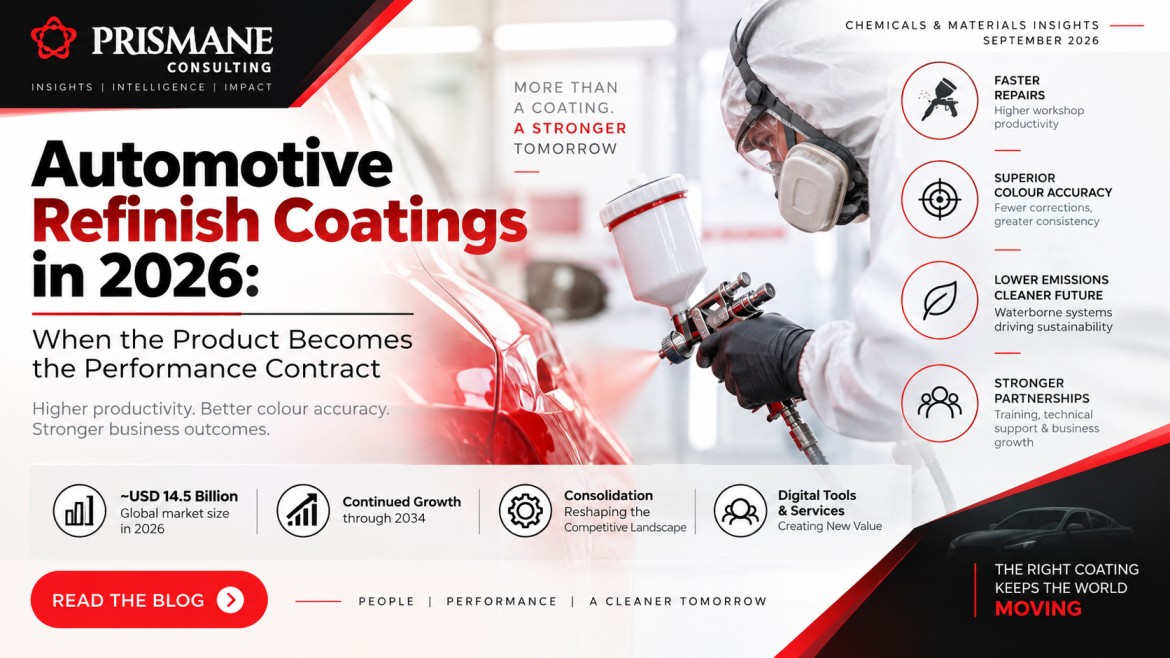
For most of its history, the coatings industry has been bought and sold on a relatively simple equation: price per litre, coverage and volume. That equation is losing relevance in the segments where coating performance carries the greatest economic consequence. A body-shop owner does not really care whether a basecoat is marginally cheaper per litre. The question is how many vehicles the workshop can turn round and how much labour is lost to colour matching and rework. The coating is increasingly being evaluated against the customer's operating economics rather than against a competitor's price. That is changing where value can be captured and who is best placed to capture it.
Colour accuracy and cycle time decide the winning system, not material price
A body shop's costs are dominated by labour, booth utilisation and rework, so a system that costs more per litre can still be the cheaper choice overall if it reduces colour-matching errors and gets vehicles through the shop faster. Modern colours, including metallics, pearlescent, multi-layer and increasingly customised finishes, raise the risk that a poor initial match requires additional blending or correction. This is why digital colour tools, spectrophotometry and automated mixing are becoming increasingly important rather than remaining premium features.
The value is not simply a better colour match. Fewer corrections mean fewer labour hours, less booth time and greater vehicle throughput. The commercial proposition is therefore shifting from selling paint to improving the economics of the repair process.
Waterborne systems and EV repair reward suppliers that own the whole process, not just the formulation
Waterborne refinish coatings are increasingly being judged on more than VOC reduction. Adoption also depends on drying behaviour, application consistency, colour matching, technician acceptance and overall repair productivity. Changing systems requires retraining, requalification and technician acceptance, so suppliers need to demonstrate that a lower-emission process can also deliver consistent and productive repairs.
Electric vehicles add another layer of complexity, with new substrates, battery-adjacent repair considerations and increasingly integrated ADAS systems making the collision-repair process more demanding. This increases the value of suppliers that can support the repairer across the broader workflow rather than simply supply paint.
PPG's August 2026 launch of the PPG QUICKLINE waterborne refinish system in the U.S. and Canada illustrates this shift. The portfolio covers basecoats, undercoats, clearcoats, toners and ancillary products, with PPG positioning the system around colour matching, blending, drying and repair productivity as well as reduced VOC emissions. The system is also backed by technical training, colour support, business development programmes and a distributor network.
Consolidation is redrawing supplier boundaries around service reach, not just formulation IP
The strategic value of refinish increasingly extends beyond formulation technology to technical-service footprints, training networks and body-shop relationships. AkzoNobel and Axalta shareholders have approved their proposed all-stock merger, with completion expected in late 2026 or early 2027 subject to the remaining conditions. The combination would create a coatings group with significant scale in vehicle refinish alongside its broader coatings portfolio.
Separately, BASF completed the carve-out of its coatings business on 30 June 2026. The new company, Surventis, includes the former BASF automotive OEM coatings, automotive refinish coatings and surface treatment businesses, with BASF retaining a 40% equity stake and Carlyle becoming the majority owner.
These transactions do not necessarily mean that formulation know-how has become less important. Rather, they highlight how competitive value in refinish increasingly extends into the ability to deliver technology through technical service, training, colour support and distribution. A strong formulation has limited commercial value if a repairer cannot consistently apply it, match the colour and complete the repair efficiently.
Diverging quarterly results show that manufacturing scale alone does not determine refinish performance
The recent financial results of major coatings suppliers also illustrate why scale alone does not explain performance. Sherwin-Williams reported second-quarter 2026 Performance Coatings Group sales of USD 1.91 billion, up 6.3% year on year, with Automotive Refinish among the businesses reporting high-single-digit growth. Axalta reported second-quarter refinish net sales of USD 545 million, up 6% year on year.
The figures do not prove that service capability is the sole driver of growth, as pricing, product mix, acquisitions, currency and regional demand also influence reported results. They do, however, reinforce an important point: manufacturing scale alone does not determine refinish economics. Colour tools, training, application support and distribution reach increasingly influence how effectively suppliers convert their technology into customer value.
What it means
Automotive refinish is becoming a business where the coating is judged against the customer's financial model, particularly labour hours, repair cycle time and rework, rather than simply against a competitor's litre price. Prismane estimates the global automotive refinish coatings market at roughly USD 14.5 billion in 2026, with continued growth through 2034. The opportunity is not being distributed evenly. Suppliers that can demonstrate measurable improvements in repair productivity, colour accuracy and rework reduction have greater scope to defend premium positioning.
Premiumisation becomes easier to defend when the conversation moves from “why does your coating cost more?” to “how much value does it generate?”. Technical services also become a source of commercial value rather than simply a support cost, because application engineering, training, colour tools and repairer relationships are difficult to replicate through formulation changes alone.
The same logic helps explain why refinish is becoming strategically attractive within larger coatings portfolios. Acquisitions and business carve-outs are changing the competitive landscape, while suppliers are investing in digital colour management, training, technical support and distribution capabilities that allow them to influence the complete repair process.
The strategic question for 2026 is therefore no longer simply how to make a better coating. It is how to prove that the coating makes the customer's operation perform better. Chemistry remains the foundation, but the economic outcome is increasingly becoming the product.
Prismane Consulting tracks the global automotive refinish coatings value chain, including demand by segment, competitive positioning and the shift towards coating-plus-service business models, through its Chemicals & Materials practice or write to us at sales@prismaneconsulting.com.