
China's capacity expansion, India's move toward domestic production, capacity rationalization in mature markets, application driven demand and the rise of circular materials are reshaping the global polycarbonate market. Prismane Consulting examines what these changes mean for capacity, demand, trade flows, operating rates and the competitive landscape.
Polycarbonate is becoming one of the most closely watched engineering polymers as the global plastics industry undergoes a structural shift.
The market sits at the intersection of several major trends: rapid capacity expansion in China, growing demand from automotive and electrical and electronics applications, increasing investment in India, pressure on high-cost production in mature markets, changing ownership structures, regional supply chain strategies and the growing importance of recycled and circular materials.
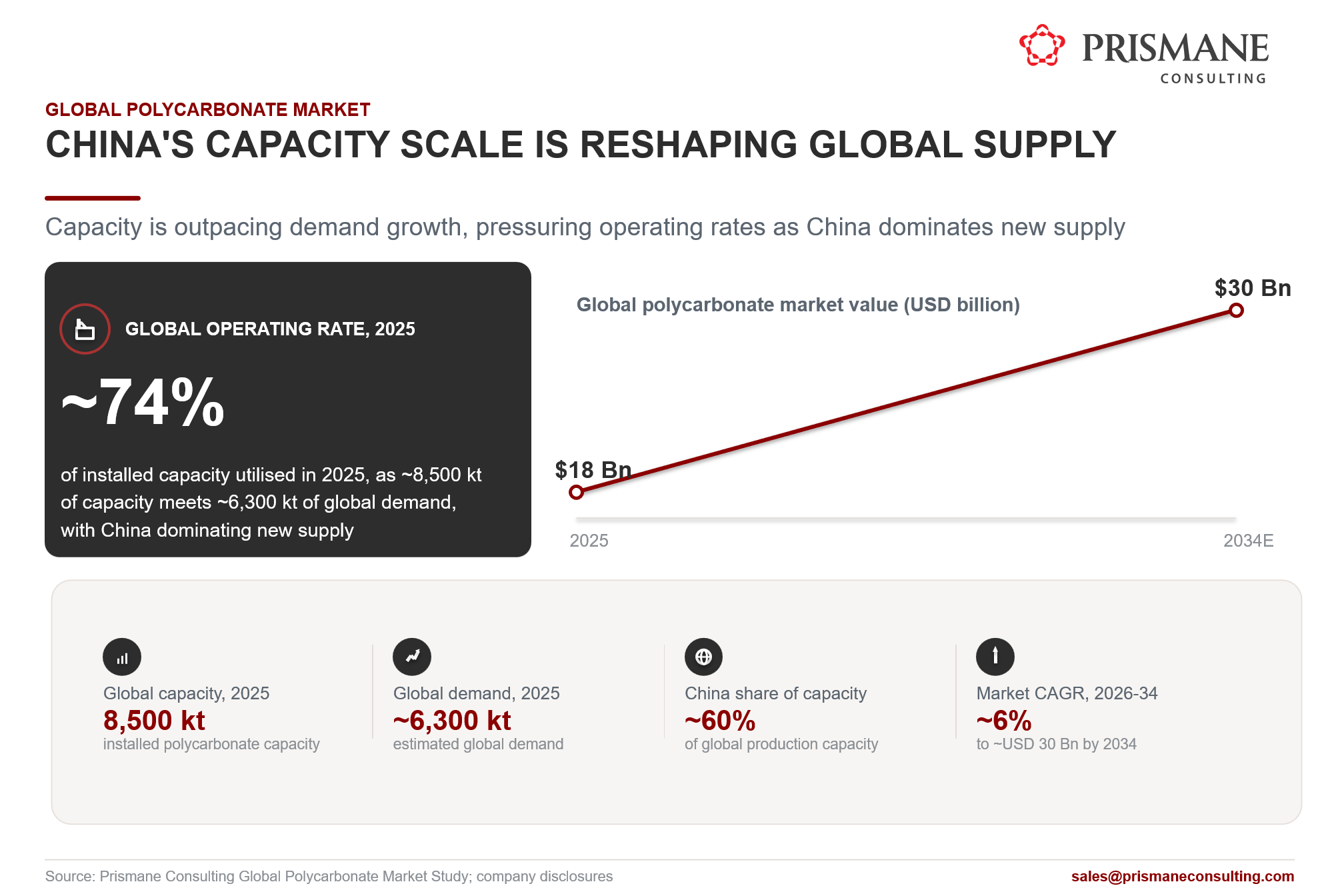
According to Prismane Consulting's latest Polycarbonate Market Model, global polycarbonate production capacity reached approximately 8,500 kilotons in 2025, while global demand was estimated at approximately 6,300 kilotons. This resulted in a global operating rate of around 74%. China alone accounted for approximately 60% of global production capacity and continues to dominate announced capacity additions through 2035.
The result is a market where future competitiveness will depend on much more than simply adding capacity.
China is changing the global polycarbonate supply balance
China has become the central market in the global polycarbonate industry.
The country's rapid capacity expansion has fundamentally changed the traditional supply and demand structure of polycarbonate. China is no longer simply a major consumer of the material. It is increasingly one of the most important sources of global supply.
Prismane Consulting's latest analysis indicates that China accounts for approximately 60% of global polycarbonate production capacity and continues to dominate announced capacity additions through 2035.
This expansion initially supported import substitution as domestic production replaced material previously sourced from overseas suppliers. However, continued capacity growth is increasingly creating pressure to find export markets for additional production.
That shift has important implications for producers outside China.
A growing Chinese supply base can influence international trade flows, regional pricing and operating rates, particularly when demand growth in mature markets does not keep pace with new capacity.
China's expansion is also extending beyond conventional commodity resin.

CNOOC and Shell's expansion in Huizhou includes a 320 kilotons per year facility covering high-performance specialty chemicals including polycarbonates and carbonate solvents. The development illustrates how China's petrochemical sector is moving further into higher value materials alongside its broader capacity expansion.
China's polycarbonate story is therefore becoming both a volume story and a value chain story.
India is moving from import dependence toward domestic polycarbonate production
India represents another important development in the global polycarbonate market.
The country has historically relied heavily on imports to meet domestic demand. Prismane Consulting estimated India's polycarbonate demand at approximately 273 kilotons in 2023, with consumption supported by construction, automotive, electrical and electronics and other engineering plastics applications. India has also seen strong growth in polycarbonate imports over recent years.
Deepak Chem Tech's planned 165 kilotons per year polycarbonate facility represents a significant change for the domestic market.
The plant is expected to commence operations around 2028 and will leverage technology acquired through its partnership with Trinseo. Deepak has also built a position in polycarbonate compounds through its acquisition of OXOC Chemicals, creating a downstream connection between resin and compounding.
The significance of the project goes beyond its nominal capacity.
Deepak is developing the polycarbonate project alongside upstream phenol and acetone production. This creates an integrated feedstock position and potentially provides a stronger cost base than a standalone resin operation.
This is particularly important because feedstock economics can have a major influence on polycarbonate competitiveness. As Prismane Consulting’s recent analysis of the engineering thermoplastics market highlights, margins are often determined as much by feedstock economics as by resin pricing.
However, India's new production capacity is unlikely to eliminate import dependence immediately.
Prismane Consulting’s India analysis estimates that Deepak's project could offset approximately 30% to 40% of India's polycarbonate imports, while a significant portion of the new production is expected to support downstream compounding.
Haldia Petrochemicals has also announced plans for a polycarbonate production facility in West Bengal. The project is strategically interesting because Haldia already produces phenol and acetone, providing another potential feedstock integration advantage.
Together, these developments could make India an increasingly important polycarbonate production and processing hub in Asia.
For a deeper look at India's emerging domestic polycarbonate industry, see Prismane Consulting's analysis, The Emerging Polycarbonate Market in India: A Game Changer for Domestic Manufacturing.
Capacity rationalization is reshaping mature markets
While China and India are expanding their positions in the polycarbonate value chain, producers in mature markets are facing a different challenge.
High production costs, excess regional supply and changing trade flows are forcing producers to reconsider the economics of individual assets.
Mitsubishi Gas Chemical has announced plans to discontinue operations at its 120 kilotons per year polycarbonate facility at Kashima in Japan in 2028. The decision reflects the broader pressure facing producers operating in markets where capacity utilization and profitability have become increasingly difficult to sustain.
The same structural pressure is visible in Europe.
Trinseo has moved to close a polycarbonate line at its Stade site in Germany, citing an uncompetitive position in the global polycarbonate market. The company has also indicated that remaining polycarbonate production will increasingly support its downstream compounding activities rather than the more volatile merchant market.
This is an important signal for the industry.
Capacity is not disappearing because polycarbonate is becoming less relevant. Instead, production is increasingly being concentrated in locations and businesses where producers can achieve better feedstock economics, higher utilization, stronger integration or greater value through downstream applications.
The industry is therefore entering a period of capacity reallocation rather than simple capacity growth.
From commodity resin to specialty materials
One of the most important changes in the polycarbonate market is the shift away from competing on undifferentiated resin alone.
The recent restructuring of engineering thermoplastics provides a useful illustration.
Prismane Consulting's analysis of the Mutares acquisition of SABIC's regional Engineering Thermoplastics business highlights a broader change in how the industry is creating value. The business includes polycarbonate, ABS, PBT and specialty compounds, but its future competitiveness will depend increasingly on operating costs, asset utilization, differentiated grades, technical support, downstream compounding and customer relationships rather than installed capacity alone.
For polycarbonate producers, this distinction is becoming increasingly important.
More than 45% of global polycarbonate consumption is used in natural resin form, while the remainder undergoes compounding or blending, according to Prismane Consulting's market analysis.
This creates opportunities for producers and compounders to capture additional value downstream.
Automotive components, electrical and electronics products, medical applications and other demanding end uses increasingly require specific combinations of impact resistance, thermal stability, optical properties, flame retardancy and dimensional stability.
The competitive landscape is therefore changing.
Resin cost remains important, but material performance, technical support, customer qualification, application development and downstream integration can be equally important.
The response of Trinseo is instructive. Rather than relying solely on merchant polycarbonate sales, the company is moving remaining production toward downstream compounding and specialty applications.
This suggests that the most durable competitive positions may increasingly be built around resin plus compounding plus application expertise, rather than resin capacity alone.
Polycarbonate demand is becoming increasingly application driven.
The demand side of the polycarbonate market is changing alongside supply.
According to Prismane Consulting, electrical and electronics is the largest application area, accounting for more than 35% of global polycarbonate demand. Construction represents roughly 25%, while automotive accounts for more than 16%.
These applications are not growing at the same pace.
Electrical and electronics demand is benefiting from electrification, connected devices, semiconductor investment, data infrastructure and increasing electronics content across multiple industries.
Automotive is becoming increasingly important as vehicle manufacturers adopt lightweight materials and use polycarbonate and polycarbonate-based compounds in headlamps, glazing, interior components, instrument panels and other applications.
The transition toward electric vehicles creates additional opportunities through lightweighting, electrical components, sensors, battery related applications and thermal management.
Construction remains an important volume application, particularly for polycarbonate sheets and related products. Prismane forecasts construction demand to grow at approximately 5% CAGR through 2034.
The future of the polycarbonate market will therefore increasingly depend on where demand is growing rather than simply on total global consumption.
Regional competitiveness is becoming more important
The geographic structure of the polycarbonate industry is also changing.
China's scale advantage is increasingly influencing global supply and trade flows, while India is building domestic production capabilities. At the same time, producers in North America and Europe are reassessing assets that are exposed to high costs or merchant market competition.
This is creating a more regionalized competitive environment.
Customers increasingly want supply security alongside competitive pricing. Shorter supply chains, regional production, technical support and the ability to respond quickly to customer requirements can all provide advantages.
Prismane Consulting’s recent engineering thermoplastics analysis highlights this broader shift toward regional competitiveness. Manufacturing location is becoming an increasingly important differentiator as customers seek to reduce exposure to logistics disruptions, geopolitical risk and long international supply chains.
For polycarbonate producers, this means that global scale and regional positioning need to be evaluated together.
Circular polycarbonate is becoming a strategic market
Another structural shift influencing the polycarbonate industry is the growing demand for recycled and circular materials.
Automotive manufacturers, electronics companies and consumer brands are increasingly specifying recycled content in new product development.
This transition is being supported by regulatory developments, corporate sustainability commitments and evolving customer expectations.
Major producers including Covestro, SABIC and LG Chem are investing in mechanical recycling, chemical recycling and certified circular feedstock solutions.
The challenge is that high-quality recycled polycarbonate is more difficult to produce than recycled commodity plastics.
Engineering applications require consistent material properties, traceability and reliable supply. Automotive and electronics customers also require stringent quality and qualification standards.
Prismane Consulting expects recycled engineering thermoplastics to grow significantly faster than virgin materials over the coming decade, with demand for recycled engineering thermoplastics projected to grow at approximately 10% CAGR through 2035.
As a result, companies that can secure high-quality post-consumer feedstock and establish reliable recycling systems may gain an important competitive advantage.
The opportunity extends beyond recycled resin.
Closed loop systems can allow producers and customers to recover material from end-of-life products and return it to new applications. This creates the possibility of a circular polycarbonate value chain in which material suppliers become more closely integrated with converters, OEMs and recyclers.
Circularity is therefore becoming more than an environmental objective.
It is becoming a competitive differentiator.
Polycarbonate capacity growth will remain concentrated in Asia Pacific
The geographic structure of the industry is becoming increasingly Asia centric.
Prismane Consulting expects most future polycarbonate capacity additions to come from Asia Pacific, with China accounting for the largest share of announced additions.
The region combines several structural advantages.
It has the world's largest manufacturing base, strong automotive and electronics industries, large domestic consumer markets and significant existing petrochemical infrastructure.
India is also emerging as a new production location as domestic manufacturers seek to reduce import dependence and integrate into higher value engineering plastics chains.
This creates an important contrast with mature markets.
North America and Europe are increasingly focused on improving utilization, rationalizing structurally disadvantaged assets, developing specialty products and expanding circular materials.
Asia Pacific, meanwhile, is combining demand growth with new production capacity.
The result is a gradual shift in the global balance of polycarbonate production, consumption and trade.
What does this mean for polycarbonate producers?
The polycarbonate industry is entering a more competitive phase.
Capacity growth will continue, particularly in Asia, but global operating rates could remain under pressure if demand growth does not keep pace with new production.
China's expanding supply base will influence international trade flows and pricing.
India's emergence as a domestic producer will gradually reduce import dependence while creating new opportunities in compounding and downstream applications.
Capacity rationalization in mature markets will remove some higher cost production from the global market.
At the same time, automotive, electrical and electronics applications will continue to create demand for higher performance grades.
Circular polycarbonate will become increasingly important as regulatory requirements and customer sustainability targets increase.
The strategic winners are therefore unlikely to be defined simply by production capacity.
They will be the companies that combine competitive manufacturing economics with feedstock integration, specialty products, application development, regional supply security and access to circular raw materials.
The Prismane Consulting view
Prismane Consulting's market research indicates that the global polycarbonate industry is moving into a period where capacity, utilization, trade flows, feedstock economics and application mix must be considered together.
The headline growth of the market can hide significant differences between regions.
China's capacity expansion is creating a fundamentally different supply environment from the one that existed a decade ago. India is beginning to build a domestic production base after years of import dependence. Mature markets are rationalizing capacity while focusing increasingly on specialty materials.
At the same time, customers are placing greater value on supply security, technical collaboration and sustainability alongside competitive pricing.
The recent Mutares acquisition of SABIC's regional Engineering Thermoplastics business provides another indication of this broader shift. The transaction does not change the underlying assets or end markets, but it highlights how ownership, operating efficiency, feedstock strategy, downstream integration and regional positioning can influence the future competitiveness of engineering plastics businesses.
For a broader perspective on this shift across PC, ABS and PBT, read Prismane Consulting's Mutares Acquires SABIC Engineering Thermoplastics: What the Deal Reveals About the Future of the Engineering Plastics Market.
The Global Polycarbonate Market Study by Prismane Consulting
Prismane Consulting's Global Polycarbonate Market Study provides a detailed assessment of the global polycarbonate industry across demand, supply, capacity, production, operating rates, trade flows, pricing and end use applications.
The study covers major countries and regions and evaluates historical market developments alongside current market conditions and long-term forecasts.
Prismane Consulting’s latest market assessment values the global polycarbonate market at approximately USD 18 billion in 2025 and forecasts it to reach approximately USD 30 billion by 2034, representing a CAGR of around 6% between 2026 and 2034. Asia Pacific is expected to remain the dominant production and consumption region.
The study also examines industry and policy developments, competitive dynamics, new capacity additions, market rationalization and strategic opportunities across the polycarbonate value chain.
For producers, compounders, converters, investors and companies evaluating new polycarbonate opportunities, the key question is no longer simply how large the market will become.
The more important questions are where the growth will occur, where new capacity will be added, how trade flows will change, which assets remain competitive and which applications will generate the highest value.
That is where detailed market intelligence becomes critical.
About Prismane Consulting
Prismane Consulting is a market intelligence and strategy consulting firm specializing in chemicals, petrochemicals, polymers, advanced materials, energy and sustainability. Through proprietary market models covering capacity, demand, operating rates, trade flows, pricing and end use applications, Prismane Consulting helps companies understand structural market shifts and make informed strategic decisions across global chemical value chains.
To discuss the Global Polycarbonate Market Study or request a sample, please get in touch at sales@prismaneconsulting.com.