
Recycled Automotive Plastics Are Moving From Sustainability Pledges to Production Parts
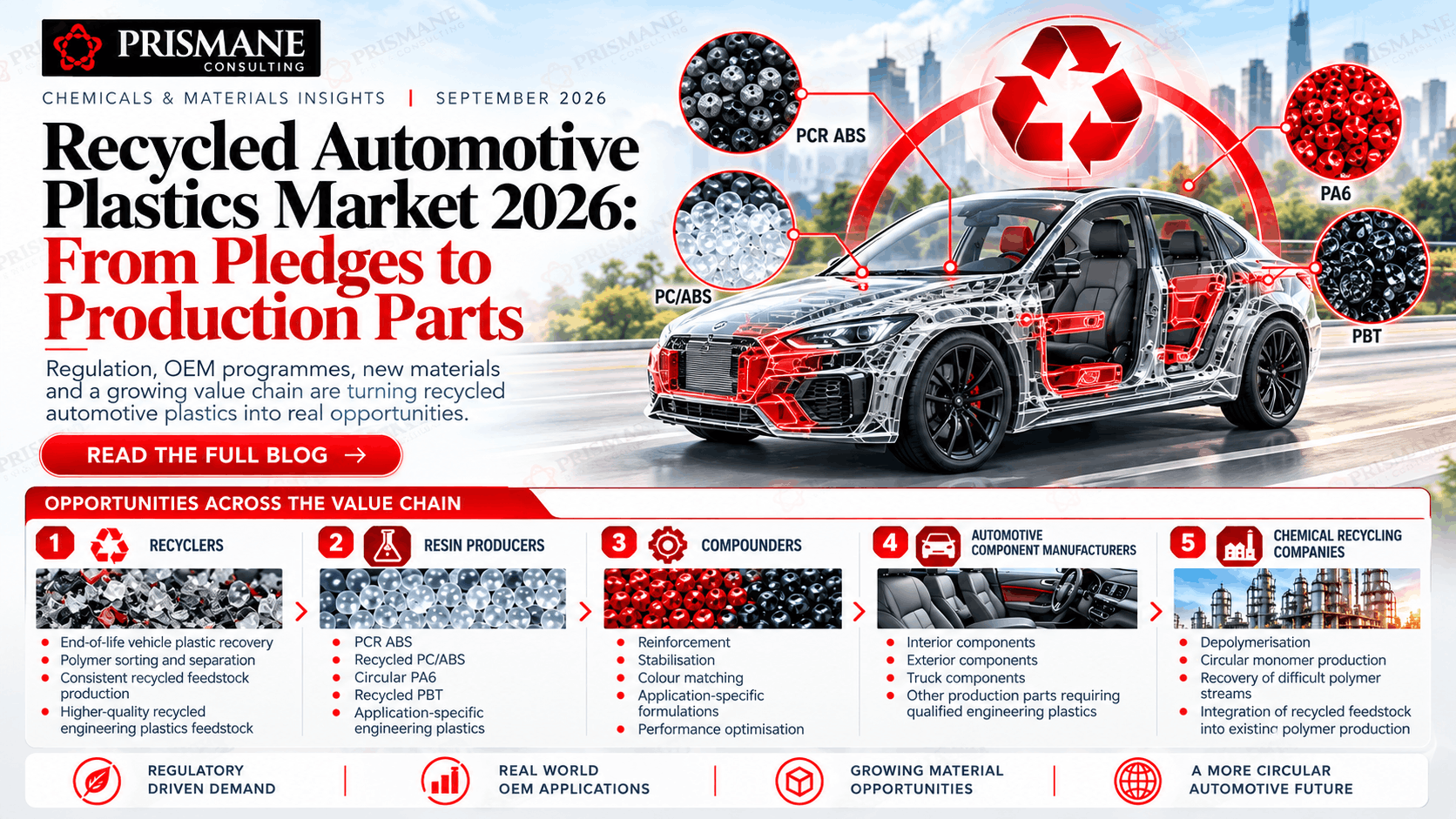
The recycled automotive plastics market is moving beyond sustainability commitments and into material qualification, supply chains and production applications. In 2026, car makers, resin producers, compounders and recyclers are increasingly working together to develop recycled materials that can meet automotive performance requirements.
The shift is visible across the automotive materials value chain: recycled PC/ABS in a Lexus interior, circular PA6 development from end-of-life vehicle plastics, truck components made from recycled rigid plastics, and a new ABS and engineering plastics partnership between LG Chem and Volkswagen Group. For automotive engineering plastics, recycled content is increasingly moving from a sustainability claim towards a material specification.
The important question is no longer simply how much automotive plastic can be recycled. It is how much recycled material can be converted into consistent, qualified and production-ready engineering plastics and compounds.
Regulation Has Turned Recycled Content Into a Design Requirement
The EU's new End-of-Life Vehicles Regulation is changing the context for the recycled automotive plastics market. The Council of the European Union formally adopted the regulation on 29 June 2026. Under the new rules, at least 15% of the plastic used to manufacture new vehicles must come from recycling six years after the regulation enters into force, rising to 25% after ten years. At least 20% of that recycled plastic must come from end-of-life vehicles or from parts removed from vehicles during their use phase.
The closed-loop requirement is particularly important. Recycled plastic from packaging, appliances or other post-consumer sources can contribute to recycled content, but it cannot by itself satisfy the requirement for material recovered from vehicles.
This creates a different procurement challenge for automakers. The industry needs to establish reliable routes from end-of-life vehicles back into vehicle manufacturing while ensuring that recovered polymers can meet the performance requirements of new components.
The targets are phased in over several years, but qualification takes time. Material suppliers, recyclers and compounders therefore have an incentive to develop and qualify solutions well before the regulatory thresholds become binding for new vehicle programmes. For the market, this is significant because regulation is beginning to influence material selection and product development, rather than simply corporate sustainability targets.
Premium Interiors Have Shown That Recycled PC/ABS Can Meet the Specification
Visible interior parts are a demanding application for recycled plastics because color, surface quality, dimensional stability and processing consistency all matter. A June 2026 development provides a concrete example. Covestro announced that its Bayblend T85X R35 CQ polycarbonate/ABS material, containing 35% post-consumer recycled content, had been adopted for selected interior components of the Lexus ES.
The material was developed through collaboration between Toyota Motor Corporation, Toyota Motor Kyushu, Kojima Industries and Covestro. Covestro says the material meets requirements for durability, surface quality, dimensional stability and processability within existing manufacturing processes. The company also reports a 25% reduction in global warming potential compared with conventional fossil-based alternatives, based on its internal calculations.
One vehicle model does not represent the entire recycled automotive plastics market. It does, however, provide a commercial example that recycled PC/ABS can be engineered for demanding interior applications.
The challenge for recycled engineering plastics is not simply increasing recycled content. The material must still behave like a specified engineering plastic within the manufacturing process and final component.
For PC/ABS, this creates a direct connection between the polycarbonate, ABS, engineering plastics and recycled plastics markets. As more automotive components move towards recycled grades, material suppliers need to balance recycled content with appearance, durability, dimensional stability and processing performance.
ABS Producers Are Linking Recycled Grades With OEM Development Programmes
The latest LG Chem and Volkswagen Group agreement adds another dimension to the recycled automotive plastics market. On 28 September 2026, LG Chem announced that it had signed an MOU with Volkswagen Group to explore next-generation plastics and composite materials for future mobility. The cooperation covers lightweighting and performance improvements using LG Chem's ABS and engineering plastics, alongside ways to expand the use of post-consumer recycled materials and cost-efficient material solutions in interior and exterior components across major Volkswagen Group automotive brands.
LG Chem says it has 2.4 million tons of annual ABS production capacity globally and a portfolio that includes high-gloss, high-heat-resistant and paintless ABS grades for customer-specific applications. The important point is not that the MOU creates immediate recycled ABS demand. It does not disclose volumes or a commercial supply commitment.
Its significance is that recycled content is being considered alongside weight, performance and cost within an OEM material development programme. For ABS producers, the growth opportunity is therefore not necessarily limited to supplying more resin. It can extend into:
- Post-consumer recycled ABS grades
- Reinforced materials
- Engineering compounds
- Application-specific formulations
- Materials capable of passing OEM qualification
This is where the market increasingly intersects with the wider engineering plastics market. Recycled ABS may become more relevant as an input for components where OEMs need a combination of recycled content, weight reduction, surface performance and cost control.
Chemical Recycling Is Being Developed for Difficult Engineering Plastic Waste Streams
End-of-life vehicle plastics can contain mixed polymers, reinforcement fibres, additives and contamination. These characteristics can limit the applications for mechanically recycled material, particularly where demanding engineering specifications need to be maintained.
Chemical recycling is therefore being developed as another route for selected polymer streams. On 25 August 2026, Envalior and SECARA announced an MOU to develop a route for converting end-of-life vehicle plastics into circular PA6 for automotive applications. SECARA's catalytic depolymerization technology is intended to produce high-purity caprolactam that can be used directly in Envalior's existing PA6 production process. If successfully scaled, the companies say the approach could enable circular PA6 while maintaining the performance requirements of automotive applications.
This remains a development-stage initiative rather than established commercial-scale supply. The economics of chemical recycling will ultimately depend on factors including:
- Feedstock availability
- Collection and sorting
- Process yield
- Energy requirements
- Product quality
- Cost competitiveness of the resulting polymer
There is therefore unlikely to be one recycling route for all automotive engineering plastics. Mechanical recycling can remain important for suitable streams, while depolymerization and other advanced recycling technologies may address polymer streams where maintaining virgin-like material properties is more difficult.
The resulting market could therefore develop around multiple recycling pathways, with the appropriate route depending on polymer type, waste quality, application requirements and economics.
Compounding Is Becoming the Bridge Between Recycled Polymer and Finished Part
Recycling a polymer is only the first step. The material still needs to be converted into a formulation that can meet the requirements of a specific automotive component. A development announced by Renewi and VDL Parree in August 2026 illustrates this value chain. Renewi processes end-of-life rigid plastics into plastic granulates. The Compound Company then converts the recycled material into an application-specific compound, which VDL Parree uses to manufacture truck components. Renewi described the project as the first use of its recycled plastic in an automotive component.
This makes compounding an important link between recycled feedstock and production-ready materials, particularly where OEMs require consistent performance and tight material specifications. A similar direction is visible in BASF's 2026 engineering plastics portfolio. The company is introducing new Ultradur RC PBT grades containing up to 30% post-consumer PET for automotive applications, alongside other engineering plastics designed for demanding applications.
The value opportunity is therefore moving beyond recycling alone. Recyclers need to produce consistent feedstock, compounders need to formulate that feedstock into materials that meet application requirements, and OEMs and Tier 1 suppliers then need to qualify those materials for production. For the market, this creates opportunities across the material chain rather than only at the recycling stage.
What It Means for the Recycled Automotive Plastics Market
The developments across ABS, PC/ABS, PA6, PBT and recycled rigid plastics point to a common direction. Regulation is creating a long-term requirement for recycled content. OEM qualification is converting recycled materials from concepts into specific component applications. Engineering plastics are creating higher performance requirements for recycled feedstock, while chemical recycling is being developed for polymer streams where mechanical recycling may not be sufficient for demanding applications.
Compounding is becoming particularly important because recycled polymers rarely move directly from a recycling process into a finished automotive component. Formulation, reinforcement, stabilization, color and processing characteristics can all determine whether a recycled polymer can meet the specification of a production part.
The global Acrylonitrile butadiene styrene (ABS) market was valued at USD 27.2 billion in 2025 and is projected to exceed USD 43 billion by 2034, growing at a 5.5% CAGR between 2026 and 2034. Recycled grades are expected to become an increasingly important part of the market as automotive qualification expands. The value opportunity is likely to extend across recyclers that can deliver consistent feedstock, compounders with formulation expertise and chemical recyclers that can demonstrate industrial-scale economics.
However, the pace should not be overstated. The EU recycled-content requirements are phased in over a decade. The LG Chem and Volkswagen cooperation is an MOU rather than a disclosed commercial volume commitment. The Envalior and SECARA initiative is still being developed. The Lexus ES example demonstrates commercial adoption, but it covers selected components rather than an entire vehicle.
The key challenge is therefore shifting from simply developing recycling technology to securing qualified, consistent and economically viable recycled feedstock at automotive scale.
Qualification Is Becoming a Critical Competitive Factor
The transition to recycled automotive plastics is not simply a recycling challenge. Automotive materials must meet specific requirements for processing, durability, appearance, dimensional stability and application performance. As recycled grades move into production components, material qualification becomes an important bridge between sustainability objectives and commercial adoption.
This is particularly relevant for engineering plastics, where changes in feedstock quality can affect formulation and final component performance. The Lexus example demonstrates how recycled PC/ABS can move into a demanding interior application when material properties and manufacturing requirements are addressed together.
Similarly, the LG Chem and Volkswagen development shows how recycled content is being considered alongside performance, lightweighting and cost within OEM material development programmes.
For suppliers, this creates an important distinction between available recycled material and qualified recycled material. The commercial opportunity will increase depend on the latter.
The Next Phase of Automotive Plastics Circularity
The recycled automotive plastics market is entering a phase where regulatory requirements, OEM development programmes, recycling technologies and material formulation are beginning to converge.
The direction of travel is visible across several polymer systems:
- ABS and PC/ABS: Increasing attention to PCR grades and OEM qualification
- PA6: Development of circular routes from end-of-life vehicle plastics
- PBT: Expansion of recycled-content engineering grades
- Rigid plastics: Movement from recovered feedstock towards application-specific compounds
- Engineering plastics: Greater emphasis on consistency and production qualification
The resulting market will not be defined by recycling volumes alone. The more important question is how effectively recycled feedstock can move through recovery, sorting, processing, compounding, qualification and production.
Recycled Automotive Plastics Market Outlook
The recycled automotive plastics market is moving from a sustainability-led discussion toward materials and supply-chain opportunity. Regulation is establishing minimum recycled-content requirements. Automotive manufacturers are beginning to evaluate recycled grades within specific applications. Material producers are developing recycled and circular engineering plastics, while recyclers and compounders are working to create feedstock and formulations capable of meeting production requirements.
At the same time, the market remains in transition. Not every announced project will translate into large-scale commercial demand. Qualification cycles remain lengthy, recycling economics remain important, and consistent feedstock availability can constrain scale.
The next stage of market development will therefore depend on the industry's ability to combine recycled content with performance, qualification, supply reliability and economics.
For automotive plastics, the defining question is no longer simply how much plastic can be recycled. It is how much recycled material can be converted into qualified engineering plastics and compounds that carmakers can use in production parts.
Prismane Consulting Perspective
The recycled automotive plastics market is becoming an increasingly integrated part of the broader automotive materials value chain. For recyclers, the opportunity lies in producing consistent and application-relevant feedstock. For resin producers and compounders, it lies in developing recycled grades that can meet demanding specifications. For automotive manufacturers and Tier 1 suppliers, the focus is on qualifying these materials for production while meeting regulatory and sustainability requirements.
This creates a market where material technology, recycling capability and application qualification are increasingly intersect.
Prismane Consulting tracks the global ABS, polycarbonate and engineering plastics value chains, including recycled grades, through its Chemicals & Materials practice.
Are you a polymer producer, recycler, compounder, automotive component manufacturer or technology provider evaluating opportunities in recycled automotive plastics?
Prismane Consulting supports clients with:
- Market sizing and forecasting
- Recycled polymer demand analysis
- Manufacturer benchmarking
- Competitive landscape analysis
- Recycling technology assessment
- Application opportunity analysis
- Feedstock and supply-chain analysis
- Regional opportunity assessment
- Market-entry strategy
Explore Prismane Consulting's Global Recycled Automotive Plastics Market Study for deeper analysis of the value chain, market dynamics and growth opportunities. Contact sales@prismaneconsulting.com