
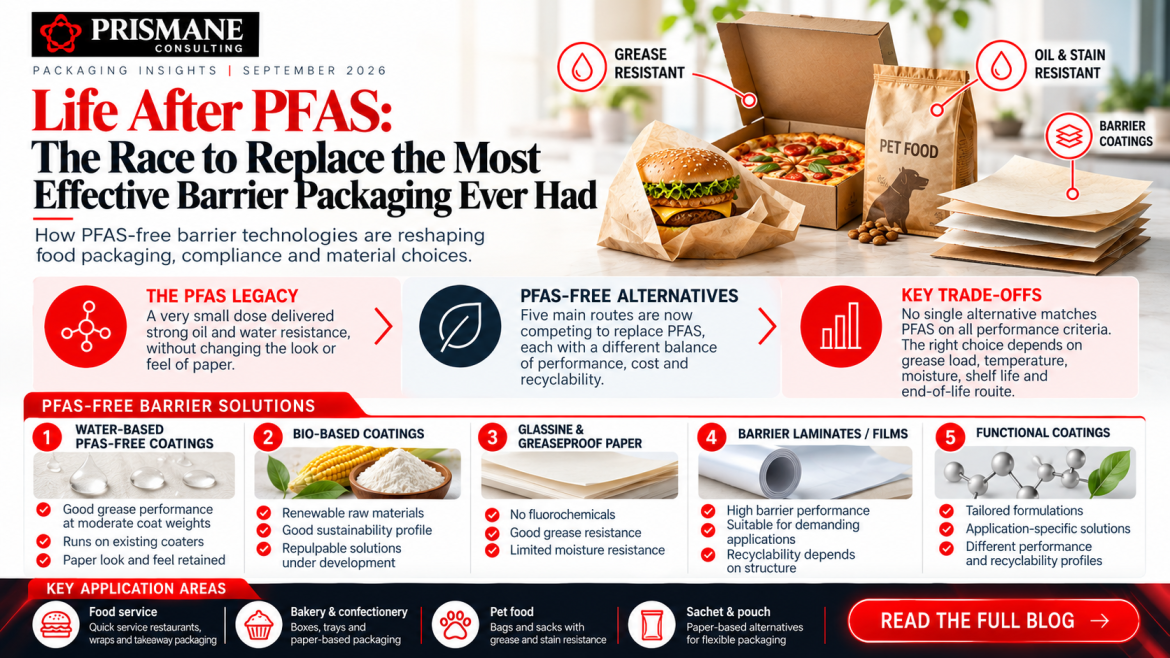
For more than 50 years, one invisible chemistry kept grease off your fingers. It kept burger wrappers clean, pizza boxes from turning translucent and pet-food bags from staining on the shelf. Since 12 August 2026, that chemistry is effectively banned from food packaging sold in the European Union.
The real story is not that PFAS is gone. It is that nothing yet does everything PFAS did, at the price PFAS did it. The industry now has to rebuild that performance in PFAS-free packaging from several imperfect parts. For converters, brand owners and material suppliers, PFAS-free packaging has moved from a sustainability talking point to a condition of market access. It is also one of the clearest growth opportunities in paper-based packaging this decade.
This article from the Prismane Consulting Packaging Practice looks at what the rules demand, how the leading alternatives compare, where the hidden risks sit and what companies should do in the next 12 months.
Why PFAS Was So Hard to Beat
PFAS (per- and polyfluoroalkyl substances) are a family of thousands of fluorinated chemicals. In paper and board, a very small dose of fluorochemical treatment lowers the surface energy of the fibres. Oil and water simply bead up and run off.
Three properties made PFAS almost impossible to displace on cost alone:
- Tiny dose, big effect. A light treatment delivered strong oil and grease resistance without changing the look or feel of the paper.
- Oil and water resistance together. Most alternatives are good at one and weaker at the other.
- Invisible to recycling. Because PFAS treatment added so little mass, treated board could still be repulped, even though the chemistry travelled with the fibre.
That last point is now the problem. PFAS do not break down easily, they accumulate in people and the environment, and they move into food. Regulators have decided the grease barrier is not worth the persistence. That leaves PFAS-free packaging as the only viable route for food service and many food brands.
The Regulatory Clock Is Already Running
The EU Packaging and Packaging Waste Regulation (PPWR), Regulation (EU) 2025/40, started to apply on 12 August 2026 with no grace period. For food contact packaging, it sets three PFAS limits: 25 ppb for any single targeted PFAS, 250 ppb for the sum of targeted PFAS and 50 ppm for total fluorine, which captures polymeric PFAS as well.
PPWR compliance does not stop at PFAS, and the later deadlines matter just as much for material choice.

Source: European Commission and published PPWR compliance timelines.
The EU is not alone. Denmark banned PFAS in paper and board food contact materials in 2020, and several US states, including California and New York, have restricted intentionally added PFAS in food packaging. For exporters, including India's large base of paper, board and flexible packaging converters, the result is the same. PFAS-free packaging is becoming the global specification, not a regional one.
The Contenders: How PFAS-Free Barrier Coatings Compare
For PFAS-free packaging, there is no single drop-in replacement. The market is splitting into five routes, each with a different balance of performance, cost and recyclability. The best choice depends on the grease load, temperature, moisture, shelf life and end-of-life route of each pack.

Ratings are indicative and depend on grade, coat weight and application. Validate them against your own test data.
Three patterns stand out.
First, water-based PFAS-free barrier coatings are the volume winner. They run on existing coaters, keep the paper look, and can reach good grease performance at moderate coat weights. The trade-off is that higher coat weights, used to chase PFAS-level performance, can hurt repulpability.
Second, bio-based coatings have the best story but the narrowest window. Research groups and start-ups are developing starch, chitosan and wax-replacement chemistries that repulp cleanly. Most still struggle with hot, oily and wet foods together.
Third, grease-resistant paper made by refining alone is having a comeback. Glassine and dense greaseproof papers use no fluorochemicals at all. Their weakness is moisture, which limits them to drier applications.
Each of these PFAS-free barrier coatings and papers solves part of the problem. None solves all of it for every pack. That is why the winners will be the suppliers who can match a barrier to a use case, rather than promising a universal fix.
The Hidden Traps in the Switch
Moving to PFAS-free packaging looks simple on paper: change the coating, run a trial, update the spec. In practice, three traps catch companies out.
1. Recycled fibre can carry legacy fluorine
The 50 ppm total-fluorine limit counts all fluorine, not only what you added on purpose. Recovered paper that once contained PFAS-treated board can bring fluorine back into new board. A converter can use a certified fluorine-free coating and still fail a total-fluorine screen. Fibre sourcing and incoming-material testing now belong in PPWR compliance, not just in coating selection.
2. Testing is two-tier, and screening is not proof
Laboratories typically start with a total-fluorine screen. If the result exceeds 50 ppm, the company must provide technical documentation showing the fluorine does not come from PFAS, or must reformulate. Brand owners are already asking suppliers for this evidence as part of food contact packaging approvals. Suppliers without test files risk losing tenders, whatever their coating claims.
3. Solving PFAS can create a recyclability problem
The easiest way to replace PFAS performance is to add plastic: a heavier dispersion coat, an extrusion layer or a film laminate. Each makes grease-resistant paper perform better today. Each can also push a pack towards a lower recyclability grade before 2030. A switch made in a hurry in 2026 could need to be redone in 2029. The smarter approach treats PFAS-free packaging and design for recycling as one project.
Where Demand Is Heading
Demand for PFAS-free packaging will not grow evenly. Our view in the Prismane Consulting Packaging Practice is that four segments will drive the transition:
- Quick-service restaurants and food service. High volumes of wraps, bags, clamshells and cups, plus strong regulatory and public pressure. Water-based coatings dominate here.
- Bakery and confectionery. A natural fit for glassine, greaseproof and bio-based grease-resistant paper, where moisture loads are low.
- Pet food. One of the toughest applications, with high fat content, long shelf life and heavy bags. Expect laminates and high-performance dispersion coatings to compete hard.
- Plastic sachet and pouch replacement. Brands moving from plastic to paper need PFAS-free barrier coatings that also give moisture and oxygen protection. This is where the next wave of innovation is focused.
Supply-side activity around PFAS-free packaging backs this up. Coating suppliers are forming regional partnerships to serve Japan and wider Asia, universities are publishing bio-based wax-replacement coatings, and paper mills are marketing fluorine-free grades as standard rather than premium.
One caution on sizing the PFAS-free packaging market. Published estimates for this space vary widely because reports define it differently. Some count only PFAS-free grease-resistant paper, while others count all PFAS-free food packaging. Before building a business case, be clear about which market you are sizing. The difference can be more than an order of magnitude.
What Converters and Brand Owners Should Do Now
Companies that treat PFAS-free packaging as a compliance tick-box will spend twice: once to switch and again to fix recyclability. A more durable plan covers five steps.
- Map your exposure. List every SKU with a grease or moisture barrier and every market it enters. Flag food contact packaging sold into the EU and into US states with PFAS rules.
- Test before you switch. Run total-fluorine screening on current packs, incoming fibre and candidate coatings. Build the technical file PPWR compliance requires before buyers ask for it.
- Match the barrier to the use case. Test grease, moisture and heat performance under real conditions: temperature, fat level, hold time and stacking. Do not rely on a supplier's data sheet alone.
- Check recyclability early. Get repulpability and recyclability assessments on the new structure. A pack that passes PFAS limits but fails the 2030 grade is only a temporary fix.
- Lock in supply. Qualify at least two suppliers of PFAS-free barrier coatings or grease-resistant paper. Capacity for high-performance grades is still building, and late movers will pay more.
For Indian and other Asian exporters, speed matters in the move to PFAS-free packaging. EU buyers are passing PPWR compliance requirements down the supply chain now, not in 2030. Suppliers who can show test data and a recyclability pathway today will win share from those still waiting.
Conclusion: The Barrier Is Now a Strategy Decision
PFAS made grease resistance cheap and simple. Its removal makes it a design, sourcing and regulatory decision in one. The companies that do well in PFAS-free packaging will not just swap one chemical for another. They will redesign packs around performance, test evidence and recyclability at the same time.
PFAS-free packaging is no longer a niche. It is the new baseline for food packaging in Europe and a growing share of global markets. The question for every converter, coating supplier and brand owner is whether they will lead that shift or be forced into it.
How Prismane Consulting Can Help
The Prismane Consulting Packaging Practice supports clients with market sizing and forecasts for PFAS-free packaging, barrier coatings and specialty papers. We also provide competitive benchmarking of coating and paper suppliers, regulatory impact analysis and go-to-market strategy for new barrier technologies. Contact our Packaging Practice team to discuss a custom study or our latest market reports.