
India’s phenol market is moving from a structurally import-led model toward a mix of domestic production, captive downstream integration and strategically important imports. Prismane Consulting examines what the next phase means for merchant supply, acetone balances, trade flows, pricing and the competitiveness of the wider phenol value chain.
For most of the last decade, India’s phenol market could be described in a single sentence: demand grew faster than domestic capacity, and imports filled the gap.
That equation is now changing.
Prismane Consulting estimates India’s phenol consumption at approximately 650 kilotons per annum, with demand expected to grow at around 8% to 9% CAGR through 2030. To place that in context, Prismane Consulting’s global phenol assessment puts world demand at approximately 12,300 kilotons in 2025, growing at close to 2.2% CAGR through 2034.
India is therefore expected to grow at roughly four times the global rate.
Faster demand growth is the part of the story most commonly discussed. In our view, the more consequential change is happening on the supply side, and specifically in how that new supply will be used.
Domestic capacity is changing the supply equation
Deepak Phenolics has already established itself as the anchor domestic producer. Its existing phenol capacity has been expanded through debottlenecking, strengthening its position in the Indian market.
The next step change is now taking shape.
Haldia Petrochemicals’ upcoming phenol complex is designed for approximately 345 kilotons of phenol, with associated acetone production. The project also includes an on-purpose propylene plant based on olefin conversion technology, making it an integrated addition to India’s phenolics value chain. Haldia has described the project as its move into integrated phenolics production.
Deepak is simultaneously adding another 300 kilotons of phenol and 185 kilotons of acetone, alongside 100 kilotons of IPA. These additions are separate from its existing Deepak Phenolics capacity.
Together, these developments could materially alter India’s domestic supply balance within this decade.
But there is an important distinction that is often lost in market commentary.
Lower import dependence does not automatically mean lower imports in absolute terms.
Import dependence is a ratio.
Import volume is a number.
When the denominator is growing at 8% to 9% a year, the two can move in opposite directions.
Demand growth could absorb a significant portion of new supply
Prismane Consulting estimates that Indian phenol demand could approach approximately 900 kilotons by 2030.
Phenolic resins remain a major demand segment, supported by construction, automotive, laminates, plywood, friction materials and industrial applications.
Growth in bisphenol-A and polycarbonate, caprolactam and other derivatives is expected to add further pull on the phenol chain.
The arithmetic is worth setting out plainly.
If demand reaches approximately 900 kilotons and imports account for roughly 30% of the market, India would still require in the region of 270 kilotons of imported phenol.
That is not an import-elimination story.
It is an import-substitution plus demand-growth story, and the two produce very different commercial outcomes for traders, importers and downstream buyers.
Our assessment of demand-side dynamics across the derivative chain draws on Prismane Consulting’s Phenolic Resins Market and Caprolactam Market studies, which track the end-use segments that ultimately determine phenol consumption.
The bigger shift is vertical integration, not volume
The next phase of India’s phenol market is not simply about producing more phenol.
It is about integrating phenol and acetone into downstream value chains.
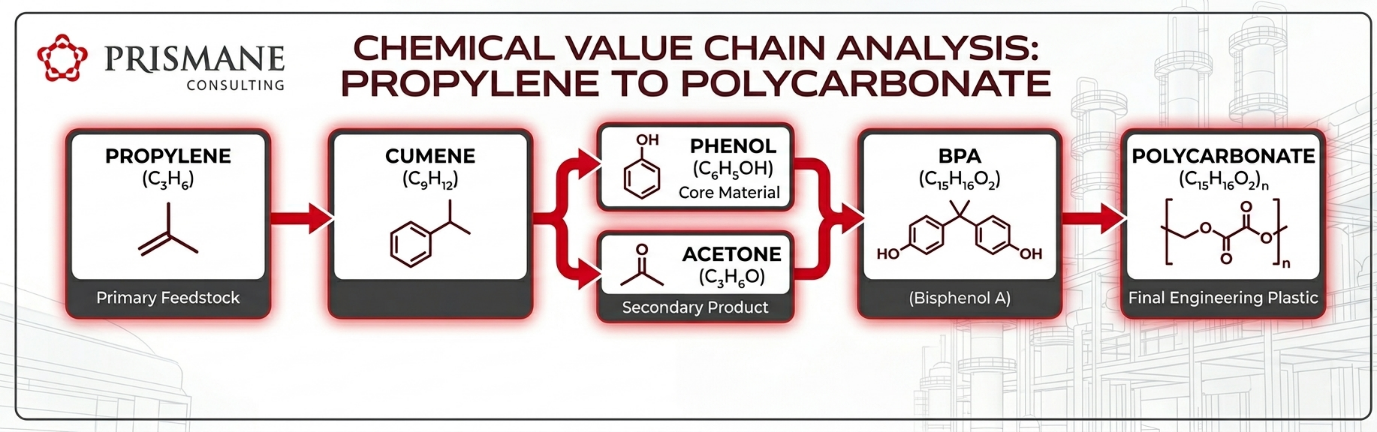
The emerging value-chain logic is straightforward:

Deepak is the clearest example of this strategy in the Indian market.
The company is developing a 165 kilotons polycarbonate resin facility alongside a new 300 kilotons phenol and 185 kilotons acetone complex, with the additional upstream capacity intended largely to support its downstream strategy. Deepak has also indicated that the new phenol and acetone capacity will support its move toward a more integrated polycarbonate value chain.
This changes the competitive equation in a fundamental way.
A producer selling phenol as a standalone product is primarily exposed to the phenol cycle.
A vertically integrated producer can capture value further downstream and reduce its dependence on merchant phenol economics.
In a cyclical intermediate, that difference in exposure can materially change the economics and resilience of an asset.
The implications extend well beyond phenol itself, into:
- Acetone availability
- BPA economics
- Polycarbonate imports
- Domestic polycarbonate production
- Downstream resin competitiveness
- Import substitution across several linked value chains
Which leads to the question we believe matters most:
How much of India’s new phenol capacity will actually be available to the merchant market?
If a meaningful share is consumed captively downstream, headline capacity growth may not translate into an equivalent increase in merchant supply.
Buyers who plan procurement strategy around announced capacity rather than available merchant capacity may therefore find the market tighter than the headline numbers suggest.
For a fuller view of how the downstream end of this chain is developing, see Prismane Consulting’s analysis of the Global Polycarbonate Market: China Capacity, India Expansion, Demand and Circularity Reshape the Industry and our earlier assessment, The Emerging Polycarbonate Market in India: A Game Changer for Domestic Manufacturing.
Acetone is the co-product that could influence operating rates
Phenol economics cannot be assessed in isolation because the cumene process produces acetone as a co-product at a fixed approximate ratio of 0.6 tons of acetone per ton of phenol.
This is where the Indian market becomes particularly interesting.
Haldia’s new complex will add a substantial volume of acetone alongside phenol, while Deepak is separately adding 185 kilotons of acetone alongside its new phenol capacity.
At the same time, deeper BPA integration can absorb part of the acetone co-product, since BPA production consumes both phenol and acetone.
The co-product balance can therefore become a critical swing factor in determining sustainable plant operating rates.
A producer that cannot place acetone competitively may face constraints on how aggressively it can run its phenol assets, regardless of underlying phenol demand.
Solvent demand, methyl methacrylate developments, pharmaceutical applications and other acetone-consuming sectors therefore matter to the economics of the phenol chain.
Trade policy is already active on this side of the chain as well, with India having initiated an anti-dumping investigation into acetone imports from Singapore, South Korea, Taiwan and Thailand.
Prismane Consulting’s Acetone Market study tracks these co-product dynamics across capacity, demand, trade flows and pricing.
Imports will remain strategically important
Even with substantial new domestic capacity, India will remain connected to the Asian and global phenol market.
Imports from Southeast Asia, South Korea, Taiwan, the Middle East and other origins will continue to influence competitive dynamics, both as physical supply and as a pricing reference.
Domestic pricing will continue to be influenced by:
- Benzene and propylene economics
- Global phenol operating rates
- Asian supply-demand balances
- Freight and logistics costs
- Currency movements
- Import parity
- Domestic plant operating rates
Domestic production may gain greater influence over the local market.
International pricing dynamics will not disappear.
Feedstock exposure in particular remains global and is assessed in Prismane Consulting’s Benzene Derivatives Market study.
Trade policy could further reshape landed economics
India’s Directorate General of Trade Remedies initiated an anti-dumping investigation into phenol imports from Saudi Arabia, Singapore, South Africa, South Korea, Taiwan, Thailand and the United States in March 2026.
As of July 2026, DGTR continues to list the investigation as ongoing.
If measures are eventually imposed, the landed economics of imported phenol could change materially, strengthening the relative position of domestic producers.
But the ultimate impact will depend on the outcome of the investigation, the level of any duties, the country coverage and how suppliers and buyers adjust sourcing strategies in response.
Trade remedies do not necessarily eliminate imports.
They can instead re-route trade flows and change landed economics.
For buyers with long-term contracts, that distinction has direct commercial consequences.
What this means for producers, buyers and investors
For domestic producers, the strategic priority is no longer capacity alone.
It is the quality of integration, the ability to place acetone and the choice between merchant exposure and captive consumption.
For importers and traders, the addressable market may remain larger than headline capacity additions imply, but it will become more competitive and more sensitive to duty outcomes and import parity.
For downstream buyers in laminates, plywood, coatings, friction materials and engineering plastics, supply security and contract structure deserve as much attention as price.
A market with fewer merchant sellers behaves differently from a market with many.
For investors, the value in this chain is increasingly moving downstream.
Assets positioned only at the phenol step remain exposed to the intermediate cycle, while integrated positions extending through BPA and polycarbonate offer a different risk profile.
The same structural logic is visible elsewhere in engineering materials, as discussed in The Engineering Plastics and Composites Industry Isn’t Recovering. It’s Changing Hands.
The Prismane Consulting view
India’s phenol market is not moving simply from import-dependent to import-free. We see a more complex structural shift taking shape, one where higher domestic production, faster demand growth, deeper vertical integration and strategically important residual imports are all operating simultaneously.
That combination creates a more demanding commercial question than the one the market has traditionally been asking.
The question is no longer “What is today’s phenol price?” It is “What is driving today’s price, and where will the next marginal ton come from?” And perhaps most importantly, “How much of that next ton will actually be available to the merchant market?”
The long-term demand case for phenol in India rests substantially on BPA, a relationship we examined in our Global Bisphenol-A (BPA) Market Study and Global Polycarbonate Market Study.
In short, India’s phenol market is not simply becoming larger. It is becoming more integrated and more complex.
New domestic capacity will reduce import dependence, but rapid demand growth means imports are unlikely to disappear. At the same time, increasing captive consumption through BPA and polycarbonate will determine how much of the new capacity actually reaches the merchant market. The acetone co-product adds another layer to the equation. As phenol production expands, the ability to absorb and monetize the associated acetone will increasingly influence operating economics and utilization rates.
The result is a market where headline capacity is only the starting point. For producers, buyers, traders and investors, the more important questions are: How much capacity will actually operate? How much will be available to the merchant market? And where will the next marginal ton come from?
That is where real chemical market intelligence begins.
The Global Phenol Market Study by Prismane Consulting
Prismane Consulting's Global Phenol Market and Forecast Analysis provides a detailed assessment of the phenol industry across capacity, production, demand, operating rates, trade flows, pricing and end-use applications.
The study covers major countries and regions, including a dedicated assessment of India, and evaluates historical developments alongside current market conditions and long-term forecasts through 2034. It also examines cumene and benzene feedstock economics, acetone co-product balances, new capacity additions, trade policy developments and competitive positioning across the value chain.
For producers, importers, converters, investors and companies evaluating new phenol and derivative opportunities, the key question is no longer simply how large the market will become. It is where the growth will occur, which capacity will reach the merchant market, how trade flows will change and which positions in the chain will remain competitive.
Explore the full range of Prismane Consulting's chemical market reports or view our Chemicals Practice for consulting support.
About Prismane Consulting
Prismane Consulting is a market intelligence and strategy consulting firm specializing in chemicals, petrochemicals, polymers, advanced materials, energy and sustainability.
Through proprietary market models covering capacity, demand, operating rates, trade flows, pricing and end-use applications, Prismane Consulting helps companies understand structural market shifts and make informed strategic decisions across global chemical value chains.
To discuss the Global Phenol Market Study, commission a customised India phenol assessment or request a sample, please get in touch at sales@prismaneconsulting.com.