
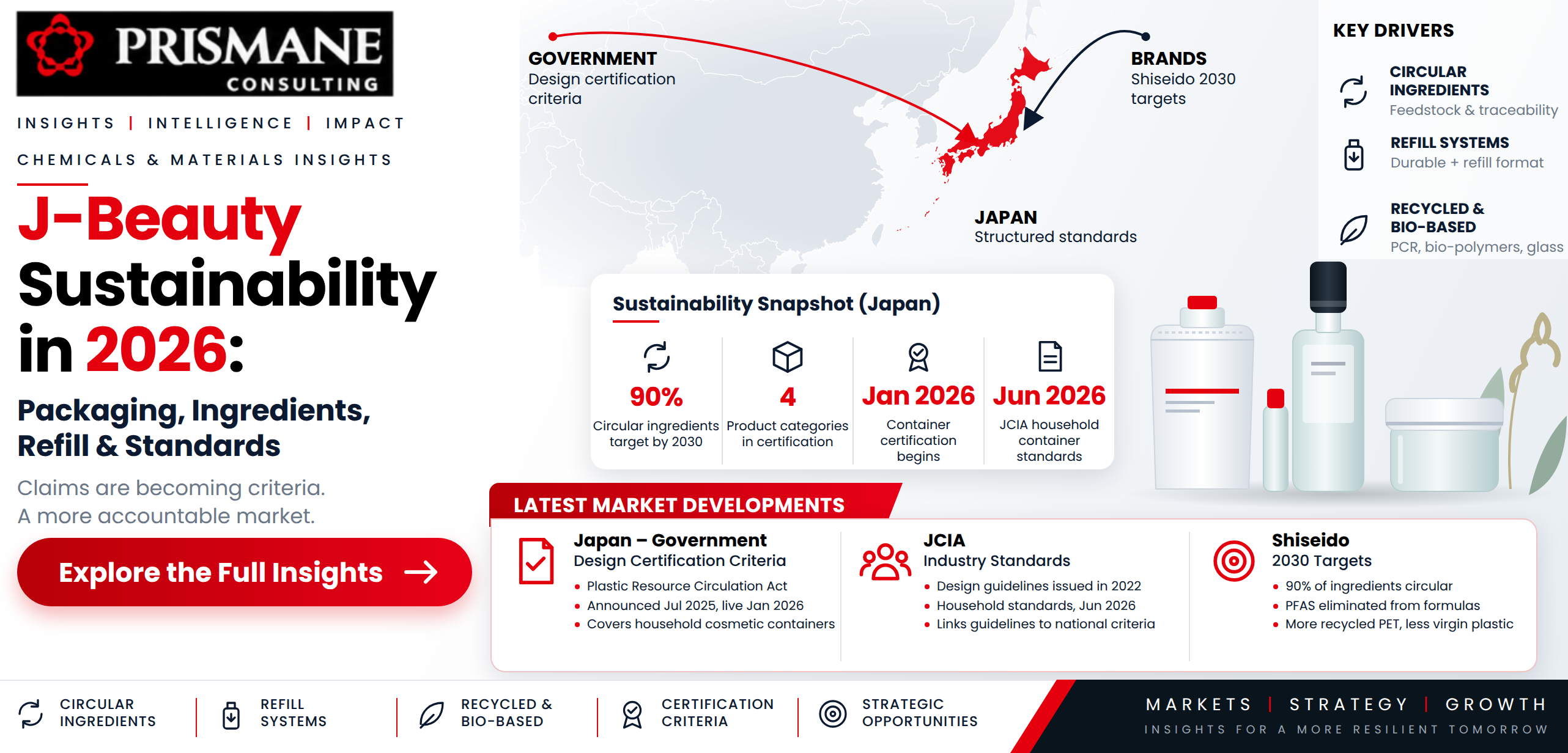
For years, J-Beauty sustainability meant a story: traditional botanicals, minimalist packaging, respect for nature. That story is now being converted into specifications. Japan has published design-certification criteria for household cosmetic containers, its largest beauty group has set numeric targets for circular ingredients and recycled packaging, and refill formats are changing what a container is supposed to do.
Our view: suppliers who still sell sustainability as a narrative will lose ground to those who can hand a procurement team a document. This piece covers what has changed in ingredients and packaging, and what it means for suppliers.

1. Packaging: Certification Criteria Replace Vague Claims
Under Japan's Plastic Resource Circulation Act, the government set design-certification criteria for four product categories, including household cosmetic containers. The criteria were announced in July 2025, and certification began in January 2026.
Industry moved in step. The Japan Cosmetic Industry Association issued guidelines for environmentally conscious design of cosmetic containers and packaging in 2022. In June 2026 it added industry standards for household cosmetic containers, sitting between those guidelines and the national criteria.
That is three layers of definition in four years. Resource efficiency, recyclability, reuse and material selection now have a reference point. For converters and packaging manufacturers, the practical consequence is simple: a claim that cannot be mapped to a criterion is a liability in front of a Japanese brand.
2. Ingredients: "Natural" Is No Longer a Specification
Shiseido has set a 2030 target for 90% of its cosmetic ingredients to be circular, meaning raw materials that are regenerated and circulated within human and natural systems. It is also targeting the elimination of PFAS from its product formulas.
Targets like this change what buyers ask of ingredient suppliers. A plant-derived label answers one question. Procurement teams increasingly want to know about feedstock origin, processing method, traceability, batch consistency and whether the material can be supplied at commercial scale. Botanical extracts, fermentation-derived materials, bio-based solvents and other renewable-feedstock ingredients all sit inside that test. Suppliers who can document those points are being asked for more and are better placed to win the business.
3. Refill: The Trend Packaging Suppliers Should Take Most Seriously
Refill is often treated as another lightweight exercise. It isn't. A refill model separates a durable primary container from a lower-material refill format that consumers buy repeatedly. That is a different product architecture and a different commercial model.
Shiseido reports adopting refillable packaging, mono-material structures, material changes and lightweighting as part of its packaging strategy. The uncomfortable implication for suppliers is that a business built on volume per unit gets harder when the unit shrinks. The upside goes to those who can supply the system: the durable container, refill pouches or cartridges, closures and dispensing mechanisms. Durability, compatibility, dispensing performance and aesthetics matter as much as resin cost.
4. Recycled and Bio-Based Materials: Substitution Is Not a Strategy
Shiseido's 2030 targets include using recycled or bio-based materials in cosmetic packaging, raising the recycled-content ratio of PET packaging and reducing virgin plastic. For manufacturers, that opens demand for recycled plastics, PCR materials, bio-based polymers and recycled glass.
Swapping the material does not automatically lower the impact. Sourcing, processing requirements, performance, recyclability, collection infrastructure and end-of-life pathways all decide the outcome. That is why material science and packaging engineering, rather than sourcing alone, now sit at the centre of J-Beauty sustainability.
5. Fermentation: Rice-Derived Ethanol as a Test Case
Fermenstation Co. Ltd., a Japanese fermentation technology company, has developed systems that convert rice and other biomass into ethanol. UNIDO reports that rice-derived ethanol production is at commercial stage in Japan, with ethanol-derived products, including cosmetics, already sold in the Japanese market.
The larger point is the model: agricultural resources and by-products become standardized industrial inputs through fermentation. The constraints are the ones that decide every bio-based material: biomass availability, collection infrastructure, processing economics, product consistency and the ability to meet cosmetic quality and regulatory requirements.
6. Tradition Is Not the Same as Sustainability
Traditional Japanese ingredients remain commercially attractive. Sourced at scale, they can create new demand for cultivation and processing, which may support agricultural communities and preserve regional production knowledge.
But "traditionally used" says nothing about environmental performance. Land use, water consumption, agricultural practice, transport, processing intensity, traceability and supply continuity all shape an ingredient's profile. As volumes grow with major brands, those factors move from the footnotes into the audit.
What It Means for Suppliers

The two halves of the value chain are also converging. A container cannot make a product sustainable if the formulation, raw materials and manufacturing process are not. Brands will increasingly judge the whole system, so suppliers should expect to be asked about theirs.
Prismane Consulting follows the global personal care ingredients and cosmetic packaging value chains, including fermentation-derived ingredients, refillable packaging and recycled-content materials. For the full Global Cosmetic Packaging & Personal Care Ingredients Market Study, contact sales@prismaneconsulting.com or click Cosmetic Packaging Market.
Key Questions on J-Beauty Sustainability
What is J-Beauty sustainability?
Sustainability initiatives across Japan's beauty value chain: ingredient sourcing, formulation, packaging design, resource efficiency, circularity and end-of-life management.
What is the main J-Beauty sustainability trends?
Circular cosmetic ingredients, fermentation-derived and bio-based materials, refillable packaging, recycled-content and bio-based packaging materials, and more structured national and industry standards.
How is sustainability changing Japanese cosmetic packaging?
Government certification criteria under the Plastic Resource Circulation Act and Japan Cosmetic Industry Association guidelines and standards now define environmentally conscious design, alongside growing use of refill systems, mono-material structures and recycled content.
What opportunities exist for personal care ingredient suppliers?
Circular ingredients, fermentation-derived materials, botanical extracts, bio-based solvents and other renewable-feedstock ingredients, for suppliers who can show traceability, consistent quality and commercial-scale supply.
What opportunities exist for cosmetic packaging suppliers?
Refillable systems, recycled-content plastics, bio-based materials, mono-material structures and lightweight formats designed around resource efficiency.