
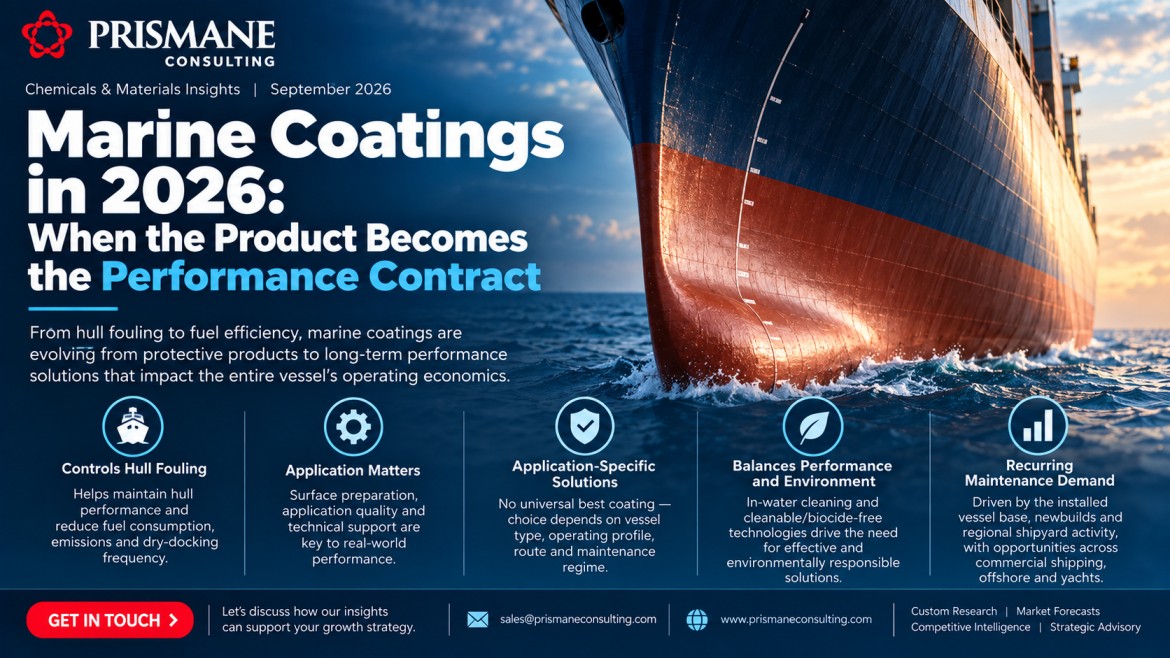
For most of its history, the coatings industry has been bought and sold on a relatively simple equation: price per litre, coverage and volume. That equation is losing relevance in the segments where coating performance carries the greatest economic consequence. A shipowner does not ultimately care what a drum costs; the question is whether the coating keeps the hull performing between dry-dockings and limits the fuel penalty from fouling. The coating is increasingly being evaluated against the customer's operating economics rather than against a competitor's price, and that is changing where value is captured.
Hull fouling has turned marine coatings into an operating cost variable, and the real opportunity is retained performance, not one-time prevention
Biofouling management is now formally recognised by the International Maritime Organization as an energy efficiency consideration, which shows how far marine coatings have moved from being viewed simply as protective maintenance products. A 2025 study covering more than 52,000 vessels found that moderate hull fouling can materially increase fuel consumption and associated emissions, with the magnitude depending on vessel type, operating profile and fouling severity. The U.S. Maritime Administration puts the fuel saving potential of effective antifouling coatings at roughly 1 to 4% under typical conditions; on a large commercial hull run continuously over years, even that level of improvement represents a material annual value.
That reframes the technical question too. The traditional antifouling brief was to stop organisms attaching. The more valuable brief is how long the coating preserves the vessel's hydrodynamic profile under real operating conditions, which shifts attention towards durability and fouling-release behaviour rather than kill efficacy alone. A coating that costs more upfront but retains performance for longer can produce a better economic outcome by reducing cleaning frequency, supporting fuel efficiency and easing dry-docking planning. It is that lifetime economics, not simply the sophistication of the chemistry, that increasingly justifies the premium.
Chugoku Marine Paints' current strategy provides a clear indication of where the industry is heading. The company is targeting an increase in the share of high-performance antifouling coatings from 59% of vessels in FY2025 to 65% by FY2030 and aims to increase its estimated contribution to shipping-sector GHG reductions from 1.07 million tonnes of CO₂ to 1.80 million tonnes. Its strategy explicitly links high-value-added antifouling products with both environmental contribution and profitability.
Coating suppliers are moving towards fleet performance partnerships rather than remaining paint vendors
Once performance becomes the product, supplying the coating alone is not enough. Surface preparation, application quality, hull condition, operating speed, trading route, idle time and cleaning frequency all shape the eventual result, which creates room for suppliers to move downstream into application guidance, inspection and hull performance monitoring bundled with the coating itself. That is a materially different commercial model from supplying drums to a yard, and it raises the bar for what a supplier needs to offer.
Two products can carry near-identical specification sheets, but the supplier that can translate those specifications into vessel-specific recommendations has a different relationship with the customer, and a harder one to displace once it is embedded in a fleet's maintenance routine.
This is increasingly visible in how marine coating companies define their own value proposition. Chugoku Marine Paints' medium-term strategy explicitly identifies performance-based approaches such as shortening shipyard construction processes and reducing maintenance requirements, while also targeting higher-value-added products and a broader scope of value provided to customers. The company is also planning strategic investments at major production sites to support long-term growth and improve supply flexibility.
The commercial opportunity is therefore expanding from the coating itself to the operating system around it. Training, inspection, technical support, product selection and performance monitoring increasingly become part of what the customer is buying.
There is no universal 'best' marine coating, because operating profile decides the economics
A high-speed container vessel on a predictable trading route has a very different fouling exposure from a vessel spending extended periods at anchor in warm, biologically active waters. Research on biofouling in tropical environments reinforces the point by linking hull condition, coating performance, maintenance and energy efficiency rather than treating them as separate variables. The practical implication is that product selection is becoming application-specific: the opportunity is less about one universally superior coating and more about a portfolio matched to vessel type, speed, route, water temperature and expected maintenance regime. That increases the value of technical sales and application engineering and makes formulation knowledge alone a less sufficient source of advantage.
Advanced Polymer Coatings (APC) has secured an agreement to supply its high-performance MarineLINE coating system for up to six new vessels being built for Champion Tankers. MarineLINE is being applied to IMO II classified product and chemical tankers under construction at Chengxi Shipyard in China, providing another example of how coating selection is increasingly tied to vessel-specific operating and cargo requirements.
This also explains why leading suppliers increasingly compete through systems rather than individual products. The coating has to perform within a particular vessel's operating profile, while the supplier has to demonstrate that performance through application support, inspection and lifecycle data.
In-water cleaning is forcing a trade-off between hull performance and environmental impact
When fouling develops, in-water cleaning can restore hull performance without waiting for dry-docking, but the process carries its own environmental cost. A 2026 study examining in-water cleaning scenarios found that particles originating from antifouling coatings represented a dominant share of the microplastic release assessed. The implication is not that cleaning and antifouling technology are incompatible, but that the economics of maintaining hull performance can no longer be separated from the environmental consequences of maintaining it.
The next generation of marine coatings will need to balance fouling control, low friction, durability, cleanability and environmental performance simultaneously. That is a considerably more demanding specification than maximising antifouling efficacy alone and favours suppliers able to demonstrate lifecycle performance rather than point-in-time laboratory results.
Marine coatings are becoming a maintenance-driven business, but the cycle is not uniform across regions or vessel segments
An important part of the marine coatings opportunity comes from long-cycle assets that require repeated maintenance rather than one-off construction. Tankers, bulk carriers, offshore structures and other marine assets require recurring corrosion protection, tank linings, antifouling and refurbishment, creating a demand stream that extends beyond newbuild projects.
The recent results of major suppliers also show why this opportunity should not be viewed as a straight-line growth story. AkzoNobel's combined Marine and Protective Coatings segment posted a low-single-digit organic sales decline in both the first and second quarters of 2026. The company's commentary pointed to two distinct causes rather than a structural weakness: marine volumes were coming off unusually strong comparisons a year earlier, while management also noted that high ship day rates were keeping vessels trading at sea for longer rather than going into dry dock. This defers dry-docking demand into later periods rather than necessarily removing it.
At the same time, Chugoku Marine Paints reported record net sales and operating profit for a third consecutive year in the fiscal year to March 2026, supported by selling price revisions and a richer mix of high-value products. Its marine coatings sales also increased strongly in Q1 FY2026, supported by higher new-ship coating shipments, particularly in China, while ship-repair coatings remained firm in Japan, Southeast Asia and other markets.
Sherwin-Williams tells a somewhat different story from a more industrial-facing slice of the same broad category. Its Protective and Marine business grew by a double-digit percentage in the first quarter of 2026 and by a further double-digit, mid-teens percentage in the second quarter, its eighth consecutive quarter of at least high-single-digit growth. Management linked this momentum primarily to data centre and semiconductor infrastructure investment rather than to shipping activity specifically.
Read together, these results show that the same broad coating category can look weak or strong in the same quarter depending on what sits behind the demand. Volumes tied directly to vessel dry-docking cycles can be deferred by an owner earning well on current charter rates, while volumes tied to adjacent industrial and infrastructure spending do not carry the same short-term deferral option.
This distinction matters for suppliers because recurring maintenance demand does not automatically translate into recurring revenue in every period. The timing of dry-docking, newbuild activity, project execution and regional investment can materially affect near-term sales even when the underlying installed asset base continues to age.
It also pulls through into a specific chemistry mix. Offshore and marine maintenance coatings rely heavily on polyurethane systems, supporting demand for polyether and polyester polyols, MDI, HDI and specialty isocyanates alongside the antifouling and fouling-release technologies discussed above.
What it means
Marine coatings are increasingly being judged against the shipowner's own financial model, including fuel consumption, hull performance, dry-docking interval and maintenance cost, rather than against a competitor's litre price. That has several consequences worth acting on.
Premiumisation becomes easier to defend because the conversation moves from “why does your coating cost more?” to “how much value does it generate?”. Technical service becomes a source of commercial value rather than simply a support cost, since application engineering, inspection, monitoring and training are difficult to replicate through formulation alone. And economic claims become harder to commoditise: a technical specification can eventually become an industry standard, but a fuel-saving or maintenance benefit backed by credible data cannot be matched simply by adjusting a formulation.
The industry's strategic direction is increasingly visible in the way leading suppliers allocate capital and develop their portfolios. High-performance antifouling, low-VOC systems, lower-carbon raw materials, production flexibility and customer-specific technical support are being developed together rather than as separate initiatives. The result is a market where the value of chemistry increasingly depends on how reliably it delivers an economic outcome in service.
That shift also strengthens the position of marine and protective coatings within the broader industrial coatings landscape, where recurring maintenance requirements and increasingly sophisticated performance expectations create opportunities further upstream in polyurethane and other specialty chemistries. It does not, however, make marine coatings immune to the shipping cycle itself: lifecycle economics only convert into revenue once a vessel actually goes into dock.
Chemistry remains the foundation, but the economic outcome is becoming the product. The strategic question for 2026 is therefore no longer how to make a better coating. It is how to prove that the coating makes the customer's asset perform better.
Prismane Consulting tracks the global marine coatings value chain, including demand by segment, competitive positioning and the shift towards coating-plus-service business models, through its Chemicals & Materials practice. For insights or further information on Paints & Coatings Markets, write to us at sales@prismaneconsulting.com.