
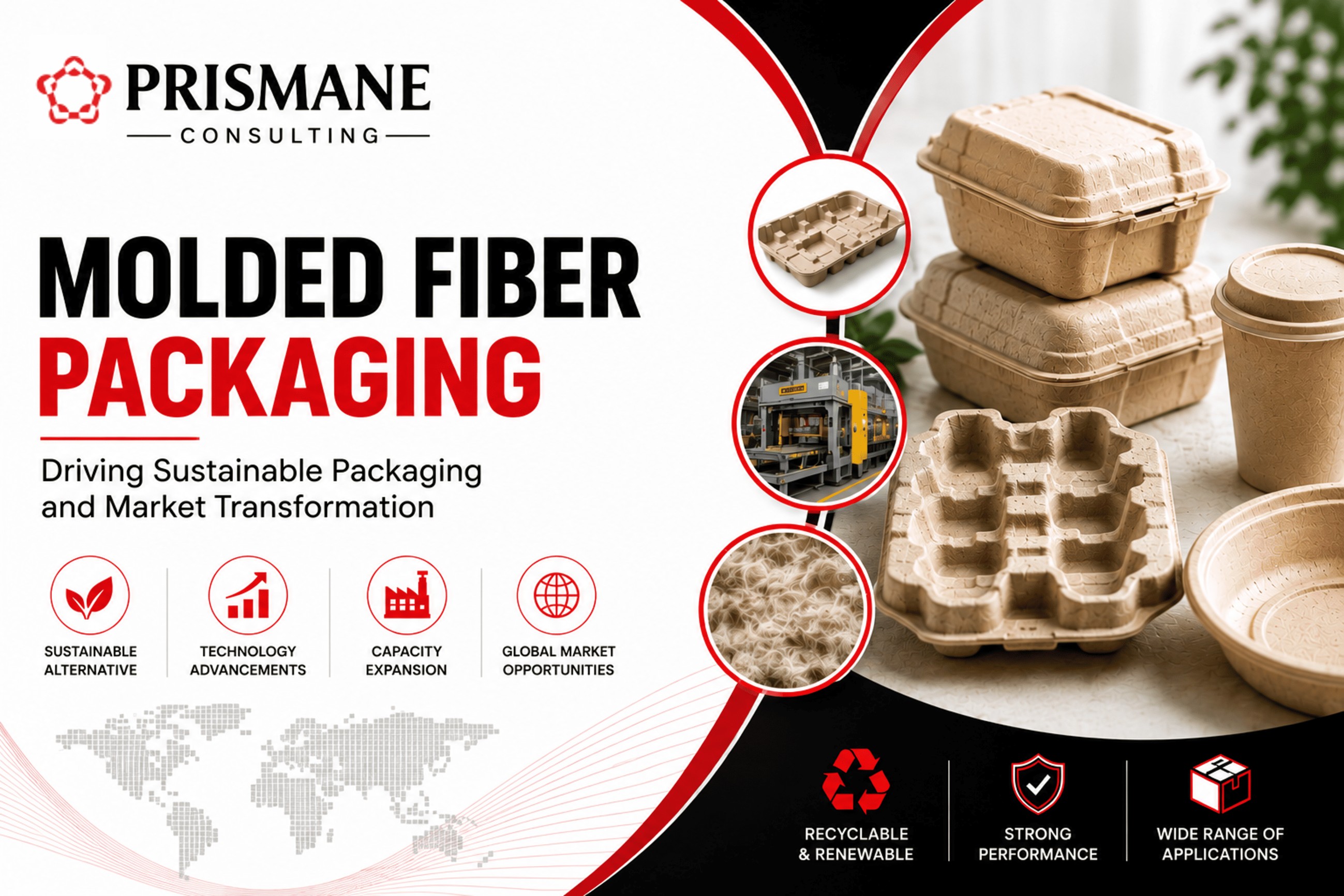
The molded fiber packaging market is shifting from a niche sustainable packaging solution towards a conventional alternative to polystyrene and plastic formats. The molded fiber packaging converts recovered and virgin cellulose fibers into trays, cartons, containers, and protective inserts, thereby increasing uses such as food packaging, food service, consumer goods, e-commerce, pharmaceuticals, and other end-uses.
The global molded fiber packaging market size was valued at $10.2 billion in 2025 and is expected to reach $17.1 billion by 2034, growing at a CAGR of 5.9% from 2026-2034. The growth is supported by increasing government initiatives to reduce use of conventional plastic packaging, increasing demand for recyclable & fiber-based formats, and increasing investments in sustainable packaging infrastructure across the globe. Demand from protective packaging and foodservice applications is expected to remain a key contributor to molded fiber packaging market growth during the forecast period.
Moreover, advancements in molding techniques, material formulation, surface treatment, and automation are broadening the application areas of molded fiber packaging across different end-use verticals and improving its performance, dimensional consistency, and scalability. Rapidly accelerating investment towards molded fiber packaging capacity additions across the globe are further strengthening regional supply capabilities.

Source: Secondary & Primary Research and Prismane Consulting Estimates
Molded Fiber Packaging: From Sustainability Alternative to Strategic Packaging Platform
Packaging requirements are undergoing a structural shift. The industry is moving beyond the traditional priorities of product containment and protection toward increasingly complex requirements around recyclability, material efficiency, regulatory compliance, and environmental performance. Fiber-based packaging, particularly molded fiber packaging, is emerging as a relevant solution for brand owners, converters, and packaging manufacturers across the globe.
One of the most significant growth opportunities for molded fiber packaging is its increasing use as an substitute to conventional plastic and expanded polystyrene (EPS) formats. Applications of molded fiber packaging products now extend across trays, egg cartons, containers, protective inserts, end caps, cups, plates, and bowls.
Stringent government regulations are becoming an important catalyst for the adoption of molded fiber packaging. For instance, the European Union's Packaging and Packaging Waste Regulation (PPWR) is particularly significant, with requirements designed to make packaging recyclable and strengthen packaging circularity over the coming years. The developments are prompting brand owners and packaging suppliers to re-evaluate existing packaging portfolios and identify new formats that may face increasing regulatory pressure.
Moreover, growth of e-commerce, food delivery, organized retail, and cross-border distribution is creating ample molded fiber packaging growth opportunities throughout the forecast period. These channels require packaging that can provide adequate protection during transportation while responding to growing expectations around material efficiency and environmental impact.
Plastic V/s Molded Fiber Packaging
While plastic packaging is expected to remain the preferred material for applications requiring high barrier performance, durability, and cost efficiency, molded fiber packaging is poised to capture incremental $ opportunity in foodservice, protective packaging, and consumer goods as sustainability regulations tighten and brand owners fast track the transition towards renewable, fiber-based packaging solutions. This landscape is expected to foster innovation rather than complete substitution, with each material serving distinct application requirements. The above-mentioned factors are expected to create high growth opportunities for molded fiber packaging market throughout the forecast period.
Factor | Plastic Packaging | Molded Fiber Packaging | Strategic Assessment |
Raw Material | Petroleum-based polymers (PP, PE, PET etc.) and recycled plastics | Recycled paper, virgin pulp, bagasse, bamboo, wheat straw, and other agricultural fibers | Molded fiber packaging has a stronger renewable feedstock profile. |
Environmental Performance | Higher carbon footprint; recycling depends on collection infrastructure | Lower carbon footprint, recyclable, biodegradable, and compostable in many applications | Regulations and ESG commitments increasingly favor molded fiber packaging. |
Barrier Properties | Excellent moisture, oxygen, grease, and chemical resistance | Typically requires coatings for moisture and grease-sensitive applications | Plastic maintains an advantage for high-barrier applications. |
Cost Competitiveness | Lower unit costs at high production volumes | Higher production costs, although narrowing with technology advancements | Plastic remains more cost-effective for large-scale production but for short-scale, molded fiber packaging is gaining high traction. |
Regulatory Exposure | Subject to increasing restrictions on single-use plastics and recycled content mandates | Supported by regulations promoting sustainable and fiber-based packaging | Molded fiber packaging benefits from favorable regulatory developments. |
End-use Applications | Food & beverage, personal care, healthcare, industrial, consumer goods | Foodservice, egg cartons, electronics, industrial protective packaging, e-commerce | Material selection depends on performance and sustainability requirements. |
Future Outlook | Continued dominance in high-performance packaging applications | Rapid growth driven by sustainability regulations and plastic substitution | Molded fiber packaging expected to gain high market share in protective and food packaging applications over the forecast period. |
Source: Secondary & Primary Research and Prismane Consulting Estimates
Accelerating Manufacturing Investments Across the Molded Fiber Value Chain
Investment across the molded fiber packaging value chain is gaining momentum as manufacturers and packaging companies look beyond material costs to evaluate production efficiency, regulatory preparedness, supply-chain resilience, product performance, and the ability to respond to evolving customer requirements.
For molded fiber producers, this shift is transforming into investments across the manufacturing ecosystem. Companies are expanding production capacities, increasing automation techniques, upgrading existing production units, and deploying advanced molding and fiber-processing technologies. According to the International Molded Fiber Association (IMFA), companies across the globe are planning to increase production capacity by approximately 75% by 2028, highlighting the molded fiber packaging demand growth in the short-term. Investment decisions are also becoming increasingly connected to regional supply-chain strategies. Manufacturing diversification and China+1 strategies are encouraging packaging companies to establish or expand production capabilities across India, Southeast Asia, and Mexico.

Source: Secondary & Primary Research and Prismane Consulting Estimates
Moving Beyond Plastic and EPS Substitution
Stringent government initiatives promoting biobased products are creating significant growth opportunities for molded fiber packaging manufacturers across the globe. For instance, the USDA BioPreferred Program, established under the 2002 Farm Bill and reauthorized through the 2018 Farm Bill, encourages federal agencies and their contractors to prioritize the procurement of certified biobased products, including disposable tableware containing a minimum of 72% biobased content.
The Business Case- “Huhtamaki and Hartmann Expand Molded Fiber Capacity”
The business case for molded fiber packaging is being increasingly proven out through actual production capacity expansion and technological investments by major packaging companies.
- In 2025, Huhtamaki increased production capacity of its Smooth Molded Fiber (SMF) lids in Northern Ireland and launched 100% recycled fiber egg cartons in the U.S. aiming to substitute expanded polystyrene packaging.
- In 2025, Hartmann also expanded its global footprint, with a deal to acquire SC Dentaş Romania and a new molded fiber production line at its Sanauli, India, facility in 2026.
These investments show that companies are not just chasing molded fiber packaging as a sustainability option but are also investing heavily towards increasing production capacity, regional supply, technology and new applications to meet growing demand of molded fiber packaging products across different end-use verticals.
Recycled Fiber- Key Raw material Used for Manufacturing Molded Fiber Packaging
Recycled fiber is a popular choice for egg cartons, fruit trays, industrial cushioning, beverage carriers and protective packaging because it is cost effective, environmentally friendly, and has enough cushioning and shock absorbing properties. The extensive availability of recovered paper, coupled with well-established recycling infrastructure in several countries, has made recycled fiber the favored choice for high-volume molded fiber packaging production across the globe. Its lower raw material cost and reduced environmental footprint enable manufacturers to produce sustainable packaging solutions while meeting increasing regulatory requirements and corporate sustainability commitments. Although recycled fibers are generally shorter than virgin fibers due to repeated processing, continuous improvements in pulp preparation, fiber blending, and molding technologies have significantly enhanced the strength, consistency, and quality of recycled fiber based molded fiber packaging products.
Wet Press Technology- Accelerating Manufacturers towards Rapid Innovation and Premiumisation
The adoption of wet press molded fiber packaging is further accelerating as brand owners seek packaging solutions that combine premium aesthetics with strong environmental credentials. The process enables manufacturers to produce lightweight yet durable products with superior finish, making it suitable for replacing plastic packaging in applications where appearance and protection are equally significant. Rapid advancements in molding equipment, automation techniques, fiber treatment technologies, and barrier coatings are further strengthening the performance of wet press molded fiber, enabling improved moisture and grease resistance while maintaining recyclability and compostability. These technological improvements are expected to support wider adoption of molded fiber packaging products across high-value packaging applications and strengthen the long-term growth prospects of the wet press molded fiber packaging segment during the forecast period.
Trays and Egg Cartons- High Growth Observed in Food and Beverage Applications
Trays and egg cartoons form the largest product type segment, holding around 35.1% share of the global molded fiber packaging market. Their increased demand is derived from the low cost, wide availability, and strong shock-absorption for fragile items like eggs, fruits, and glass bottles. India’s FSSAI promotes biodegradable packaging under its Eat Right India Initiative, while the EU’s Packaging Waste Regulation mandates packaging-waste cuts of 5% by 2030, pushing egg and produce packers towards molded fiber trays. These developments are enabling trays and egg cartons to expand beyond traditional egg packaging into premium fresh food, ready-to-eat meals, fruit and vegetable packaging, and other high-value food applications, supporting the long-term growth of this segment.
Foodservice Is Creating a Scalable Opportunity
The food & beverage industry is the largest end-use segment for molded fiber packaging due to its widespread application in packaging eggs, fresh produce, ready-to-eat meals, beverages, bakery products, takeaway food, and foodservice items. The segment is further benefiting from rising investments by food manufacturers and foodservice companies in plastic-free packaging solutions that comply with evolving food-contact regulations and corporate sustainability commitments. Molded fiber packaging is increasingly being adopted for fresh fruits and vegetables, meat and poultry trays, bakery products, and takeaway meal packaging due to its recyclability, compostability, and ability to protect products while maintaining product quality throughout the supply chain. Continuous innovations in moisture-resistant and grease-resistant fiber packaging are also expanding its suitability for a wider range of food and beverage applications.
From Sustainability to Scalability: Emerging Trends in Molded Fiber Packaging
The molded fiber packaging industry has reached a point where technology, cost competitiveness, regulatory compliance and product performance are just as important as sustainability.
- Capacity expansion is one of the clearest industry trends.
- Recyclable and PFAS-free packaging development is becoming increasingly important.
- Advanced molding technologies are expanding the addressable market.
- Government procurement is another emerging demand channel.
Asia-Pacific Emerges as a Key Growth Engine for Molded Fiber Packaging
Regional dynamics are becoming increasingly important to the development of the molded fiber packaging market, with Asia Pacific, North America, and Europe representing the major centers of demand, investment, and technological development. Differences in regulatory frameworks, manufacturing capabilities, consumer preferences, and end-use industries are shaping the pace of adoption across regions.
Asia Pacific is positioned as a key growth engine for molded fiber packaging, supported by its large manufacturing base, expanding foodservice industry, growing e-commerce ecosystem, and increasing focus on reducing plastic waste. Countries such as China, India, Japan, and Southeast Asian economies are attracting investment in fiber-based packaging production as brands and converters seek locally manufactured alternatives to plastic and EPS.
India is particularly attractive due to rising organized retail, food delivery, quick-service restaurants, and government initiatives aimed at reducing single-use plastics. Meanwhile, China's extensive packaging manufacturing ecosystem provides advantages in terms of production scale, supplier availability, and technology adoption.
Competitive Landscape
The molded fiber packaging market is relatively concentrated, with competition divided between globally integrated manufacturers, regional packaging specialists and emerging companies with a technology focus.
- Tier-1 manufacturers are predicted to account for a share of 55% to 60% of the global market by 2025 driven by the large customer base, extensive product portfolio and manufacturing scale. Prominent Tier-1 manufacturers includes Huhtamaki, Hartmann, Novolex and Sabert.
- Tier-2 manufacturers including CKF Inc, Genpak LLC, Omni-Pac Group, Henry Molded Products Inc and others are regional leaders strongly focusing on product innovations and specialized packaging solutions.
- Tier-3 manufacturers including Pulpak and PAPACKS Sales GmbH are strongly encouraged towards technology innovations and implementing emerging sustainability packaging solutions.
Global Molded Fiber Packaging- Company Market Structure (2025)

Source: Secondary & Primary Research and Prismane Consulting Estimates
Competitive positioning is increasingly shaped by: -
- Production capacity
- Advanced molding technology
- Product innovation
- Cost efficiency
- Customized solutions
- Supply-chain resilience