
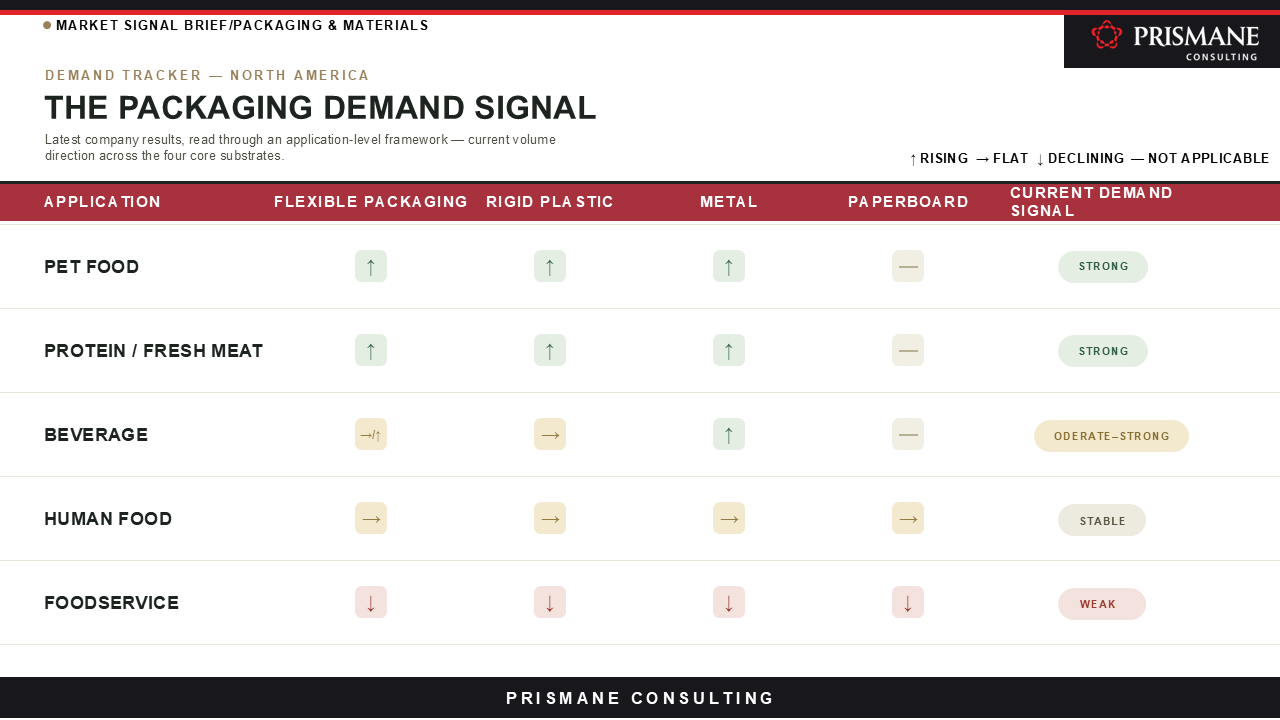
Most packaging categories in 2026 are sending mixed signals.
One packaging producer reports volume growth while another reports declines in the same end market. In many cases, the difference is not underlying consumption. Acquisitions, divestitures, customer wins, inventory movements and packaging-material substitution can all make individual company results difficult to interpret as a direct measure of end-market demand.
A stronger signal emerges when the same application is growing across multiple packaging materials and across multiple producers.
By that measure, pet food and protein currently stand out as two of the clearest positive demand signals in North American packaging. Recent results from flexible, rigid plastic and metal packaging producers point in the same direction, providing stronger evidence of underlying category demand than growth reported by any single packaging producer.
This distinction matters. If only one packaging format is growing, the increase may reflect material substitution or market share gains. When several independent packaging formats serving the same application grow simultaneously, the probability of genuine end-market expansion becomes considerably higher.
That makes pet food and protein particularly important categories to watch when assessing North American packaging demand in 2026.
The Cross-Material Demand Signal
The underlying principle is straightforward: packaging-company volume growth is not necessarily equivalent to end-market growth.
Several factors can distort a single producer’s reported volumes:
- A flexible packaging producer can gain share from a rigid format.
- A metal-can producer can lose customers even while overall food consumption rises.
- An individual company’s reported volume can be affected by acquisitions, divestitures, customer concentration and inventory movements.
Cross-material analysis helps reduce these distortions. When the same end-use category demonstrates positive volume trends across flexible packaging, rigid plastic and metal, the evidence for underlying demand becomes considerably stronger.
Recent company results provide this type of evidence for pet food and protein:
- Amcor, fiscal Q4 results showed improving volumes across pet care and protein-related packaging, with comparable flexible packaging volumes up ~1% and rigid packaging volumes up ~0.5%, both sequential improvements.
- Silgan, reported high-single-digit volume growth in pet food metal containers during Q2, while consumer food volumes were stable.
- Graphic Packaging, described food and beverage paperboard categories as stable, while foodservice and household-related categories remained under pressure.
Taken together, these results suggest a meaningful divergence within food packaging: pet food and protein are demonstrating stronger cross-format momentum, while several broader human-consumption categories remain flat or negative.
North American pet food packaging demand is currently estimated at USD 5.5 billion in 2025, while protein and fresh-meat packaging volumes are estimated to have changed substantially.
The implication is not that packaging substitution has disappeared. Rather, the simultaneous growth across multiple formats makes underlying category demand a more credible explanation for the observed volume increases.
Pet Food: Increasingly Important Across Packaging Formats
Pet food deserves particular attention because its growth is no longer visible through a single packaging format.
Metal cans remain important for wet pet food, while flexible and rigid plastic formats serve dry food, treats, pouches, tubs and other applications.
This creates an important distinction for packaging producers:
- A producer competing solely within one material may interpret pet food growth as an opportunity to capture share.
- A broader market view suggests something more significant: the underlying pet-care category itself is generating incremental packaging demand across several formats.
This makes pet food increasingly relevant for capacity planning, customer targeting and investment decisions.
The category also benefits from relatively defensive consumer behavior. Pet owners tend to protect spending on essential pet products even when discretionary household consumption weakens, providing a degree of resilience compared with more economically sensitive packaging applications.
Beverage Cans: Strong First-Half Growth, but a Temporary Distortion Remains
Beverage cans provide a different type of positive signal.
Crown Holdings reported global beverage can volume growth of approximately 5% in the second quarter, with North America also increasing by approximately 5%. Europe grew faster, while Asia recorded double-digit gains, partly offset by weaker Latin American demand.
However, the forward-looking guidance is more informative than the quarterly headline:
- Crown expects North American shipment growth of approximately 3%–4% for the full year, compared with global growth of around 3%.
- Management indicated that World Cup-related demand would not repeat in the third quarter.
This creates an important distinction between reported growth and underlying growth. A 5% quarterly increase should not automatically be extrapolated throughout the remainder of the year. The company’s full-year guidance provides a more appropriate baseline for modelling North American beverage-can demand.
The structural outlook nevertheless remains positive. Beverage cans continue to benefit from consumer and brand-owner preferences for aluminum packaging, while producers continue to invest in capacity.
North American aluminum can-sheet capacity currently stands between 2.5 and 3.0 MMT in 2026, with tight can production capacities and mid-to-high 90% utilization across North American operations, pushing brand owners toward long-term supply contracts and inventory buffers.
The key question for the market is therefore no longer simply whether beverage cans are growing, but how much of the current growth represents sustainable underlying consumption versus temporary event-driven demand.
Consumer Food Is Stable – and Stability Matters
Consumer food packaging provides an important counterpoint. Silgan described consumer food can volumes as stable, with quarterly movements affected partly by changes in soup and vegetable order timing. Graphic Packaging similarly characterized food and beverage paperboard demand as stable, while Amcor’s liquids category remained broadly flat.
In isolation, these numbers might appear disappointing. In context, they are relatively resilient:
- Foodservice volumes declined by more than 5%.
- Household-related packaging categories declined by approximately 2%–5% in the reported period.
Against this backdrop, stable shelf-stable and packaged food demand demonstrates the defensive nature of food consumption.
That defensive characteristic is strategically important. Food and beverage packaging does not necessarily need to generate high volume growth to remain an attractive core market. Its importance comes from the combination of large absolute consumption, recurring demand and relatively low sensitivity to economic cycles.
For packaging producers, therefore, the distinction between “flat” and “weak” is important. A flat food category can represent a much stronger demand environment than a rapidly growing discretionary category exposed to economic volatility.
The World Cup Effect: Why Q2 Should Not Be Annualized
The second-quarter results also introduce an unusual analytical complication: event-driven consumption.
Multiple packaging producers referenced World Cup-related demand when discussing the quarter or the broader consumption environment:
- Crown expects the benefit to fade in the third quarter.
- Amcor acknowledged that some of its volume improvement may have reflected World Cup-related consumer demand, although management did not consider the impact material at the company level.
- Graphic Packaging faced questions on whether increased on-premises activity from the event should have produced stronger foodservice volumes, but management pointed instead to broader category weakness.
The important point is that the available disclosures do not provide a sufficiently clean basis for isolating the exact contribution of the World Cup to North American packaging consumption.
Accordingly, second-quarter volumes should not simply be annualized. For market modelling, the more appropriate approach is to treat Q2 as containing a potentially temporary demand component and use subsequent-quarter results to establish a cleaner underlying run rate. This is particularly important for beverage packaging, where event-related consumption can have a disproportionate impact on short-term shipment volumes.
The North American Packaging Demand Signal
The latest company results can be interpreted through a broader application-level framework:
Application | Cross-Material Evidence | 2026 Signal | Direction |
Pet food | Flexible, rigid plastic and metal all growing | Genuine category expansion; ~USD 5.5B North American market (2025) | Up |
Protein | Amcor pet care/protein packaging volumes improving sequentially | Improving momentum alongside pet food | Up |
Beverage cans (N. America) | Crown: +5% Q2; full-year guidance +3%–4% | Q2 inflated by World Cup demand; use full-year guide as baseline | Up (moderating) |
Consumer food | Silgan, Graphic Packaging and Amcor all report stable volumes | Defensive, recurring demand despite no growth | Flat |
Foodservice / household | Declines of ~2%–5% (household) and 5%+ (foodservice) | Broad-based weakness across formats | Down |
Source: Prismane analysis based on company disclosures; directions indicate directional market signals rather than directly comparable growth rates.
The value of this framework is that it moves the analysis away from asking “Which packaging company grew?” and toward the more useful question: “Which end-use categories are generating demand across multiple packaging formats?”
That distinction is increasingly important in a mature packaging market, where individual producers can gain or lose share without the underlying end market moving by the same magnitude.
What Does This Mean for Packaging Producers?
Three conclusions stand out.
- Pet food currently represents one of the most defensible growth opportunities within food packaging. Its demand signal is visible across multiple packaging formats, reducing the likelihood that observed growth is solely the result of material substitution. Packaging producers with exposure to pet food should evaluate capacity, customer concentration and format-specific opportunities in the category separately from broader consumer-food demand.
- Beverage-can producers should plan around sustainable annual growth rather than the Q2 headline. Crown’s 3%–4% North American full-year guidance provides a more appropriate planning assumption than the 5% quarterly increase, particularly given the temporary influence of major sporting events.
- Producers exposed to shelf-stable consumer food should not interpret flat volumes as a structural deterioration in demand. The category remains relatively defensive and is currently outperforming more discretionary foodservice and household-related applications.
The broader lesson is that North American packaging demand in 2026 cannot be understood through material-level growth rates alone. Application-level triangulation is becoming increasingly important.
Pet food and protein currently provide the clearest examples of this.
The next question is what happens in the categories moving in the opposite direction, the pressure on foodservice and household packaging will be the focus of Part Two of this series.