
The nonwoven fabrics market is no longer developing along a single, predictable path. For decades, the industry's growth story was straightforward: polypropylene and polyester delivered consistent performance at increasingly efficient production costs, and volume followed wherever those economics were strongest. That foundation remains important, but it is now only one part of a broader market equation.
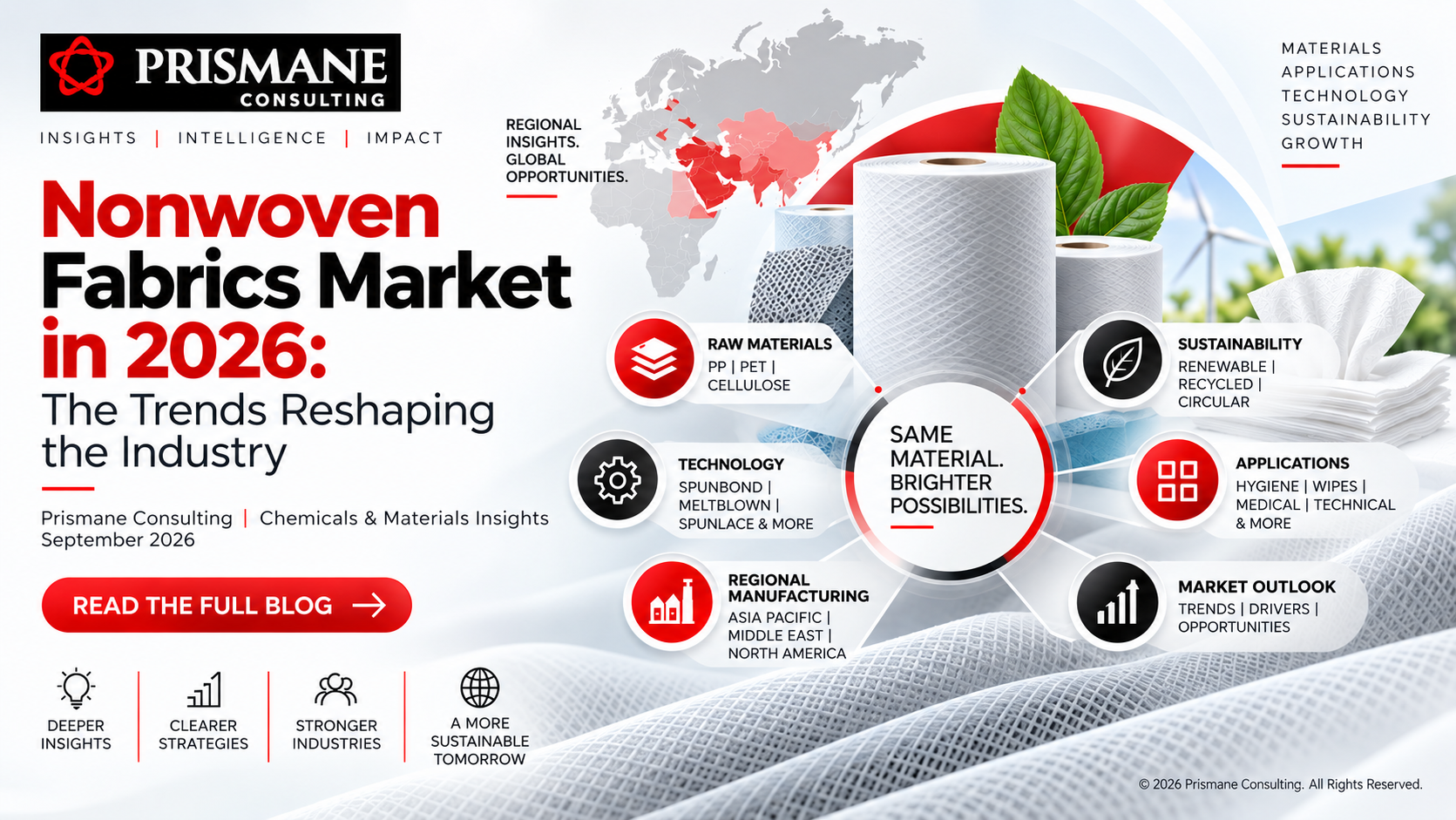
In 2026, the global nonwovens market is being shaped by raw-material and tariff economics, regional manufacturing strategy, industry consolidation, sustainability and end-of-life requirements, and the growing commercial relevance of cellulose-based fibers alongside established synthetic materials.
At Prismane Consulting, we see the industry moving from a predominantly volume-driven material market toward a more application-specific, technology-driven and regionally integrated industry.

Raw-Material Economics Still Set the Baseline
Polypropylene remains the backbone of the nonwoven fabrics market, particularly in spun bond hygiene and several industrial applications, because it combines low cost, wide availability and efficient processing. Polyester retains a strong position in durable and technical nonwovens where dimensional stability, strength and thermal performance are priorities.
These materials benefit from a largely installed manufacturing base, established converting infrastructure and decades of application-specific development. Replacing them at scale requires an alternative material to match not only fiber cost, but also processing efficiency, product performance and supply availability.
However, manufacturers are increasingly evaluating the total economics of a nonwoven structure. Raw material costs, energy consumption, production efficiency, transportation, conversion requirements and end-of-life considerations are becoming part of the material-selection equation.
A material with a higher fiber cost can become commercially attractive if it enables lower basis weight, improves product performance or addresses regulatory requirements that are increasingly important to customers.
Consolidation and Regional Ownership Are Reshaping the Supply Base
Ownership structures across the nonwovens industry are also shifting toward greater regional control.
A notable 2026 example was Takween Advanced Industries finalizing full ownership of Advanced Fabrics Factory Co. (SAAF) in Saudi Arabia by acquiring its Chinese partner JOFO Nonwovens' remaining 70% stake. SAAF serves medical, hygiene and industrial nonwoven applications.
Transactions of this type matter beyond their balance-sheet impact. They reflect growing interest in direct control over regional capacity, customer relationships and supply reliability rather than relying entirely on exports from distant production bases.
The Middle East is consequently becoming more relevant to the global nonwoven manufacturing landscape. Saudi Arabia and other Gulf markets are developing capabilities around healthcare, hygiene and technical materials, while their geographic position provides access to markets across the Middle East, Africa and parts of Asia and Europe.
For customers requiring consistent specifications and reliable supply, regional production can also support faster qualification, technical development and response times.
Sustainability Has Moved From Claim to Qualification Requirement
Renewable feedstocks, recycled content, biodegradability and end-of-life performance are increasingly embedded in material-selection decisions across hygiene, wipes and several technical nonwoven categories. This is creating opportunities for cellulose-based fibers such as lyocell and viscose, particularly in wipes and selected hygiene and medical applications.
However, sustainability credentials alone are unlikely to determine material substitution at scale. Material still needs to run efficiently on existing or adaptable equipment, meet performance specifications and support a commercially viable product before environmental attributes can be translated into sustained market adoption.
The direction of travel is therefore toward application-specific material selection, rather than a uniform shift away from synthetic fibers. Commodity hygiene structures are likely to remain predominantly polypropylene-based where cost, softness, strength and high-speed processing are the primary requirements. Premium products and plastic-free wipes, by contrast, provide a stronger commercial case for cellulose-based structures where customers place greater emphasis on renewable feedstocks and end-of-life characteristics.
Regional Manufacturing Footprint Is Becoming a Competitive Factor
Asia-Pacific remains the centre of gravity for global nonwoven production, supported by its scale in hygiene products, textiles, medical products and consumer goods manufacturing. China, Japan, South Korea and Southeast Asia continue to play important roles across hygiene, medical, filtration and industrial nonwoven applications. The region's importance extends beyond domestic consumption, with integrated polymer, fiber, machinery and converting industries supporting a strong manufacturing ecosystem.
The Middle East presents a different but increasingly important development. Investments in local manufacturing, industrial diversification, healthcare and hygiene infrastructure are creating opportunities for nonwoven production closer to regional customers.
North America presents another distinct pattern. According to INDA, Association of the Nonwoven Fabrics Industry, the 13th annual North American Nonwovens Supply Report found that regional nonwoven capacity grew by less than 1% in 2025 while production edged down, with the industry's overall operating rate settling at around 78%. Changing trade conditions, including tariff developments, contributed to the moderation.
These differences are becoming strategically important. Manufacturers are increasingly evaluating not only where demand exists, but where production should be located to serve customers competitively and with greater supply-chain resilience.
The U.S. Nonwoven Fabrics Market
The U.S. nonwoven fabrics market spans hygiene, wipes, medical products, filtration, geotextiles, automotive applications and other industrial uses. Two dynamics are particularly relevant in 2026.
The first is trade policy. Changes in tariffs and import economics can alter the competitiveness of domestically produced and imported nonwoven roll goods. This can encourage producers and converters to reassess sourcing strategies, regional production and inventory requirements.
The second is growing attention to product composition and disposal. Wipes and other disposable products are facing greater scrutiny around labelling, flushing claims, plastic content and end-of-life behavior.
The result is a market in which domestic manufacturing capability, process flexibility and adaptable material structures are becoming increasingly valuable.
Technology May Matter as Much as the Fiber
The competitive position of a nonwoven material cannot be separated from manufacturing technology. Spun bond, melt blown, spun lace, air laid, dry-laid and needle punched technologies create fundamentally different structures. Fiber diameter, fiber length, basis weight, web formation, bonding and surface treatment all influence final product properties.
This becomes particularly important as manufacturers pursue lightweighting. Reducing material consumption while maintaining strength, softness, absorbency or barrier performance requires increasingly precise control over the production process.
Hydroentanglement can produce high-performance structures from different fiber combinations, while spun bond and melt blown remain important for high-throughput applications and engineered filtration structures. Air laid technology provides another route for absorbent and highly porous products. The implication is significant: future competition may increasingly be determined by process capability rather than fiber availability alone.
Technical Nonwovens Provide a Second Growth Engine
The nonwoven industry is often associated with disposable hygiene products, but technical applications are becoming increasingly important. Filtration, medical products, automotive components, construction materials, acoustic products, geotextiles and industrial applications all use nonwoven structures because they can be engineered for specific functional requirements.
This creates a competitive environment different from commodity hygiene products. Technical customers may place greater emphasis on filtration efficiency, tensile strength, thermal resistance, acoustic performance, barrier properties or long-term durability than on simple material cost.
The expansion of these applications creates opportunities for higher-value nonwoven products and greater technical differentiation. This is particularly relevant to the U.S. nonwoven fabrics market, where established industrial, healthcare and filtration applications provide a substantial base for technically engineered products.
Cellulose Is Gaining Ground, but Selectively
Cellulose-based nonwovens have become one of the industry's most visible development areas. Lyocell, viscose and other regenerated cellulose fibers are attracting interest across wipes, hygiene, medical and selected technical applications.
The expansion of nonwoven-grade lyocell production in Asia illustrates the development of the supply side. In March 2026, Lenzing began producing nonwoven-grade VEOCEL lyocell fibers at its Thailand facility, expanding regional availability of cellulose-based fiber solutions.
However, cellulose should not be interpreted as the end of synthetic nonwovens.
Polypropylene nonwoven fabric continues to offer a compelling combination of cost, processability, strength and availability in many high-volume applications. Polyester remains important where dimensional stability, durability and thermal properties are required. In several applications, blended structures may provide a better balance than either purely synthetic or purely cellulosic materials.
The opportunity will therefore depend on the balance between environmental requirements, product performance, production economics and customer acceptance.
Circularity Is Moving Beyond Sustainability Claims
Circularity is another area where the industry's thinking is becoming more sophisticated. Adding recycled content is relatively straightforward compared with designing a complex disposable product for recovery at end of life. Hygiene products can contain several polymers, cellulose fibers, adhesives, elastics and other functional components, making separation and recycling technically challenging. This is pushing the industry toward design for circularity.
Manufacturers increasingly need to consider material combinations, product construction, collection systems and recycling technologies at the design stage rather than treating end-of-life as a separate issue. Closed-loop approaches for diapers and other absorbent hygiene products are therefore important not simply because they provide a potential recycling route, but because they challenge manufacturers to reconsider product construction itself. The next stage of sustainability in the nonwovens industry will increasingly focus on system-level resource efficiency rather than individual material claims.
Regulation Is Becoming a Competitive Factor
Regulation is no longer simply a compliance function for nonwoven manufacturers. Developments around packaging waste, single-use products, extended producer responsibility, product safety and environmental claims are influencing material selection and product design across major markets.
For manufacturers supplying multiple regions, regulatory fragmentation can become a commercial issue. Material or product construction that works in one market may require modification in another because of different requirements around composition, labelling, disposal or environmental claims.
The ability to anticipate regulatory changes and translate them into product specifications could therefore become a competitive advantage alongside manufacturing efficiency and raw-material cost.
The Nonwovens Industry Is Becoming More Consolidated and More Regional
The 2026 nonwovens landscape is increasingly defined by the interaction between consolidation and regionalization. Scale is becoming valuable where companies need to invest in new equipment, technical development, sustainability programmes and customer qualification.
At the same time, regional production is becoming strategically attractive because supply chains are more exposed to geopolitical disruption, freight volatility and raw-material availability. Globalization is therefore not necessarily reversing. Instead, the industry is moving toward a more complex model in which companies maintain global capabilities while building stronger regional production and customer networks.
What the Changes Mean for Nonwoven Manufacturers
For manufacturers, competing only on production volume is becoming increasingly difficult. A stronger strategic position is likely to come from a combination of:
- Material flexibility
- Process capability
- Regional manufacturing
- Technical customer support
- Application development
- Lightweighting expertise
- Circularity capabilities
Manufacturers need to understand not only how to produce a nonwoven, but also why a customer requires a particular structure and how regulatory or sustainability requirements could change that requirement. This creates opportunities for companies that can move between commodity and specialty applications, develop blends and alternative materials, optimize lightweight structures and provide reliable regional supply.
Nonwoven Fabrics Market Outlook
The nonwoven fabrics market is unlikely to experience a single material revolution. Instead, the next phase will be characterized by selective changes across materials, technologies and applications. Synthetic fibers will remain essential because of their established economics and performance. Cellulose-based fibers will gain ground where their properties and environmental characteristics create sufficient value. Recycled materials will become more relevant as circularity requirements develop.
Technical nonwovens will continue to create higher-value opportunities, while hygiene products will increasingly be influenced by demographic change, lightweighting and regulatory requirements. Regional manufacturing will also become more important. The expansion of Asian capacity, increasing investment in emerging markets and greater manufacturing activity in regions such as the Middle East will gradually reshape supply chains. Consolidation will give larger companies greater control over technology, capacity and customer relationships. The central change is therefore not a transition from one fiber to another.
The nonwovens industry is moving from a volume-driven material market toward a more application-specific, technology-driven and regionally integrated industry. For producers, converters and investors, the strategic equation will increasingly be:
The right material + The right process + The right manufacturing footprint + The right end-of-life strategy
for the right application.
From our perspective at Prismane Consulting, the next phase of the nonwoven fabrics market will be defined less by a single breakthrough material and more by the ability to integrate materials, technology, applications and regional supply chains. Polypropylene and polyester will remain essential. Cellulose will gain relevance where it delivers a meaningful combination of performance and sustainability. Technical nonwovens will create opportunities for differentiation, while circularity and regulation will increasingly influence product development.
The strategic advantage will therefore belong to companies that can move beyond selling fiber or fabric alone and instead solve a specific customer application with the right combination of material, process, performance and lifecycle economics.
That is what will define the next phase of the global nonwoven fabrics market.
Prismane Consulting provides market intelligence, competitive intelligence, market sizing, forecasting and strategic advisory across chemicals, materials, packaging, energy and industrial markets.
Our Chemicals & Materials practice tracks the global nonwovens and fiber value chain, including polypropylene, polyester and cellulose-based nonwoven substrates.
For deeper analysis of the global nonwoven fabrics market, connect with the Prismane Consulting team at sales@prismaneconsulting.com