
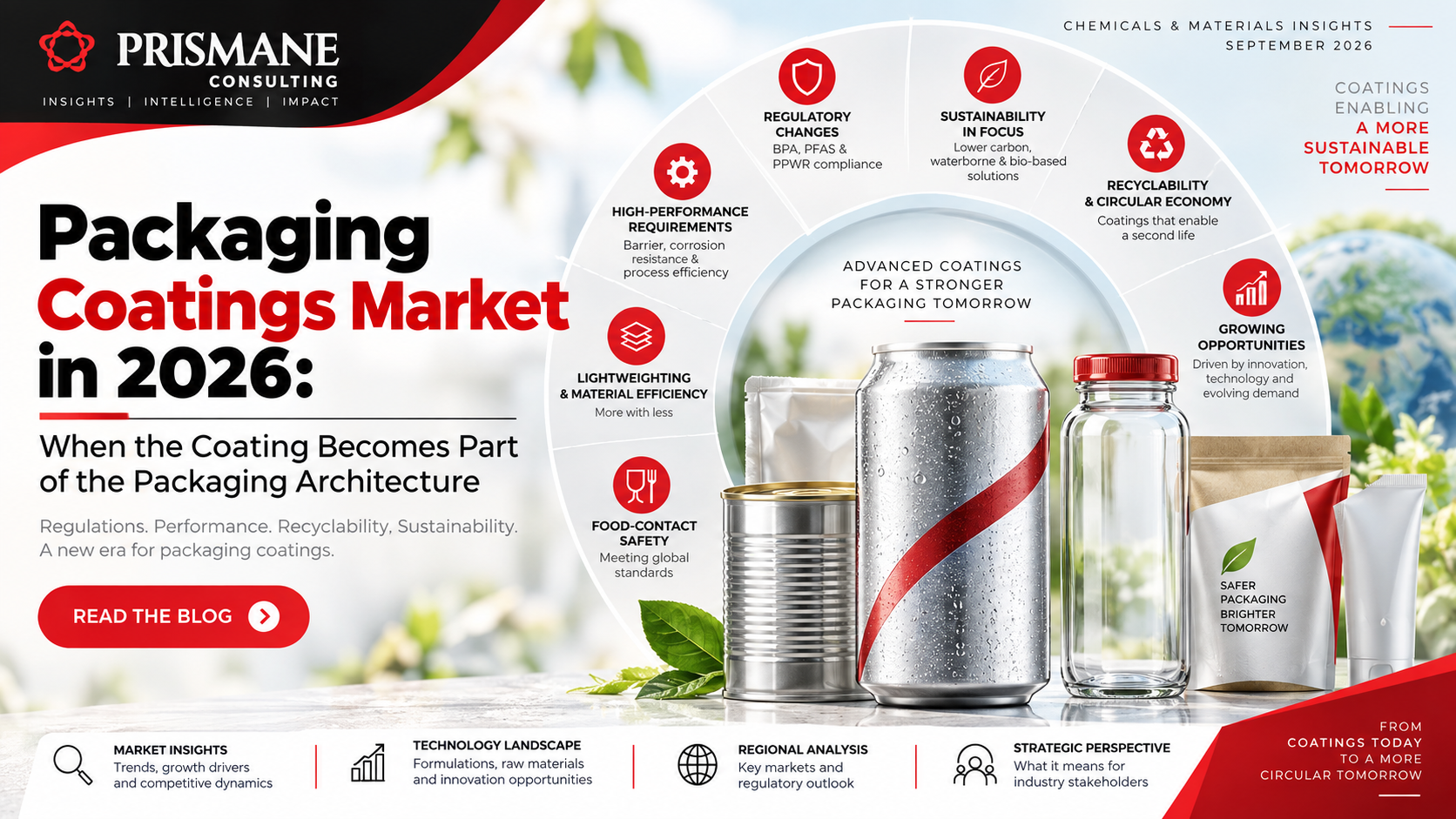
The packaging coatings market is entering a new phase of competition.
For years, the coating applied to a can, closure, tube or other packaging format was largely treated as an invisible functional layer. Its role was straightforward: protect the substrate, preserve the packaged product and provide the required appearance.
That definition is becoming too narrow.
In 2026, packaging coatings increasingly sit at the intersection of food-contact compliance, packaging recyclability, chemical regulation, lightweighting, production efficiency and sustainability. The coating still has to protect the package, but it must now perform within a much more demanding packaging system.
For packaging manufacturers, converters, coating suppliers and brand owners, the question is therefore changing. It is no longer simply whether a coating performs. It is whether it performs while meeting evolving regulatory requirements, supporting efficient production, reducing environmental impact and remaining compatible with future recycling systems.
Packaging Coatings Are Becoming a Regulatory Technology
Regulation has become one of the most important forces shaping the packaging coatings industry.
Europe has moved particularly quickly. Restrictions on bisphenol A (BPA) in food-contact materials are accelerating the transition away from conventional BPA-containing coating systems, directly affecting applications such as coatings used on metal food and beverage cans.
At the same time, the European Union's Packaging and Packaging Waste Regulation (PPWR) is reshaping expectations around packaging sustainability, recyclability and circularity. Restrictions concerning PFAS in food packaging add another layer of complexity for coating formulators and packaging manufacturers.
For packaging manufacturers, replacing a restricted substance is relatively straightforward if chemical compliance is the only objective. Replacing it while maintaining adhesion, corrosion resistance, flexibility, retort performance, taste and odour neutrality, shelf-life protection and production-line efficiency is considerably more difficult.
This is why BPA-NI coatings, BPA-free packaging coatings, PFAS-free coatings and food-contact coatings are becoming increasingly important technology categories within the global packaging coatings market.
The industry is not simply removing substances. It is rebuilding coating systems around a new regulatory baseline.
The Difficult Part Is Replacing Chemistry Without Losing Performance
Packaging is an unusually demanding coatings application.
A beverage-can coating may need to withstand forming, filling, sterilisation or pasteurisation, storage and distribution without compromising either the package or its contents. Food cans can encounter aggressive products and demanding thermal-processing conditions. Closures, tubes and specialty packaging introduce different mechanical, chemical and barrier requirements.
Consequently, the transition towards alternative packaging coating technologies cannot be evaluated through laboratory performance alone.
A coating may satisfy migration requirements but create difficulties on a production line. It may meet corrosion-resistance specifications but require changes to curing conditions. It may offer a lower carbon footprint but increase coating consumption or reduce processing efficiency.
This is shifting competitive advantage towards formulation capability combined with application engineering.
Packaging coating suppliers are increasingly working directly with can makers, converters and brand owners during qualification and production trials. The product being sold is becoming less like a formulation and more like a validated manufacturing solution.
Packaging Coatings Market Growth Is Not Uniform
The packaging coatings market should not be viewed simply as a volume-growth story.
Recent company performance illustrates how regulatory transitions, technology adoption and competitive share gains can create significant differences between suppliers.
PPG reported high-single-digit organic sales growth for its Packaging Coatings business in 2025, supported by higher sales volumes across regions and share gains in Europe. The company subsequently reported double-digit organic sales growth in packaging coatings during both the first and second quarters of 2026, with packaging coatings volumes more than 20% higher on a two-year stacked basis.
This points towards strong technology adoption and competitive share movement.
However, the broader industrial coatings environment provides a useful counterpoint. AkzoNobel reported lower volumes in its industrial coatings business in 2025, with packaging coatings affected by strong prior-year comparisons. Packaging volumes also remained lower in Q2 2026 even as other parts of industrial coatings improved.
The implication is important for companies assessing the global packaging coatings market.
Packaging coatings growth is increasingly being driven by technology transitions, regulatory adoption, customer qualification and competitive positioning, rather than simply by growth in overall packaging consumption.
This makes the market more nuanced than headline packaging demand figures might suggest.
Lightweight Packaging Is Increasing the Importance of the Coating
Packaging manufacturers continue to pursue lightweight packaging and material reduction.
In metal packaging, downgauging can reduce the amount of steel or aluminum required per package. However, thinner substrates can also leave less tolerance for weaknesses in corrosion protection, forming performance and coating adhesion.
As a result, the coating becomes a more important component of the overall packaging architecture.
This is particularly relevant for beverage cans, food cans and closures, where manufacturers are balancing material efficiency against demanding performance requirements.
A high-performance packaging coating that enables thinner substrates while delivering reliable forming, protection and efficient application can contribute to a broader packaging-optimisation strategy.
This creates a growing intersection between packaging coatings, lightweight packaging and sustainable packaging design.
Sustainability Is Moving From the Package Into the Coating
The sustainability discussion around coatings is becoming considerably more sophisticated.
It is no longer sufficient to describe a coating as waterborne, BPA-free or bio-based and assume the sustainability question has been answered.
Customers are increasingly evaluating the complete packaging system:
- How much coating is required per package?
- What is the curing-energy requirement?
- What is the solvent and VOC profile?
- What is the carbon footprint of the raw materials?
- Does the coating affect recycling?
- Can the package maintain its required shelf life?
- Does the formulation create additional processing requirements?
These questions are pushing suppliers towards sustainable packaging coatings, lower-carbon raw materials, improved application efficiency, waterborne technologies, alternative chemistries and more energy-efficient curing systems.
Sustainability is therefore becoming a broader concept than simply replacing one ingredient.
For metal packaging, this development is particularly important. The coating must protect the package during its first life without undermining the value of the metal during its next life.
Recycling Is Changing What “Good” Packaging Coating Means
The growth of the circular packaging economy introduces another layer of complexity.
Metal packaging already benefits from established recycling pathways, but the coating remains part of that system. As regulation increasingly focuses on recyclability, recycled content and resource efficiency, coating formulation can no longer be evaluated independently from end-of-life considerations.
The same principle extends to plastic, paper and flexible packaging.
Future packaging coating technologies will increasingly need to consider what happens after use, rather than focusing exclusively on filling, distribution and shelf life.
This could favor technologies that:
- Deliver high protection or barrier performance at lower coating weights
- Minimise substances that can create recycling challenges
- Support established recycling processes
- Reduce energy and emissions during application
- Maintain package performance across its complete lifecycle
The result is a fundamental shift from coating performance to packaging lifecycle performance.
Food-Contact Compliance Is Becoming a Competitive Differentiator
Food-contact compliance is also reshaping the competitive landscape.
Food-contact packaging coatings must address requirements associated with migration, potential interaction with food, taste and odour, processing conditions and documentation throughout the supply chain.
This makes regulatory expertise increasingly valuable.
For a packaging manufacturer, a coating supplier capable of supplying a compliant formulation provides one level of value. A supplier capable of supporting qualification, documentation, regulatory interpretation and production trials across multiple markets provides substantially greater value.
This is becoming particularly important as regulatory requirements diverge between regions.
A coating system developed for one market may not automatically deliver the same commercial advantage in another. Suppliers therefore need formulation flexibility and regional technical capabilities alongside global manufacturing scale.
The Next Competition Is Moving Upstream
The transformation of the packaging coatings industry is also creating opportunities further upstream.
The most important innovation may not always occur in the final coating formulation. Resin chemistry, crosslinkers, additives and alternative raw materials will increasingly determine whether suppliers can achieve the required combination of performance, regulatory compliance and carbon reduction.
This creates opportunities for polyester, acrylic and other alternative resin systems, alongside lower-carbon feedstocks and more energy-efficient curing technologies.
The value chain is consequently becoming more interconnected.
A packaging coatings supplier increasingly needs visibility into:
- Raw-material availability
- Regulatory status
- Chemical restrictions
- Carbon footprint
- Feedstock alternatives
- Future regulatory requirements
- Supply-chain resilience
Meanwhile, packaging manufacturers need confidence that coating technologies will remain compliant, technically viable and commercially available throughout the lifetime of their production assets.
“Supply security is therefore becoming part of the technology proposition”
What This Means for the Packaging Coatings Market in 2026
The packaging coatings market is moving away from a model where coatings are primarily judged on price, appearance and basic protection.
The next generation of packaging coatings will increasingly be evaluated against a broader set of criteria:
Food-contact safety | BPA-NI performance | PFAS-free formulation | Recyclability | Barrier performance | Lightweighting | Curing efficiency | Carbon footprint | Production-line compatibility
However, not every packaging format will move at the same pace.
Beverage cans, food cans, closures, tubes and specialty packaging have different technical requirements. Regional regulations will also influence adoption timelines and technology choices.
What is becoming increasingly clear is that packaging coatings are no longer simply protecting packaging.
They are helping determine whether the package itself can meet the regulatory, manufacturing and sustainability requirements of its next generation.
This is likely to make formulation capability, regulatory readiness and application engineering as important as coating chemistry itself.
In 2026, the competitive question is therefore shifting from:
“Which coating performs best?”
to:
“Which coating enables the packaging system to perform best?”
That is where the next phase of competition in the global packaging coatings market is likely to be decided.
Prismane Consulting Perspective
At Prismane Consulting, we view packaging coatings as an increasingly strategic component of the broader packaging value chain—not simply as a specialty chemical input.
Our Chemicals & Materials practice tracks the global packaging coatings value chain across packaging formats, coating technologies, regulatory developments, competitive positioning and upstream requirements for resins, crosslinkers, additives and specialty chemicals.
For packaging companies, coating manufacturers, chemical suppliers and investors, understanding these interconnected dynamics is becoming critical to identifying where the next opportunities—and risks—will emerge.
For insights or further information on Packaging Coatings, Paints & Coatings Markets, and related Chemicals & Materials intelligence, write to us at sales@prismaneconsulting.com.