
For most of its history, polyethylene competed on price per kilogram. A converter picked a grade, ran it, and the resin supplier's job ended at the gate. That model is breaking down. A recent collaboration between ExxonMobil Signature Polymers, Greenage Industries and Reinhardt Teknik to develop a rotomoulded kayak around a metallocene PE grade looks, on the surface, like a niche product story. We think it is something more significant: an early, well-documented example of polyethylene producers learning to sell manufacturing economics rather than molecules. Here is what we take from it, and what it means for anyone tracking the global polyethylene value chain.
Cycle time is now a resin selling point, not a processing footnote
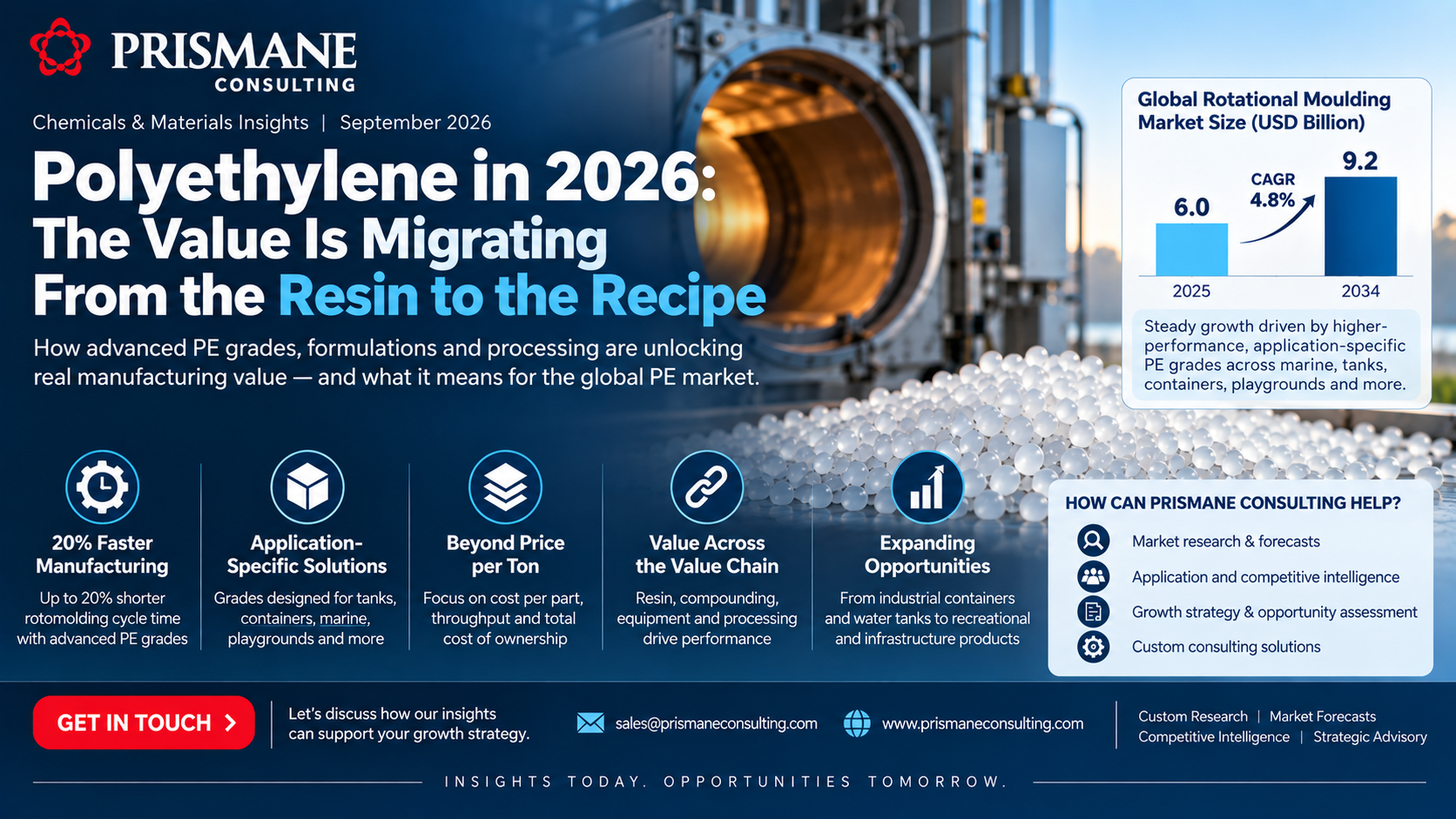
In the ExxonMobil, Greenage and Reinhardt Teknik development, the headline metric was not a mechanical property. It was a manufacturing one. The partners reported up to a 20% reduction in Rotomolding cycle time using ExxonMobil's Exceed Tough metallocene LLDPE alongside a Greenage compounded coloured powder formulation and Reinhardt Teknik's processing setup. Cycle time carries outsized weight in rotational moulding because the mould must pass through several thermal stages, heating, cooling and demoulding, before a part comes off the line. A material that reaches the required melt condition faster, tolerates a wider processing window or cools more efficiently earns its keep well beyond its mechanical datasheet. A 20% cycle-time reduction will not hand a converter a 20% cost reduction outright; labour, mould handling and loading stay largely fixed. But where thermal processing dominates the cycle, even a partial conversion of that saving into extra throughput moves the needle on utilisation across an entire installed asset base. That changes the question a resin supplier should be answering. It is no longer “how much does the resin cost?” It is “how much does this material cost me per finished part?” Once a converter starts asking the second question, impact strength and ESCR on a datasheet stop being the whole pitch. Hours of machine time saved, additional parts produced and cost taken out per unit become the currency.
Grade development is narrowing toward named end uses
ExxonMobil Signature Polymers' rollout of Exceed Tough m 4536UV12 makes the second trend explicit. This is a metallocene PE grade engineered for rotational moulding and positioned against a named set of applications: storage and septic tanks, containers, housings, marine and recreational products, and playground equipment, built around impact strength, environmental stress-crack resistance and processing latitude. This is a real change in how polyethylene gets marketed. A material is no longer positioned as one more entry in a broad LLDPE or HDPE family. It is built and sold around a specific application and that application's performance requirements, which is the difference between selling polyethylene as a commodity input and selling it as an application-specific solution. The same molecule carries very different economic value depending on where it lands. A kilogram of PE sold into a crowded commodity application has little room to differentiate. A formulation qualified for a demanding application supports a materially higher value proposition. We would not read this as a signal to displace commodity PE broadly. The opportunity is narrower and more specific: find the applications where a modest improvement in material performance creates a disproportionate benefit for the converter.
Portfolio branding signals a move from molecules to solutions
ExxonMobil's consolidation of its polyolefin portfolio under the Signature Polymers brand, rolled out in stages from the third quarter of 2024 through the second quarter of 2025, reinforces the point. Legacy names such as Enable, Optema, Escor and Paxon were folded into simplified lines including Exceed, Exxtra, Vistamaxx, Exact and ExxonMobil Performance Polymers. Read narrowly, this is a naming exercise. We read it as a commercial one. Simplifying navigation across a differentiated portfolio only pays off if the supplier expects converters to be choosing between application-matched grades more often, and wants the sales conversation to move away from resin price and toward application performance, processing efficiency and total cost of ownership. That shift changes what it takes to sell the material. A commodity resin sells on price, availability and a standard spec sheet. An application-specific grade requires sitting with a converter's process engineers, compounders, equipment suppliers and product designers, engagement that builds deeper relationships and raises switching costs once a material is embedded in a formulation and a process. We would watch closely for competitors following the same consolidation logic.
The compounding and equipment layer is where the value actually gets assembled
The kayak case matters for a further reason: the resin was never evaluated on its own. Greenage Industries built the compounded coloured powder formulation. Reinhardt Teknik brought the processing and equipment expertise. The commercial performance of a polymer is rarely the resin alone. A producer engineers the molecular architecture, but the compounder decides how that material behaves after pigmentation, stabilisation, additive incorporation and powder preparation, and the equipment supplier determines how efficiently the formulation becomes a finished part. Polymer architecture, additives, formulation, powder characteristics, mould design and processing conditions together set the part's economics. That cuts both ways for resin producers. The opportunity is to become embedded in the customer's development process, the way ExxonMobil did here. The risk is the opposite outcome: the compounder, equipment supplier or converter captures most of the downstream value while the resin producer stays an interchangeable raw-material supplier standing behind someone else's formulation.
Rotational moulding is a faster proving ground for advanced PE than cable or film grades
The contrast with high-performance cable applications makes the point well. Polyethylene systems in demanding cable applications sit behind stringent standards and long-term reliability expectations, so a material change typically means extensive testing before a new grade is trusted at scale. Rotational moulding is a different commercial environment. Performance is judged on impact resistance, ESCR, weatherability, stiffness and processing behaviour, and a converter can validate a new material directly on its own production line. That shorter qualification loop is precisely why new metallocene chemistry reaches commercial rotomoulded parts, a kayak included, well ahead of the highest-reliability electrical applications. It is also why Rotomolding is the more useful launch pad for a supplier trying to prove a material's worth through actual manufacturing performance rather than laboratory data alone.
The next opportunities sit in total cost of ownership, not USD per ton
The logic extends well past kayaks. Rotomolding already consumes significant PE volumes across marine products, water and chemical tanks, industrial containers, agricultural equipment, playground products and other large hollow components, each with its own mix of impact resistance, ESCR, chemical resistance, UV stability and processing-latitude demands. What makes any one of these segments attractive is the balance of volume, performance requirements, willingness to pay and competitive intensity, and the best target is rarely the largest application. It is the one where the incremental value of the advanced material is large relative to its added cost. Commodity PE is priced and judged on a simple chain: USD per tonne, margin per tonne, capacity utilisation, market share. Application-driven PE is won or lost on a different chain: USD per part, production hours, throughput, scrap, energy, total manufacturing cost. An advanced PE grade can carry a higher resin price and still produce a lower cost per part, which means its supplier is no longer competing against another resin. It is competing against the converter's total production cost, and that is a case won with data from the production floor, not a datasheet.
What it means
As per Prismane Consulting estimates, the global rotational moulding market was valued at roughly USD 6.0 billion in 2025 and is projected to reach approximately USD 9.2 billion by 2034, a CAGR of around 4.8%. Polyethylene remains the dominant feedstock across that base, but volume growth is not where we would focus attention. The more consequential shift is in product mix and value capture. A converter will pay a premium for a resin that demonstrably shortens cycle times, raises throughput, lowers scrap, extends part durability, widens the processing window or cuts energy consumption per unit, and that willingness to pay is what now separates a speciality grade from a commodity one. For resin producers, this calls for a different kind of market intelligence: not just PE demand by region, but which applications are moving toward higher-performance grades, where converters are hitting production bottlenecks, and how much economic value a material upgrade can genuinely unlock. Judged on those terms, a smaller application can be more strategically attractive than a larger one if it carries a stronger premium, faster growth and less competitive crowding. The kayak is not the new market. The shift toward performance-driven polyethylene, and the value it opens up for producers, compounders and converters willing to sell and buy on total cost of ownership rather than price per kilogram, is the real story.
Prismane Consulting Perspective
We would push this further than the case study itself. The question worth asking is not whether your business sells polyethylene well. It is whether you can say, with data, what your material does to a customer's cost per part, and whether you know which two or three applications in your portfolio could support a premium if you could prove it under real production conditions rather than on a datasheet. That is a different discipline from tracking capacity and operating rates, and it is where we expect the next pool of value in polyethylene to be won or lost.
Prismane Consulting tracks the global polyethylene and rotational moulding value chain, from resin technology and grade development to converter economics and regional demand, through its Chemicals & Materials practice. For the full Global Rotational Moulding Market Study, visit prismaneconsulting.com, or write to us at sales@prismaneconsulting.com.