
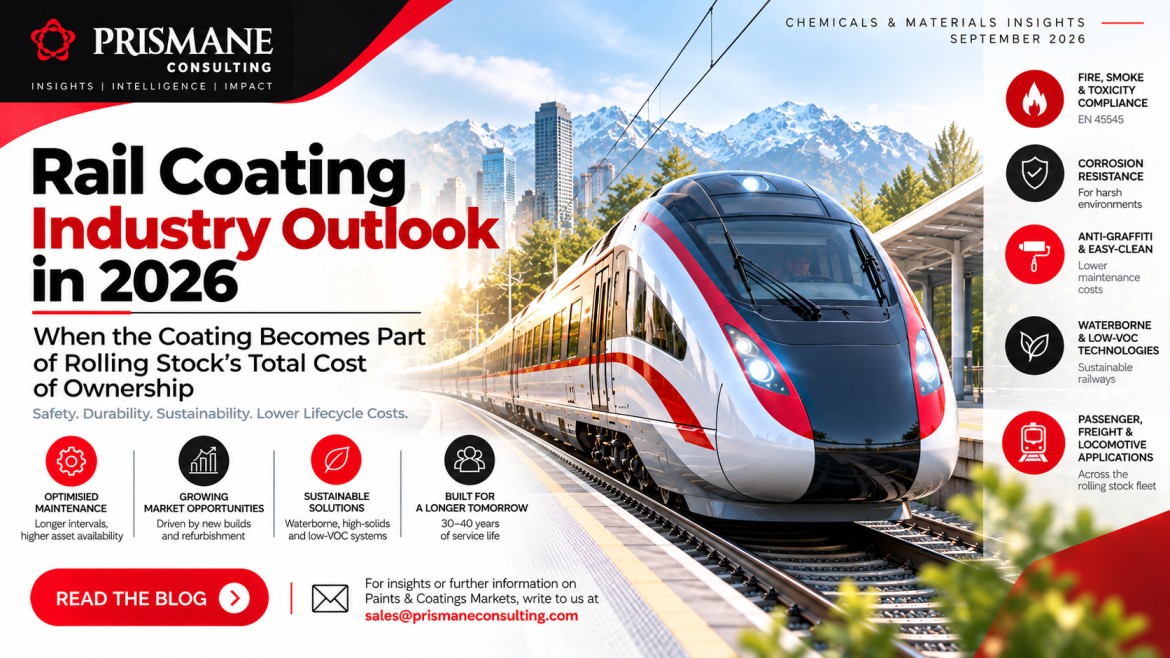
A locomotive or freight wagon is not repainted because it looks tired. It is repainted, or more often touched up, against a maintenance schedule set years in advance, on rolling stock that can remain in service for thirty to forty years.
That long asset life, combined with safety-critical fire performance requirements inside passenger vehicles, makes rail coatings a category where the coating is judged against decades of maintenance economics rather than a single point of sale. In 2026, this distinction is becoming more important as operators and rolling-stock manufacturers place greater emphasis on asset availability, maintenance intervals, application efficiency and environmental performance.
The railway coatings market is increasingly being shaped by how effectively a coating protects the asset while reducing the time and cost required to maintain it. This is gradually shifting the conversation from coating cost per litre towards total cost of ownership.
Rail Coatings Are Priced Against a Thirty to Forty Year Asset Life
Rolling stock is refurbished rather than replaced on anything like a passenger car's timeline. Repainting, corrosion remediation and component recoating therefore create recurring demand long after the original vehicle has entered service.
For operators, the commercial objective is not simply to purchase a lower-cost coating. It is to extend the period before the next major intervention while keeping the vehicle in service for as much of that period as possible.
This changes the value equation for coating suppliers. A system that extends maintenance intervals, reduces surface preparation or simplifies recoating can have a much greater economic impact than a relatively small difference in material price.
The same logic is driving greater attention towards curing speed and application efficiency. Rail maintenance facilities operate within tightly scheduled windows, and every additional day that a locomotive, coach or freight wagon remains in a paint shop is a day that the asset is unavailable to the operator. Current rail coating systems are increasingly being positioned around fast drying, ease of application and rapid return-to-service alongside corrosion and weathering performance.
Fire, Smoke and Toxicity Make Interior Coatings a Safety-Qualified Product
Rail coatings have another characteristic that separates them from many conventional industrial applications: some are directly tied to passenger safety.
In Europe, EN 45545-2 establishes fire protection requirements for railway applications, including requirements relating to flame spread and depending on the product and application, heat release, smoke and toxic gas emissions. This creates an additional qualification requirement for coatings used on relevant passenger-vehicle components.
An interior coating therefore cannot simply be reformulated to reduce cost, change raw materials or improve environmental performance without considering whether the modified system continues to meet the relevant fire-performance requirements.
This can slow chemistry substitution, particularly where an established coating system has already been qualified by a rolling-stock manufacturer or operator. It also makes testing, certification and technical support important parts of the supplier proposition alongside the formulation itself.
For passenger rail, this creates a different competitive environment from conventional industrial coatings, where a change in resin or additive package may be implemented primarily on the basis of application and cost performance.
Freight Coatings Are Being Judged on Impact Resistance and Turnaround Time
Freight rail creates a different coating challenge.
Wagons are subjected to loading and unloading impacts, abrasion, weather exposure and demanding operating environments. The coating therefore has to combine corrosion protection with mechanical durability, while allowing the vehicle to move through the maintenance shop quickly.
Recent developments in waterborne freight-rail systems illustrate this direction. Coating platforms are increasingly being designed around impact resistance, corrosion and weathering performance, fast drying and high-build application, with some systems also allowing direct-to-metal application or simplified processing. The objective is not only to reduce VOC emissions but also to improve workshop throughput and reduce the time an asset remains out of service.
This is important because waterborne technology is no longer being evaluated solely as an environmental alternative. Advances in resin chemistry are allowing waterborne systems to compete more directly on durability, adhesion and weatherability in demanding applications.
The same development is visible in powder coatings for selected rail applications, particularly railcar bodies, wheels and undercarriage components where controlled factory application is possible. Their combination of corrosion and weathering resistance with solvent-free application creates another route towards lower-emission finishing.
Anti-Graffiti Performance Is Becoming Part of the Maintenance Equation
Passenger and urban rail create another cost that is less significant in freight: cleaning.
Metro and commuter vehicles can be exposed to graffiti and repeated cleaning cycles throughout their operating lives. A coating that resists graffiti but deteriorates during repeated cleaning does not necessarily solve the underlying maintenance problem.
This is driving greater interest in anti-graffiti and easy-clean systems that can maintain adhesion, colour and gloss after repeated cleaning. The requirement is particularly relevant for high-utilisation fleets where vehicles can move through service multiple times a day and cleaning or refinishing can take an asset out of operation.
Rail-qualified powder systems, for example, are being developed with combinations of corrosion resistance, weathering performance, fire protection and resistance to anti-graffiti cleaners. This illustrates how several performance requirements are increasingly being brought together within the same coating specification.
The commercial value is therefore not limited to preventing graffiti. It lies in reducing the frequency and complexity of the maintenance response that follows it.
Waterborne and High-Solids Systems Are Moving from Compliance to Economics
Environmental requirements continue to push the rail coatings industry towards lower-emission technologies, particularly in markets with stringent VOC requirements.
But the more important development is that waterborne and high-solids systems are increasingly being evaluated on operational performance rather than environmental credentials alone.
Fast drying, high-build application, lower solvent use, reduced material consumption and easier application can all influence the economics of a coating system. Current high-solids rail products, for example, are being positioned around corrosion protection and rapid top-coating as well as lower VOC and HAP emissions.
This means the transition should not be viewed simply as solvent-borne coatings being replaced by waterborne coatings.
Different technologies will continue to coexist because rail applications are too diverse for a single chemistry to dominate. Epoxy systems remain important for corrosion protection and primers, polyurethanes continue to serve demanding topcoat applications, acrylic systems are gaining ground in selected applications, while powder coatings can offer advantages for components that can be processed under controlled factory conditions.
The competitive question is increasingly which technology provides the best combination of durability, application efficiency, regulatory compliance and lifecycle cost for a particular rail application.
Refurbishment Gives Rail Coatings a Different Demand Cycle
The size of the installed rail fleet creates a structural advantage for coatings suppliers.
New-build rolling stock generates demand, but an ageing fleet does not disappear when new production slows. It enters another phase of its economic life, where repainting, corrosion repair, component refurbishment and life extension become increasingly important.
That makes rail coatings less dependent on a single new-build cycle than many OEM-focused coatings markets.
It also creates a more technically demanding aftermarket. Refurbishment projects often involve existing coatings, variable substrates, difficult surface preparation and compressed maintenance windows. A system that performs well in a controlled new-build factory environment may not automatically deliver the same value in a refurbishment depot.
This is increasing the importance of technical service and application support, particularly where coating suppliers can help operators optimise surface preparation, film build, curing and recoating schedules.
Rail Coatings Are Becoming More Specialised, Not More Uniform
The industry is unlikely to converge around one universal rail coating technology.
Passenger coaches require colour retention, weathering resistance, cleanability and, in many interior applications, fire performance. Freight wagons face greater emphasis on impact and abrasion resistance. Locomotives combine demanding exterior exposure with branding and appearance requirements. Underframe and below-solebar applications introduce another combination of water, salts, dirt and mechanical exposure.
This application diversity creates room for several coating technologies to develop in parallel rather than forcing the industry towards a single replacement chemistry.
It also helps explain why established rail qualifications and technical relationships remain commercially important. Rail coatings are not simply general industrial coatings that happen to be applied to trains. Product approval, fire testing, application experience and compatibility with existing systems can influence supplier selection over a vehicle's operating life.
The Commercial Competition Is Moving Beyond Film Build
As rail fleets mature, coating consumption does not necessarily rise in direct proportion to the number of vehicles.
The bigger opportunity is to increase the value delivered by each maintenance intervention.
A coating that can be applied in fewer stages can reduce labour and workshop time. A faster-drying system can shorten the depot cycle. A more durable topcoat can extend the interval between major recoats. An anti-graffiti surface can reduce cleaning requirements. A lower-VOC formulation can improve environmental performance without sacrificing service life.
This is changing the commercial discussion between coating suppliers and rail operators.
Once the coating itself represents only one part of the total cost of a maintenance intervention, factors such as application efficiency, technical support, qualification, warranty and maintenance intervals become increasingly important in supplier selection.
What It Means
The rail coatings market is moving into a more performance-driven phase.
Corrosion protection remains the foundation, but it is no longer sufficient as the sole measure of coating value. Fire, smoke and toxicity requirements create a separate qualification barrier for passenger-vehicle interiors, while freight applications are placing greater emphasis on impact resistance, rapid drying and depot throughput.
Waterborne and high-solids technologies are gaining relevance as environmental requirements tighten, but their long-term opportunity will depend on their ability to deliver the durability and application performance expected from rail assets. Anti-graffiti and easy-clean systems are similarly being evaluated through their ability to reduce maintenance rather than simply provide a specialised surface characteristic.
The strongest structural opportunity remains refurbishment. Rail assets can remain in service for decades, and every additional year of service creates another opportunity for coatings to influence maintenance cost, downtime and appearance. This makes the aftermarket fundamentally different from a conventional OEM coatings cycle.
Market size is also difficult to compare across published estimates because definitions can vary significantly between rolling stock coatings and broader railway coatings that include infrastructure and other applications. For Prismane Consulting, the more useful approach is to maintain a clearly defined rolling-stock scope and build the market from vehicle demand, coating consumption, technology mix and refurbishment requirements rather than relying on inconsistent external market boundaries.
The more durable conclusion is that the value of a rail coating is increasingly being determined by what happens after it is applied.
A system that protects the vehicle for longer, reduces maintenance intervention, shortens workshop time or withstands repeated cleaning can influence the economics of the asset far beyond the initial material cost. As fleets age and operators place greater emphasis on availability and lifecycle cost, those characteristics are becoming increasingly important in coating selection.
For suppliers, this means the competitive proposition is moving towards a combination of coating chemistry, durability, safety qualification, application efficiency and technical service. For operators and rolling-stock manufacturers, the relevant measure is increasingly the cost of maintaining the vehicle over its operating life rather than the price of the coating itself.
Prismane Consulting tracks the global rail coatings value chain, including demand by rolling stock segment, coating technology, application, regional market dynamics, regulatory developments and competitive positioning, through its Chemicals & Materials practice. For insights or further information on Paints & Coatings Markets, write to us at sales@prismaneconsulting.com.