
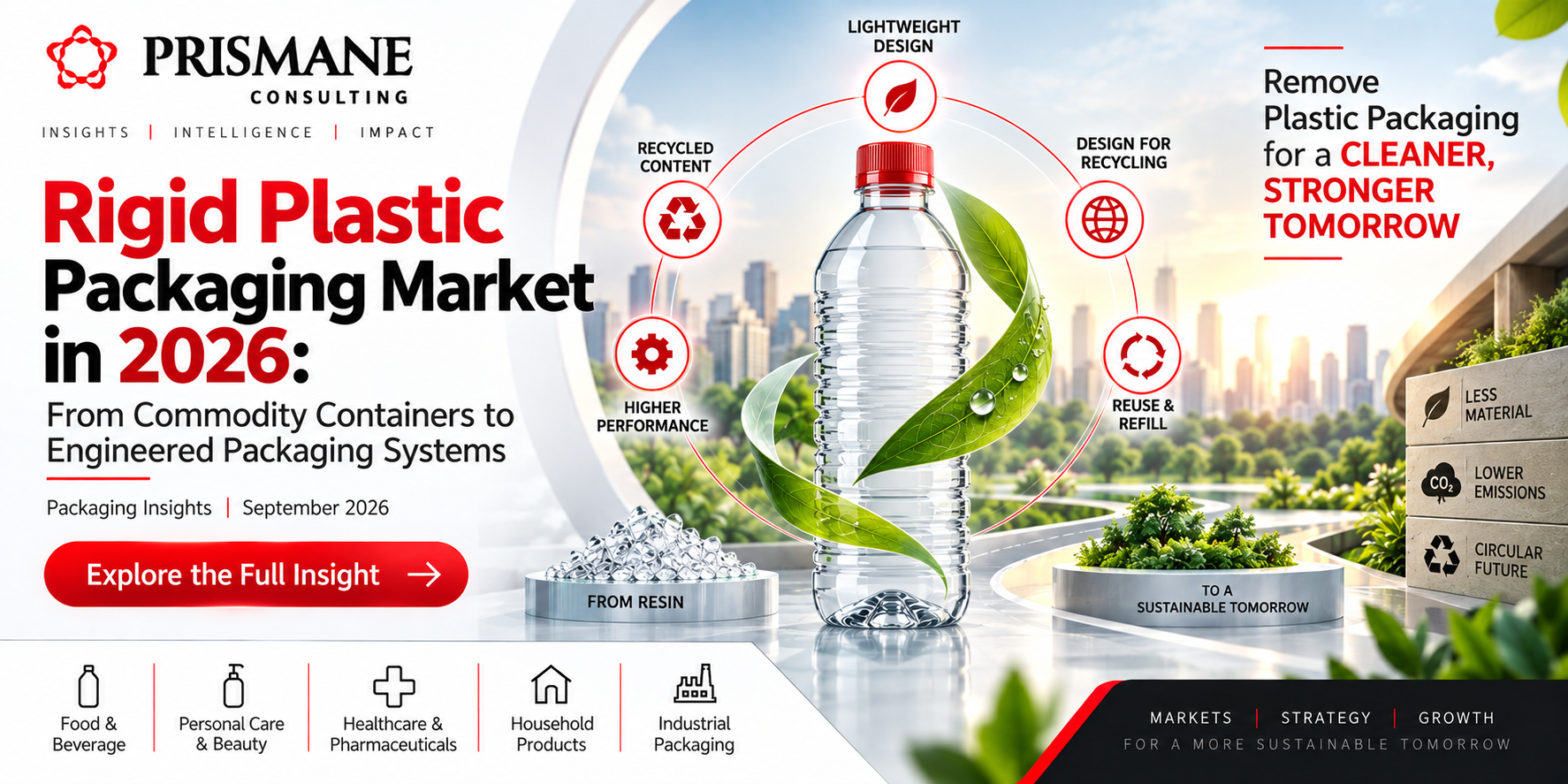
The rigid plastic packaging market is entering a new phase of competition. Bottles, jars, tubs, trays, cups, containers and closures continue to benefit from plastics low weight, durability, processability and design flexibility. Yet cost and scale are no longer the only competitive variables.
Lightweighting, recycled content, recyclability, barrier performance, filling-line compatibility and application-specific design are becoming equally important. A rigid package is increasingly evaluated as a complete system: resin selection, wall thickness, closure, color, label, mold design and processing can influence product protection, logistics, manufacturing efficiency and end-of-life recovery.
We see this transition as a shift from commodity container manufacturing toward engineered packaging systems. Through 2034, the key question will be how effectively suppliers can deliver product performance and manufacturing efficiency while reducing material intensity and improving circularity.
Rigid Plastic Packaging Is Moving From Volume to Value
Rigid plastics have historically offered an attractive combination of durability, low weight and efficient high-volume manufacturing. That proposition remains strong, but packaging decisions now involve more variables.
A container may need to incorporate recycled material, reduce virgin plastic, remain recyclable, protect the product, operate on automated filling lines and satisfy brand-owner sustainability requirements.
Regulation is accelerating this change. The European Union’s Packaging and Packaging Waste Regulation (PPWR) began applying on August 12, 2026, with major requirements around recyclability, recycled content, waste prevention and reuse being phased toward 2030 and beyond.
For packaging manufacturers, this means the lowest resin cost does not necessarily translate into the lowest total packaging cost. Compliance, EPR obligations, material recovery and customer requirements increasingly influence package economics.
Five Forces Shaping the Market Through 2034
PET, HDPE and PP Will Compete on Different Performance Platforms
The rigid plastic packaging market is unlikely to converge around one universal polymer.
PET will remain deeply embedded in beverage packaging and other applications requiring clarity, lightweighting, food-contact suitability and established recycling pathways. Its combination of low weight and mechanical performance makes it difficult to displace them in high-volume beverage formats.
HDPE will remain important where stiffness, chemical resistance, impact strength and product protection dominate. Household chemicals, personal care, industrial containers and selected food applications will continue to support demand.
PP offers heat resistance, stiffness and design flexibility, supporting tubs, cups, closures, food containers and household packaging.
The strategic question for converters and resin suppliers is therefore not simply which polymer will replace another. It is which material provides the best combination of performance, economics and circularity for a specific application.
Lightweighting Is Entering a More Difficult Phase
Lightweighting remains one of the most important trends in rigid plastic packaging because lower package weight can reduce resin consumption, transportation requirements and packaging-related emissions.
However, the easiest gains have already been captured in many mature formats. Reducing a bottle further while maintaining top-load strength, drop resistance, carbonation retention, dimensional stability and filling-line performance requires more sophisticated engineering.
Preform design, mold geometry, material distribution, stretch ratios, processing conditions and barrier technologies will therefore become increasingly important.
The lightest package is not necessarily the best package. Excessive material reduction can create performance or recycling problems. The objective is shifting toward optimal material intensity: achieving required performance with the lowest practical material use.
Recycled Content Is Becoming a Design Variable
Recycled plastic is moving from a sustainability initiative toward a core packaging specification. This is particularly visible in PET, where collection and recycling systems provide a relatively mature platform for recycled material.
India’s plastic packaging EPR framework also establishes progressive recycled-content obligations for specified packaging categories, increasing the importance of recycled resin in packaging strategies.
PCR is not, however, a simple drop-in replacement for virgin resin. Color, odor, contamination, viscosity, mechanical properties, appearance and food-contact requirements can affect incorporation levels.
This creates a distinction between recycled resin availability and application-qualified recycled resin. Converters with reliable PCR supply, quality-control capabilities and processing expertise can therefore differentiate themselves through consistency and performance.
Design for Recycling Is Becoming Packaging Engineering
Recyclability increasingly depends on the complete package rather than the container polymer alone.
A PET bottle may be recyclable in principle, while its color, label, adhesive, closure, sleeve or other components can influence sorting and recycling performance. Similar considerations apply to HDPE and PP packaging.
As regulatory requirements evolve, design-for-recycling is becoming a core development discipline. Resin suppliers, converters, mold designers, label suppliers, brand owners and recyclers will increasingly need to consider the package as a connected system.
This creates new value for packaging engineering. A format that costs slightly more to manufacture may become more attractive if it delivers better recovery performance, easier compliance and stronger alignment with customer sustainability targets.
Reuse Will Grow in Selected Applications
Recycling will remain central for many rigid plastic formats, but reuse and refill systems will gain relevance where collection, cleaning and redistribution can be economically organized.
Reusable containers require different designs because they must withstand repeated handling, washing, filling and transportation. They can also require stronger reverse logistics systems.
The PPWR includes reuse and refill measures, with important requirements phased toward 2030. However, reuse is not universally superior to recycling. Transportation distances, return rates, cleaning infrastructure and system scale determine its economics.
Closed-loop foodservice, institutional, transport and selected industrial applications are therefore more likely to provide opportunities than open, fragmented systems.
Where New Value Pools Will Emerge
Food and Beverage
Food and beverage will remain major volume engines for rigid plastic packaging, supported by urbanization, convenience consumption and packaged-product penetration.
Growth will increasingly favor formats that combine lightweighting, barrier performance, recycled content and filling-line efficiency. PET, HDPE and PP will continue serving different product requirements.
Personal Care and Beauty
In personal care and beauty, packaging also contributes to brand differentiation. Shape, transparency, dispensing, surface finish, weight and tactile quality can influence consumer perception.
This creates opportunities for higher-value rigid packaging where functionality and design intersect.
Healthcare and Pharmaceuticals
Healthcare packaging operates under demanding technical and regulatory requirements. Product protection, compatibility, sterilization, barrier performance and traceability can outweigh simple material cost considerations.
Specialized rigid packaging can therefore offer opportunities where qualification and technical capability create barriers to commoditization.
Household and Industrial Packaging
Household and industrial applications will continue to support demand for HDPE, PP and other rigid plastics where chemical resistance, impact strength, sealing and handling performance are important.
PCR integration can create opportunities, although contamination and performance requirements can make qualification more demanding.
The Container Is Becoming Part of the Manufacturing System
Packaging design is becoming increasingly connected to production-line performance.
A technically recyclable container can still be commercially unattractive if it slows filling, increases rejection rates, creates capping or sealing problems, or requires expensive equipment modification.
This becomes more important as manufacturers increase PCR content and reduce wall thickness. Changes in resin characteristics and container geometry can affect filling, sealing, capping, stacking and transportation.
Packaging suppliers that can demonstrate performance at commercial production speeds will therefore have an advantage. The boundary between packaging design and manufacturing is becoming less distinct.
Regional Markets Will Follow Different Paths
Europe is moving toward stronger requirements around recyclability, recycled content, packaging minimization and reuse, with PPWR providing a major regulatory framework.
North America will continue to combine strong demand for food, beverage and household packaging with growing attention to recycled content and recovery economics.
Asia-Pacific will remain a major structural growth region as packaged food, beverages, personal care, healthcare and organized retail expansion. India and Southeast Asia are particularly important markets, but local collection systems, informal recycling, resin economics and consumer purchasing power will determine the pace of circular packaging adoption.
For multinational packaging companies, regional strategies will increasingly be more relevant than a single global packaging roadmap.
What Will Define Leading Rigid Plastic Packaging Suppliers?
Manufacturing scale will remain important through 2034, but scale alone will not determine competitive positioning.
Leading suppliers will increasingly combine material science, packaging engineering, lightweighting expertise, PCR integration, manufacturing capability and design-for-recycling knowledge.
Their competitive model will expand from:
Resin → Conversion → Container
towards:
Material → Design → Processing → Product Performance → Recovery
This shift creates opportunities for polymer producers, compounders, converters, mold manufacturers, recyclers, machinery suppliers and brand owners that can collaborate across the packaging value chain.
The Rigid Plastic Packaging Outlook to 2034
Rigid plastic packaging is unlikely to disappear because of sustainability pressures. Instead, sustainability requirements are changing which formats remain competitive.
The fundamental advantages of plastics—low weight, durability, design flexibility, processability and compatibility with high-speed production—remain significant. But they increasingly need to coexist with lower virgin-material consumption, higher recycled content, improved recyclability and greater material efficiency.
Through 2034, value is likely to increasingly migrate toward:
- Lightweight engineered containers
- PCR-rich packaging
- Specialty rigid packaging
- Advanced closures
- High-performance barrier solutions
- Refillable formats
- Packaging designed around specific recovery pathways
The industry is therefore moving from volume optimization toward systems optimization.
From our perspective at Prismane Consulting, rigid plastic packaging is entering an era in which engineering and circularity will increasingly converge.
The strongest solutions will not necessarily be those using the least plastic, the highest recycled content or the cheapest resin in isolation. They will be solutions that optimize the complete packaging system.
That means balancing:
Material Efficiency + Product Protection + Manufacturing Economics + Recycled Content + Recyclability + Consumer Functionality
The strategic question is no longer simply whether rigid plastic packaging has a future. It is how the industry can deliver maximum functional value with minimum material intensity while remaining economically and technically compatible with evolving circularity systems.
Conclusion
The rigid plastic packaging market in 2026 is becoming a more sophisticated intersection of materials science, packaging engineering, manufacturing technology, recycling infrastructure and regulation.
PET, HDPE and PP will continue to play important roles, but their competitiveness will increasingly depend on application-specific performance.
Lightweighting will continue, although each incremental reduction will require greater engineering precision. PCR will expand, but consistency and qualification will become increasingly important. Design for recycling will become a core development discipline, while reuse will grow where closed-loop economics support it.
For packaging converters and suppliers, the opportunity is therefore not simply to produce more rigid plastic packaging. It is to develop better-engineered packaging systems that deliver more functionality with less material and greater circularity.
The transition from commodity containers to engineered packaging systems is likely to define the next decade of the global rigid plastic packaging industry.
Our packaging research evaluates market dynamics across the value chain—from raw materials and manufacturing technologies to applications, end-use industries, competitive landscapes and emerging opportunities.
For strategic insights on the rigid plastic packaging market, PET packaging, HDPE packaging, PP packaging, recycled plastic, sustainable packaging and broader packaging industry trends, connect with Prismane Consulting.
For further information on rigid packaging markets, contact Prismane Consulting at sales@prismaneconsulting.com.