
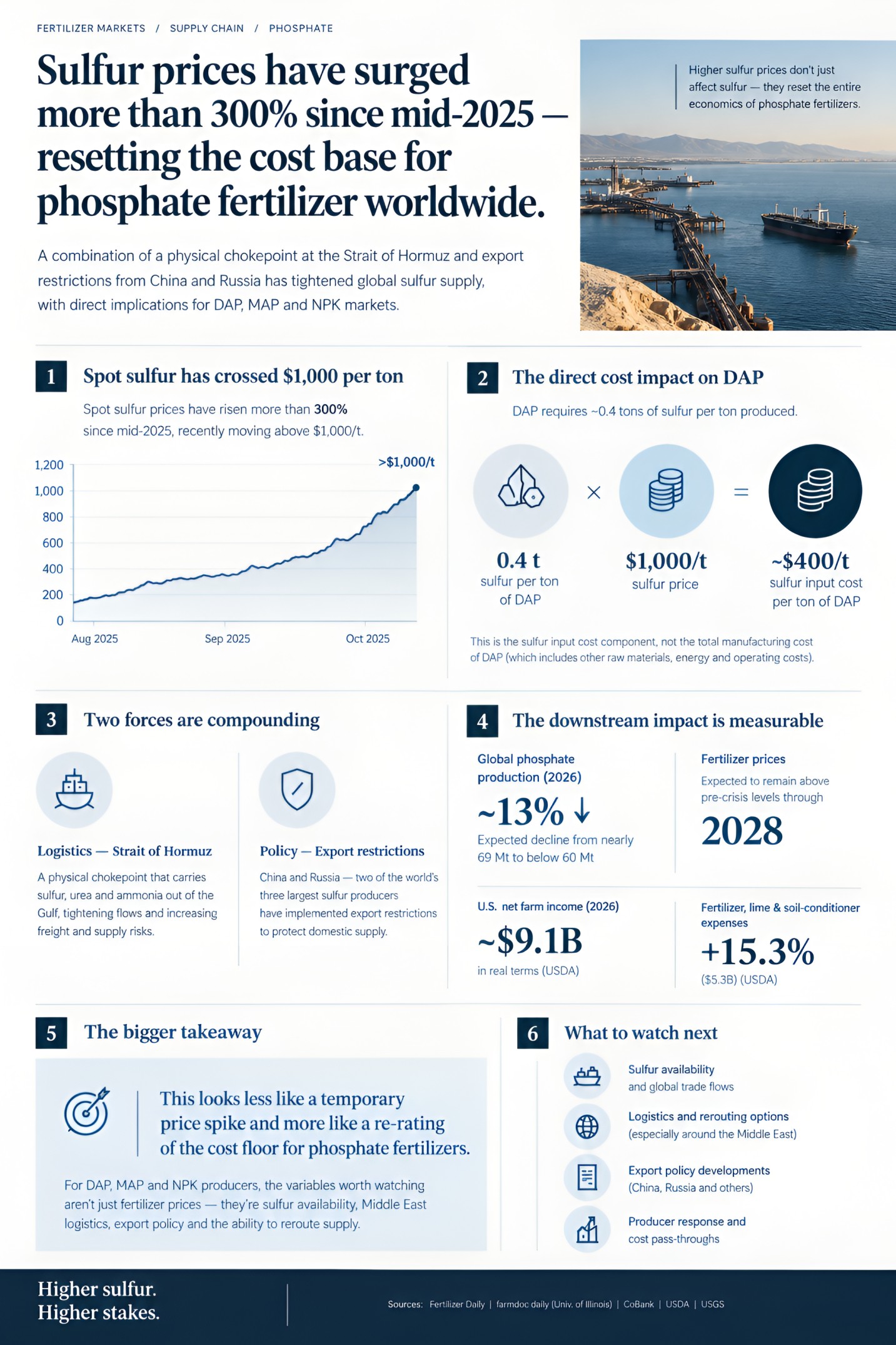
Sulfur has emerged as a critical cost variable for the global fertilizer industry. Spot sulfur prices have recently moved above $1,000/t, representing an increase of more than 300% since August 2025. The sharp escalation has been driven by a combination of Middle East logistics disruptions, tighter export availability and growing concerns over global sulfur supply.
The implications extend well beyond the sulfur market. Sulfur is a key feedstock for sulfuric acid production, which is fundamental to the manufacture of phosphoric acid and, subsequently, phosphate fertilizers such as DAP, MAP and phosphate-based NPK grades.
Why sulfur matters to phosphate fertilizers
The economics can be illustrated through DAP production. According to analysis from the University of Illinois, producing one tonne of DAP requires approximately 1.5–2.0 tonnes of phosphate rock, 0.4 tonnes of sulfur and 0.2 tonnes of ammonia.
At a sulfur price of $1,000/t, the sulfur requirement alone represents approximately $400/t of DAP before accounting for phosphate rock, ammonia, energy, conversion, logistics and other manufacturing costs.
This does not mean that sulfur represents $400/t of total DAP production cost. Rather, it demonstrates how rapidly a previously lower-cost input can become a significant component of the overall cost structure when its price increases sharply.
Supply constraints are amplifying the pressure
The sulfur market is facing pressure from both logistics and trade policy.
Middle East disruptions have affected the movement of sulfur and other fertilizer-related commodities through major trade routes. At the same time, Russia has implemented restrictions on exports of liquid, granular and lump sulfur. Russia's latest measure applies from July 1 through December 31, 2026, with specific exemptions.
The combination of constrained logistics and restricted exports has tightened internationally available sulfur supply and increased price volatility.
The impact is already visible in phosphate fertilizer markets. University of Illinois analysis shows that U.S. Corn Belt DAP prices increased from around $700/t early in 2026 to approximately $850/t by August, while sulfur prices moved above $1,000/t. The study also found a 0.70 correlation between DAP and Vancouver sulfur prices since 2024, highlighting the relationship between sulfur costs and phosphate fertilizer pricing.
DAP, MAP and nitrogen fertilizer prices
Recent U.S. fertilizer prices illustrate the broader market environment. As of September 9, 2026, reported U.S. averages were approximately $939/t for DAP, $1,087/t for MAP, $548/t for UAN 28% and $708/t for UAN 32%.
Global benchmarks show a similar cost environment. In early September, Indian DAP was assessed at approximately $900–920/t CFR, while Brazilian MAP was around $830–850/t CFR. Despite recent price corrections, these levels remained substantially above the beginning-of-2026 Indian DAP benchmark of approximately $668–669/t CFR.
For sulfur-containing fertilizers, the pressure is also evident. Ohio's second-quarter 2026 fertilizer survey placed thiosulfate 12-0-0-26 at an average of $494/t, compared with $805/t for DAP and $845/t for MAP in the same survey.
What does this mean for producers?
For DAP, MAP and NPK producers, sulfur availability is increasingly becoming a strategic consideration rather than simply another raw-material cost.
Higher sulfur prices can raise production costs, while logistical disruptions and export restrictions can limit access to physical supply. Producers therefore face increasing pressure to secure sulfur, optimize procurement, manage inventories, and determine how much of the additional cost can be passed through to customers.
For buyers and downstream fertilizer markets, the key variables to watch are sulfur availability, Middle East logistics, export policies, phosphate rock and ammonia costs, and producer cost pass-through.
The current sulfur market therefore represents more than a temporary commodity price increase. It is reshaping the cost dynamics of phosphate fertilizer production and could continue influencing DAP, MAP and NPK pricing, production economics and global trade flows as the market moves through 2026 and into 2027.
At Prismane Consulting, we work across DAP, MAP, ATS, UAN and NPK fertilizer markets, analyzing capacity, pricing, feedstock economics, supply chains and market developments to help clients understand changing fertilizer economics.