
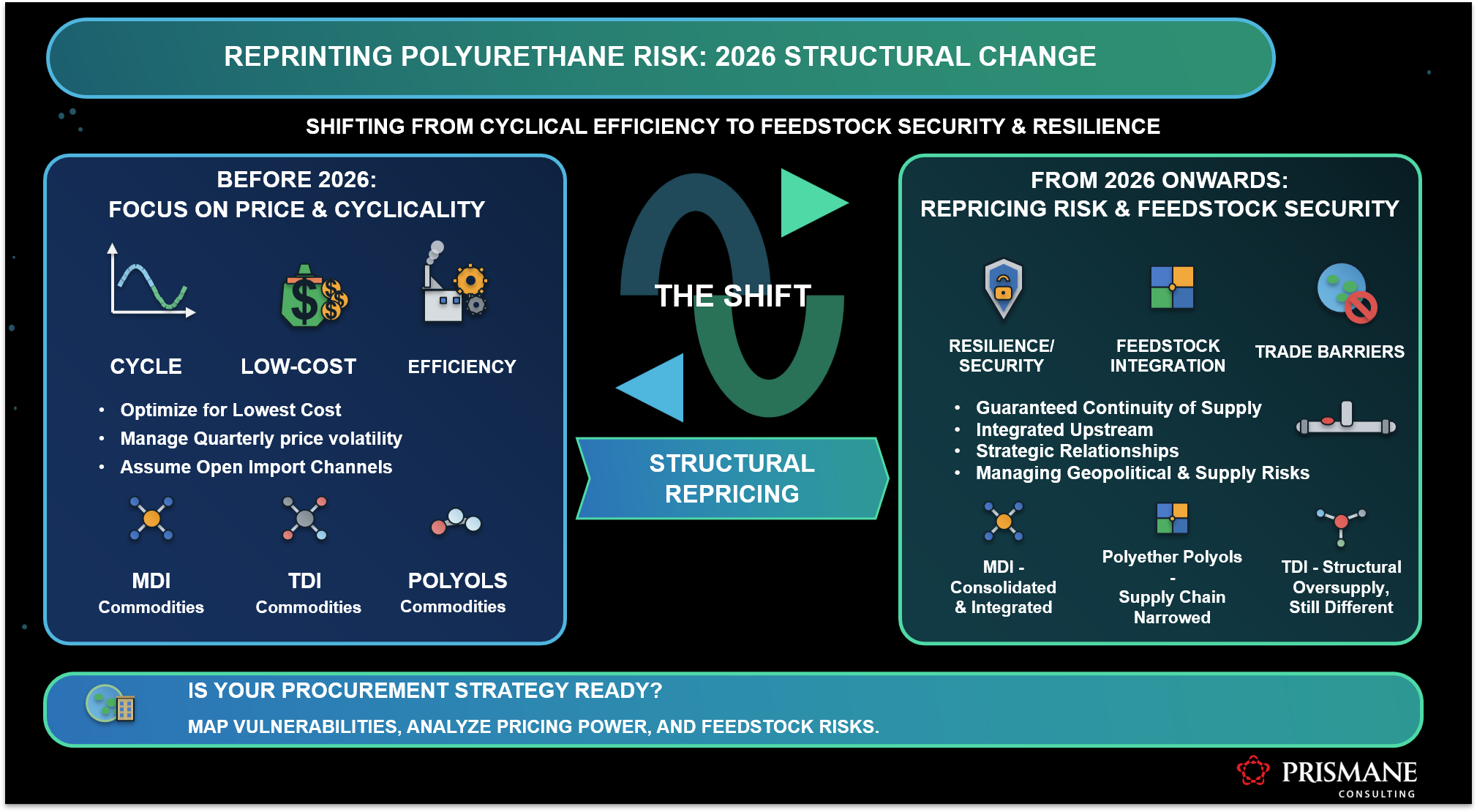
Why 2026 marks the beginning of a structurally different polyurethane market rather than the end of another downcycle.
For much of the first half of 2026, the narrative around polyurethane looked encouraging. Prices for MDI, TDI and polyether polyols strengthened, producers adopted a more constructive tone, and market commentary increasingly pointed toward the start of a recovery.
We believe that interpretation is incomplete.
The defining feature of 2026 has not been stronger demand. It has been the repricing of supply risk, and that distinction is more than semantics. Demand cycles are temporary, while structural changes in supply chains reshape industries for years. This year, geopolitical disruption, feedstock shortages, trade intervention and corporate restructuring converged to change how the polyurethane value chain manages security of supply. Prices moved accordingly, even as many downstream industries continued to struggle.
Understanding that difference matters, because companies preparing for a cyclical recovery may be optimizing for the wrong future.
The Market Is Sending Two Different Signals
Normally, rising prices and improving sentiment signal strengthening demand. That was not the case in 2026.
The initial rally across polyurethane intermediates was triggered less by improving consumption than by fear over supply continuity. Escalating tensions in the Middle East and the temporary closure of the Strait of Hormuz disrupted expectations around energy and petrochemical feedstocks. Buyers responded predictably: inventories were rebuilt, purchasing accelerated, and suppliers gained pricing leverage. The resulting increases created the appearance of improving fundamentals.
Beneath the pricing, though, end-use demand remained subdued. Construction activity continued to disappoint across several major economies. Automotive production forecasts weakened as manufacturers trimmed expectations. Furniture and bedding markets stayed under pressure from cautious household spending.
In other words, prices strengthened while demand softened.
That combination is unusual but not unprecedented. Markets reprice when supply uncertainty becomes more important than consumption. The important question is whether those supply risks disappear once geopolitical tensions ease, and increasingly, the answer appears to be no. This is the dynamic we traced in Polyether Polyols Price: The Quiet Casualty Reshaping Global PU Supply: a chain repricing on geopolitical and feedstock shocks, not on real downstream pull.
There Is No Single Polyurethane Market
One of the industry's biggest analytical mistakes is treating polyurethane as a single market. It isn't. The events of 2026 showed that MDI, TDI and polyether polyols responded to fundamentally different constraints despite serving the same downstream industries.
To put the scale in context, global polyurethane demand stands at roughly 27,000 kilotons, split broadly across MDI at around 10,500 kilotons, TDI at about 3,000 kilotons, and polyether polyols at approximately 9,500 kilotons, with Asia-Pacific accounting for close to 55% of consumption. The three intermediates, however, sit in very different supply positions.
Polyether polyols experienced the sharpest disruption after force majeure declarations hit propylene oxide availability. Multiple suppliers moved customers onto allocation simultaneously, sharply reducing spot liquidity. Availability, not demand, became the principal driver of pricing. Global polyether polyol capacity is estimated at around 16,000 kilotons, of which roughly 55% sits in China, leaving Western markets structurally dependent on a narrower regional supply base once imports tighten.
MDI followed a different path, tightening through upstream chlorine and carbon monoxide constraints combined with planned and unplanned outages. Global MDI capacity is estimated at approximately 12,500 kilotons against demand of around 10,500 kilotons, an operating rate near 84%. The market is also highly concentrated, with the top producers (Wanhua, BASF, Covestro and Dow) controlling close to 70% of global capacity. Unlike many commodity chemicals, a significant share of MDI is produced as highly specialized grades with limited substitution, and that combination of concentration and reduced flexibility amplified the impact of operational disruptions and helped MDI hold firmer than the commodity average. It is also, tellingly, where the industry is now adding capacity.
TDI presented an entirely different picture. Global TDI capacity is estimated at roughly 4,200 kilotons against demand of around 3,000 kilotons, leaving operating rates near 71% and the market in structural oversupply. Additional capacity, weaker differentiation and slower long-term demand growth continue to pressure producers despite periodic pricing improvements.
Grouping these under a single pricing narrative obscures the strategic reality. A converter buying MDI for insulation systems faces a fundamentally different supply landscape than a mattress manufacturer sourcing flexible slabstock polyol, or a foam producer buying TDI. Increasingly, procurement strategy has to reflect those differences.
The Four Relief Valves Are Narrowing
Historically, the polyurethane industry had several mechanisms that softened the impact of temporary disruptions. When one supplier ran into difficulty, buyers relied on four relief valves:
- Imports
- Supplier substitution
- Inventory drawdowns
- Delayed purchasing
Through 2026, each became less effective.
Trade policy narrowed import flexibility. Antidumping measures reduced access to Chinese MDI in key Western markets, China's removal of export VAT rebates altered the economics of polyether polyol exports, and higher tariffs across multiple chemical chains further cut sourcing options. Supplier substitution grew harder as simultaneous production disruptions hit multiple producers at once. And as inventories normalized after earlier destocking, the buffer that stock drawdowns once provided thinned out.
For procurement organizations accustomed to managing cyclical volatility, this is a structural change, not a passing one. The industry's traditional shock absorbers are becoming less reliable, and they are unlikely to be restored when the current price cycle turns.
Producer Strategy Reveals Where the Market Is Heading
Perhaps the strongest evidence that the industry is changing comes not from pricing but from capital allocation. Companies reveal their long-term expectations through investment decisions, not quarterly commentary. Viewed that way, two developments stand out, and they point in the same direction.
The proposed combination of Olin and Huntsman is fundamentally a feedstock-integration strategy. Olin contributes one of North America's largest chlor-alkali businesses, and chlorine is a core input to Huntsman's MDI and polyurethane systems. Huntsman's Geismar MDI site sits alongside Olin's Louisiana chlor-alkali assets, forming an integrated US Gulf Coast cluster with feedstock access at producer economics. The combined company strengthens control over critical upstream raw materials while reducing exposure to third-party supply volatility.
Covestro's expansion points to the same conclusion from the other end of the barrel. Backed by XRG, the Abu Dhabi platform linked to ADNOC, Covestro announced a new world-scale MDI investment in Shanghai while evaluating additional capacity in the UAE. This is an energy major reaching downstream into MDI, marrying feedstock ownership with polyurethane capacity in the regions where demand growth is expected to be strongest over the coming decade. To put the new Shanghai train in perspective, its roughly 660 kilotons annual capacity represents about 5% of current global MDI capacity, and China already accounts for close to 45% of the world's total MDI capacity.
These are not isolated decisions. They reflect a common assumption: competitive advantage is increasingly determined by secure access to feedstocks rather than manufacturing efficiency alone. For much of the past decade, success depended on optimizing production costs. The next decade may instead reward the companies that can guarantee continuity of supply.
Procurement Is Becoming a Strategic Function Again
For downstream converters, the implications extend well beyond purchasing. The key question is no longer whether prices rise or fall next quarter. It is whether procurement is prepared for a structurally different supply environment. Several long-held assumptions deserve reconsideration.
The lowest-cost supplier may no longer represent the lowest total risk. Import markets may not offer the flexibility they did during past disruptions. Supplier diversification is becoming a permanent operating requirement rather than a contingency plan. And long-term strategic relationships may create more enterprise value than short-term pricing advantages, particularly with the supplier base itself consolidating into larger, feedstock-secure players with more pricing discipline.
These considerations increasingly separate resilient supply chains from vulnerable ones. Procurement is once again becoming a strategic capability rather than a transactional one.
Beyond the Current Cycle
It would be easy to read 2026 as just another volatile year in a cyclical industry. History suggests otherwise.
Commodity cycles explain changes in utilization rates and pricing. They do not explain why trade barriers continue to expand. They do not explain why leading producers are investing billions in upstream integration. They do not explain why buyers are finding fewer sourcing alternatives during periods of disruption.
Those developments point toward structural change. The polyurethane industry is transitioning from an era defined primarily by production efficiency toward one where resilience, supply continuity and feedstock security become equally important sources of competitive advantage. Companies that keep optimizing exclusively for price may find themselves exposed to disruptions they can no longer mitigate through traditional sourcing.
The market is not simply recovering. It is reorganizing itself around a different definition of competitive strength, and those who recognize that shift early will be better positioned for whatever the next cycle brings.
At Prismane Consulting, we spend our time beyond the headline price, mapping where pricing power really sits across MDI, TDI and polyols, where the import relief valves have closed, and why the industry's largest players are spending to integrate upstream. We first traced this repricing in our analysis of the polyether polyols chain and the Middle East conflict. The consolidation that followed only reinforces it across the wider value chain.
Interested in how these dynamics affect your specific MDI, TDI or polyol sourcing and pricing strategy? Get in touch with Prismane Consulting.
Capacity, demand and operating-rate figures cited above: Prismane Consulting database.