
India’s Paints and Coatings Market Is Entering a New Competitive Phase
Three years ago, the competitive story in India’s decorative paints market was still largely about who could build the strongest dealer network, reach more towns and spend more effectively behind the brand. That equation is changing.
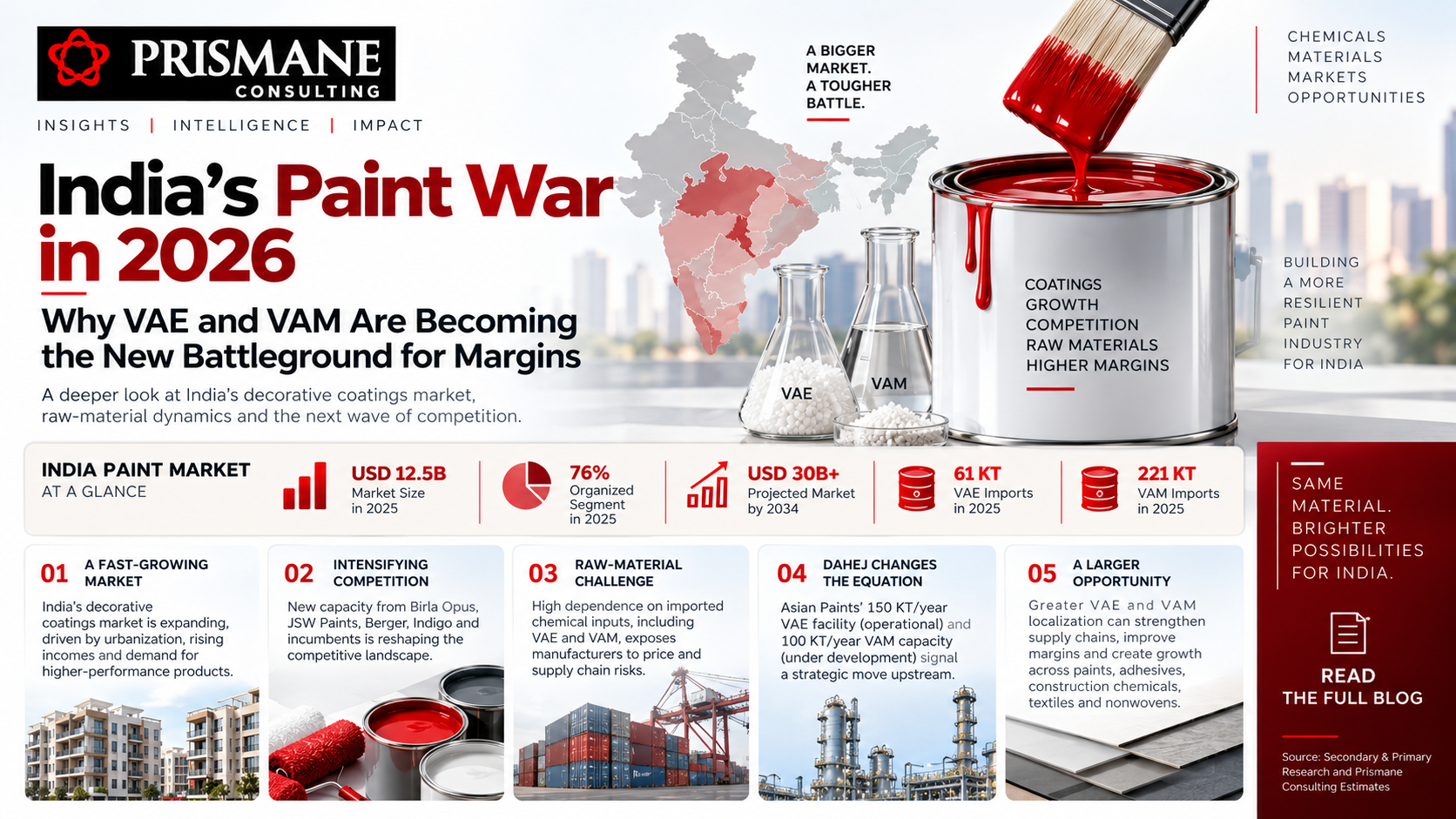
India’s decorative coatings market is expanding while the industry absorbs a new generation of capital-intensive competitors. Grasim has built Birla Opus at significant manufacturing scale. JSW Paints has expanded through the acquisition of Akzo Nobel India. Berger continues to invest in capacity and distribution, while Indigo Paints and established leaders are defending their positions through different combinations of product, manufacturing and market strategies. As competition intensifies, another question is becoming increasingly important:
Who controls the raw materials underneath the paint?
That is where Asian Paints’ investment in VAE and VAM at Dahej becomes strategically important. The company has commenced commercial production from its 150 kilotons per year VAE facility and is developing 100 kilotons per year of VAM capacity. The project is not simply another chemicals investment. It represents a move further upstream into a value chain that has historically depended significantly on imports.
India Paints and Coatings Market 2026: Key Numbers

Source: Secondary & Primary Research and Prismane Consulting Estimates
India’s Paints and Coatings Market Is Growing Fast Enough to Attract Serious Capital
India’s decorative coatings market is already substantial and continues to expand. Prismane Consulting estimates the market at approximately USD 12.5 billion in 2025, with the market projected to exceed USD 30.0 billion by 2034. The organised segment accounted for approximately 76% of the market in 2025, reflecting the continued shift towards branded coatings, stronger distribution networks and higher-performance decorative products.
As the market expands, paint manufacturers are increasingly balancing finish quality, durability and application performance against raw material costs and margins. This is bringing greater attention to binder selection, with Vinyl Acetate Ethylene (VAE) and Vinyl Acetate Monomer (VAM) technologies becoming increasingly relevant to the evolution of water-based decorative coatings. Growth at this scale was bound to attract new capital, and the competitive structure has consequently started to change.
Birla Opus has completed its first phase of expansion with six greenfield plants and a total installed capacity of 1,332 million litres per annum. Following the commissioning of its Kharagpur plant in October 2025, the company reached approximately 24% of organised decorative paints capacity in India, according to the underlying analysis. Its manufacturing platform is also backward integrated into emulsions and resins, giving the business greater control over important intermediates as it scales.
JSW Paints has taken a different route, completing the acquisition of a 60.76% stake in Akzo Nobel India in December 2025. Following the open offer, its overall holding reached 61.2%. The transaction brought established brands including Dulux, International and Sikkens into the JSW portfolio and expanded its presence across India’s decorative and industrial coatings markets.
Berger continues to strengthen its manufacturing and distribution network, while Indigo Paints has built its position through product differentiation, manufacturing and market development. The result is an industry with substantially more capacity and increasingly intense competition for growth. That makes the cost of producing each litre more important than before.
For paint manufacturers, therefore, the question is no longer simply how much capacity can be added, but how efficiently can that capacity be operated while maintaining the performance expected from modern decorative coatings.
The Raw-Material Problem Sits Underneath the India Paints and Coatings Market Growth Story
Paint companies cannot fully control their cost curve simply by adding manufacturing capacity. A significant part of the industry’s economics remains exposed to imported chemical inputs and international supply chains. Titanium dioxide remains a major formulation cost, while polymers and other intermediates can expose manufacturers to international pricing, freight, currency movements and supply disruptions.
VAE and VAM are particularly relevant because they sit directly within the value chain that Asian Paints is now bringing into India. India imported approximately 61 KT of VAE in 2025, while VAM imports were approximately 221 KT. Around 98% of VAM imports came from Saudi Arabia and Singapore. The VAM number is particularly important because VAM is the monomer used to manufacture VAE.
India therefore has exposure not only to imported finished polymer but also to the imported intermediate beneath it. That makes domestic VAE capacity only part of the solution.
Dahej Changes the Equation From VAE to VAM
Asian Paints 150 KT/year VAE facility should not be interpreted as 150 KT of merchant supply suddenly entering the Indian market. The facility is primarily designed around the company’s captive requirements. Its significance is therefore strategic rather than simply volumetric.
Domestic VAE production can reduce Asian Paints exposure to imported polymer while providing greater control over supply planning, inventory and product development. It can also reduce exposure to freight and currency movements associated with imported material. But the more important move is upstream.
The company is developing 100 KT/year of VAM capacity, alongside ethylene storage and handling infrastructure. Once operational, this would address another major source of import dependence and give Asian Paints greater control over the economics of its VAE production.
The project is therefore best understood as a phased integration strategy. VAE production is already operational, while VAM and associated upstream infrastructure remain under development. That distinction changes the broader market question. The issue is no longer simply whether India can produce VAE domestically.
It is whether India can progressively build a domestic value chain around it.
VAM Localization Creates an Upstream Opportunity
The next link in the chain is acetic acid. VAM production requires acetic acid and ethylene, making domestic VAM production strategically relevant to India’s upstream acetic acid market. This is significant because India remains heavily dependent on imported acetic acid.
GNFC currently operates an acetic acid capacity and is a sole domestic producer. The company has also signed a MoU with INEOS Acetyls to evaluate a 600 KT/year acetic acid plant at Bharuch, targeted for 2028. GNFC has indicated that India imports approximately 85% of its annual acetic acid requirements.
The GNFC opportunity is therefore part of a broader value-chain development rather than a direct extension of the Asian Paints project. If India adds VAM capacity, the domestic requirement for acetic acid becomes more strategically relevant. Additional local acetic acid availability could, in turn, strengthen the economics of downstream VAM and VAE production.
India’s Potential VAE and VAM Value Chain
Acetic acid and ethylene are key feedstocks for VAM production. VAM is subsequently used to manufacture VAE. VAE serves downstream applications including paints and coatings, adhesives, construction chemicals, textiles and nonwovens.
Greater domestic availability across these stages could strengthen linkages between India’s upstream chemical producers and its growing downstream paints and coatings and materials industries. The more of that chain that can be supplied domestically, the less dependent downstream industries become on imported intermediates.
Vertical Integration Is Becoming One of Several Competitive Strategies in the India Paints Market
This does not mean every paint company will build its own VAE or VAM plant. The economics of integration depend on consumption scale, capital availability, technical requirements and the strategic importance of the input.
Asian Paints has the downstream scale to justify captive VAE production and is taking integration further into VAM. Birla Opus demonstrates another approach. Grasim entered the market with large-scale manufacturing and integrated emulsion and resin production from the outset.
JSW Paints has used acquisition to build scale and market access rather than pursuing paint-specific feedstock integration. Berger continues to combine manufacturing investment with distribution strength, while Indigo Paints competes through a different balance of product positioning, manufacturing and market reach.
The important point is not that one strategy will replace all others. It is that raw material control is becoming part of the competitive toolkit.
For a large paint manufacturer, domestic production of a strategic input can provide a hedge against imported material costs and supply disruptions. For companies without sufficient scale to integrate, the response may instead involve long-term sourcing arrangements, formulation optimisation, manufacturing efficiency or differentiated products.
As competition becomes more intense, each company will have to determine which parts of the value chain are worth controlling and which are better sourced externally.
Import Substitution Could Also Expand the VAE Market
The immediate impact of domestic VAE production is likely to be import substitution, but the longer-term effect could be broader. VAE is relevant beyond decorative paints, including adhesives, construction chemicals, textiles and nonwovens. A domestic supply base can reduce lead times, inventory requirements and exposure to international logistics and currency movements, potentially making VAE-based formulations more accessible to downstream users.
This does not mean imported VAE will disappear. Different grades have different performance requirements, and specialised products may continue to be imported. Instead, the sourcing mix could evolve, with domestic production addressing strategically important volumes while imports continue to serve specialised requirements and supply gaps.
That creates the possibility of both import substitution and demand expansion. India does not necessarily have to remain a 61 KT VAE market simply because that was the scale of imports in 2025.
What VAE and VAM Localization Could Mean for India’s Paints and Coatings Industry
The strategic implications extend beyond one manufacturer or one production facility.
- Greater Control Over Input Costs: Domestic production can reduce exposure to international freight, currency movements and imported-material price fluctuations.
- More Resilient Supply Chains: Local availability can improve supply planning and potentially reduce dependence on international logistics.
- Greater Control Over Formulation Development: Captive access to strategic intermediates can provide manufacturers with greater flexibility in product development and formulation optimisation.
- New Opportunities for Upstream Chemical Producers: Additional VAM production could increase demand for domestic acetic acid and strengthen linkages between upstream and downstream chemical markets.
- Potential Downstream Market Expansion: Greater VAE availability could support wider adoption across paints, adhesives, construction chemicals, textiles and nonwovens.
These developments do not eliminate competitive pressure. Instead, they change where some of that pressure is managed, from the finished paint market towards the underlying chemical value chain.
The Paint Battle Is Moving Upstream
This is ultimately why the Dahej project matters beyond Asian Paints. India’s decorative coatings market is growing, but the competitive structure is changing with it. Birla Opus has introduced large-scale manufacturing and backward integration. JSW Paints has expanded through acquisition. Berger continues to invest in manufacturing and market reach, while Indigo Paints and other established players are pursuing their own combinations of product differentiation, manufacturing efficiency and distribution.
At the same time, Asian Paints is moving upstream into VAE and VAM. The industry’s next phase will therefore be shaped not only by those who can sell more paint, but also by who can manage the economics of the inputs required to produce it.
For Asian Paints, VAE is the first major step. VAM takes the integration further.
For upstream producers such as GNFC, increasing VAM localisation could create additional demand for domestic acetic acid. The immediate story is import substitution. The larger story is control of the value chain.
If domestic VAM capacity develops alongside VAE, while India expands its acetic acid production base, the country could progressively move towards a more integrated domestic ecosystem spanning acetic acid, VAM, VAE and downstream paints and coatings. That is a much bigger structural shift than one new polymer plant.
Prismane Consulting Perspective
India’s paints and coatings market is entering a phase where the battle for margins is moving upstream. VAE is the first visible move. VAM could be the more consequential one.
For paint manufacturers, the strategic question is increasingly broader than capacity expansion or distribution reach. It is about determining which parts of the chemical value chain can create greater control over cost, availability, innovation and supply resilience.
For chemical producers, meanwhile, the opportunity extends beyond supplying one downstream application. The development of VAM and VAE capacity could strengthen linkages across paints, adhesives, construction chemicals, textiles and nonwovens.
The result could be a gradual shift from an import-dependent supply model towards a more integrated domestic ecosystem. The next competitive advantage in India’s paints and coatings industry may therefore begin before the paint reaches the factory.
For detailed analysis of market size, production capacity, demand, producers, applications, trade flows and long-term industry outlook, explore Prismane Consulting. For market sizing, competitive intelligence or strategic assessments of Global and India paints and coatings related materials, contact sales@prismaneconsulting.com.