
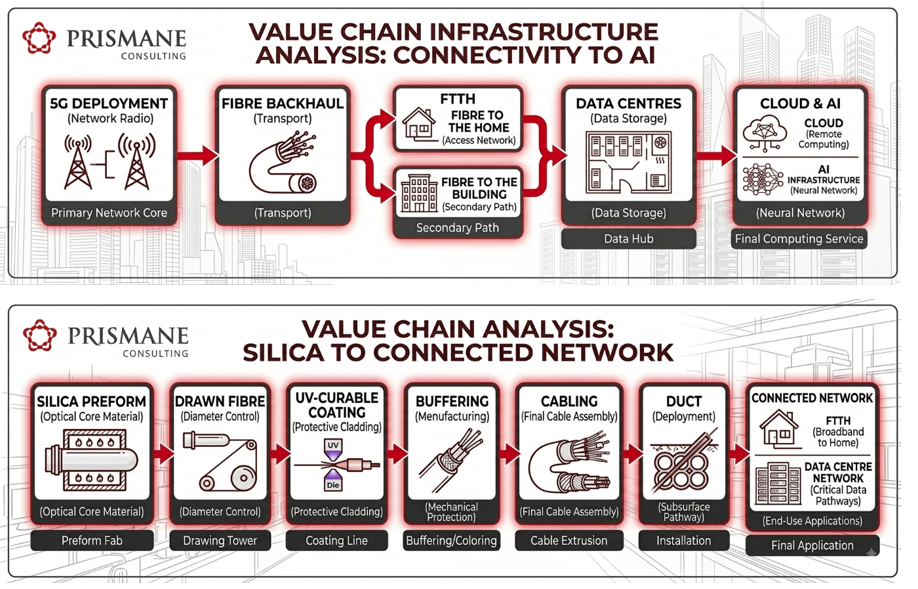
India's optical fibre expansion is usually read as a telecom story. Prismane Consulting reads it as a materials story. This analysis examines where the incremental polymer demand actually sits across the fibre and cable value chain, why tonnage and value are concentrated in different places, and why fibre-kilometre growth will not translate one-for-one into polymer growth.
India's optical fibre industry is entering a new phase.
The next wave of growth is no longer being driven only by conventional telecom infrastructure. 5G backhaul, fibre-to-the-home, data centres, cloud infrastructure and the build-out of AI networks are collectively increasing the volume of high-speed connectivity infrastructure the country requires. Recent expansion plans by Birla Furukawa Fibre Optics are one visible indication of this shift.
For material suppliers, the more useful question is what sits upstream of that.
Every additional kilometre of optical fibre and optical fibre cable requires materials, and several of those materials are specialty polymers. In our assessment, India's connectivity build-out therefore creates an addressable opportunity that extends well beyond the telecom sector itself, into coatings, polyolefins, engineering resins and flame-retardant compounds.
But the opportunity is not evenly distributed, and it is not proportional to fibre growth. That is the part most assessments get wrong.
The signal: India's fibre and cable capacity is expanding
Birla Furukawa is one of India's established optical fibre manufacturers, supplying fibre for telecommunications and data communication applications including FTTH networks. Its planned expansion comes at a time when the wider domestic ecosystem, including STL, HFCL, Finolex Cables, Polycab and others, is seeing renewed investment across fibre and cable capacity.
The demand drivers behind this are increasingly structural rather than cyclical:

As traffic grows, operators require greater fibre density, higher transmission capacity and more sophisticated cable designs. This is not a replacement cycle for ageing telecom infrastructure. It is a net build-out.
One caution is warranted, and it applies to any capacity-led thesis. The optical fibre industry has previously demonstrated that announced capacity and consumed capacity can diverge sharply, with periods of global oversupply compressing utilisation and pricing across the chain. Prismane Consulting's view is that material suppliers should size this opportunity against deployed fibre and cable, not against installed manufacturing capacity.
Why an optical fibre is a polymer product
Optical fibre itself is drawn from a silica preform. But a bare glass filament of roughly 125 microns is mechanically fragile and cannot survive handling, cabling or field deployment.
It therefore requires a dual-layer UV-curable acrylate coating applied in-line at the draw tower, typically bringing the coated fibre to around 245 to 250 microns. The soft primary layer cushions the glass against microbending losses, while the harder secondary layer provides mechanical and environmental protection.
Once that coated fibre is converted into cable, polymer content increases substantially. The value chain looks like this:

At the cable level, the material set typically includes buffer tubes, water-blocking materials, strength members, ripcords, inner sheaths and outer jacketing. Prismane Consulting's assessment is this is where a substantial majority of the polymer tonnage opportunity sits, while the coating step carries a disproportionate share of the value per kilogram.
That asymmetry is the single most important commercial feature of this value chain, and it should shape how any supplier approaches it.
Where the tonnage is: cable, and the duct around it
Cable jacketing and sheathing consume polyethylene in meaningful volume. HDPE and MDPE remain the workhorse materials for outside-plant constructions, valued for mechanical protection, moisture resistance and processability, with LLDPE and blends used where flexibility or environmental stress crack resistance is prioritised.
Buffer tubes are commonly produced from PBT, although alternative polymer systems are used depending on cable architecture and performance requirements. This is an often-overlooked engineering resin opportunity sitting inside what is usually described as a polyolefin application.
The larger and more frequently missed volume opportunity, however, sits outside the cable entirely.
Modern FTTH and access networks are increasingly deployed using blown fibre installed into HDPE micro-ducts. In such deployments the duct infrastructure can consume more polyethylene than the cable it carries, and ducts are frequently installed ahead of the fibre itself in anticipation of future demand.
In Prismane Consulting's view, any assessment of the polymer opportunity that stops at the cable jacket materially understates the polyethylene demand created by India's network build-out. Suppliers evaluating this market should size ducting alongside cabling. Our Polyethylene (PE) Market study covers the grade-level demand and pricing dynamics relevant to both applications, while comonomer availability for these grades is assessed in our Asia Pacific Linear Alpha Olefins (LAO) Market study.
Where the value is: coatings and specialty compounds
The coating opportunity behaves in exactly the opposite way.
Because the acrylate layer adds only around 120 microns of radial thickness to a 125-micron glass fibre, the mass of coating consumed per fibre-kilometre is very small. In tonnage terms, fibre coatings will always be a minor line item in a polymer producer's portfolio.
In value and defensibility terms, they are a different proposition entirely.
UV-curable fibre coatings are performance-critical, globally supplied by a small number of qualified producers, and subject to long qualification cycles. Approval typically requires draw-tower trials at commercial line speeds, micro-bend and attenuation testing, adhesion and delamination performance, hydrolytic and thermal ageing, and strip-ability validation. A fibre manufacturer does not change coating supplier casually.
Prismane Consulting's assessment is that this combination of technical criticality, concentrated supply and high switching cost makes fibre coatings the most margin-defensible position in the chain, and simultaneously the slowest and most capital-intensive to enter. The commercial characteristics are examined in our UV Curable Resins Market study.
Sitting between these two extremes are LSZH and flame-retardant compounds. Indoor, riser, plenum and data centre cabling increasingly requires low-smoke, zero-halogen constructions, where formulation expertise, filler loading, mechanical property retention and processing behaviour matter as much as the base polymer. Prismane Consulting regards this as the most attractive risk-adjusted segment for Indian compounders, since it offers specialty economics without the qualification barriers or capital intensity of fibre coating. The underlying additive dynamics are covered in our Global Flame Retardants Market study.
The data centre driver is a value story, not a volume story
Hyperscale and AI infrastructure is genuinely changing the demand equation, but not in the way the volume narrative suggests.
Data centre connectivity is characterised by very high fibre counts over comparatively short distances, in contrast to long-haul and access networks, where fibre counts are lower, but route lengths are far greater. Intra-facility cabling is also predominantly indoor, which means LSZH and flame-retardant constructions rather than commodity HDPE jacketing.
The consequence is straightforward. India's data centre build-out will generate disproportionately more specialty compound demand than commodity polyolefin demand, while FTTH and long-haul deployment will do the reverse.
For suppliers, this means the two demand drivers are not substitutes. They point toward different products, different customers and different margin structures. The broader shift toward electrical, electronics and data infrastructure as a driver of engineering material demand is examined in our analysis of the Global Polycarbonate Market.
The counterpoint: cable design is reducing polymer intensity
There is a structural offset that any credible assessment must account for.
Cable architecture is moving steadily toward higher fibre density and smaller cross-sections. Rollable ribbon designs, intermittently bonded ribbons, reduced-diameter fibres and micro-cable constructions all serve the same objective, which is to fit more fibres into existing or smaller duct space.
Every one of those developments reduces polymer consumed per fibre-kilometre.
Prismane Consulting's view is therefore that fibre-kilometre growth and polymer demand growth will not move one-for-one. Polymer demand should be expected to grow more slowly than fibre volumes in commodity jacketing, while material value migrates toward the constructions that make higher density possible, including precision-extruded buffer tubes, thinner-wall jacketing with retained mechanical performance, and coatings engineered for reduced-diameter fibre.
This is the same pattern visible across engineering materials more broadly, where value has been migrating from tonnage toward formulation and technical differentiation, as we discussed in The Engineering Plastics and Composites Industry Isn't Recovering. It's Changing Hands.
Sizing the opportunity properly
The commercial opportunity can and should be quantified rather than described.
Prismane Consulting's approach is to link incremental fibre and cable production to material intensity at each step of the chain:
Incremental fibre or cable production × polymer consumption per unit × average selling price = addressable material opportunity
The discipline lies in doing this separately for each material, because the intensity factors and price points differ by an order of magnitude:
Material | Primary demand driver | Volume opportunity | Value per kg |
UV-curable acrylates | Fibre coating | Low | High |
PBT and engineering resins | Buffer tubes | Moderate | Moderate to high |
HDPE / MDPE | Cable jacketing and sheathing | High | Low |
HDPE | Micro-duct infrastructure | High | Low |
LSZH and flame-retardant compounds | Indoor, riser and data centre cable | Moderate | High |
Source: Secondary & Primary research and Prismane Consulting estimates
Aggregating these into a single market number obscures the decision a supplier actually faces. Separating them reveals it.
We applied a comparable framework to India's footwear export ambition in A Potential USD 150 Million Opportunity: What India's Footwear Export Push Means for Specialty Polymer Producers, and the methodology translates directly to connectivity infrastructure.
Localisation adds a second route to market
India is actively seeking to localise critical manufacturing value chains, and fibre and cable production is already well established domestically. Upstream specialty materials are less so.
This creates two distinct routes for polymer suppliers. The first is to supply India's growing fibre and cable manufacturers from existing production. The second is to localise production of specialty materials currently sourced through imports.
Prismane Consulting's assessment is that the second route is the more defensible where technical qualification creates barriers to entry, precisely because those barriers cut both ways. They slow entry, but they also protect the position once established. We observed the same dynamic in medical polymers, discussed in India's Precision Tubing Moment: How Localized Medical Polymers Are Redrawing the MedTech Map.
Where the Opportunity Sits
The polymer opportunity created by India's optical fibre and cable expansion is not uniform. Different materials participate at different stages of the value chain, with significant differences in volume potential, value density and barriers to entry.
For a polymer producer, this distinction is critical. The largest opportunity by tonnage may not be the most attractive opportunity by value, while materials with relatively limited consumption can offer stronger margins and greater customer stickiness.
Commodity polyolefins offer scale.
HDPE and MDPE benefit from the sheer volume of cable and microduct infrastructure required as India's fibre network expands, but competition is relatively high and differentiation is limited.
Specialty coatings offer value density.
UV-curable fibre coatings require significantly less material by weight, but their technical criticality, qualification requirements and customer switching barriers create a much more defensible position for established suppliers.
Compounds offer a middle ground.
LSZH and flame-retardant systems combine meaningful material consumption with higher value per kilogram and greater formulation differentiation. This could make them particularly relevant for suppliers targeting indoor, enterprise and data-centre connectivity applications.
The implication is straightforward: the biggest polymer opportunity by volume is not necessarily the most attractive opportunity by value.
For companies evaluating entry into this market, the more relevant question is therefore not simply how much polymer India's optical fibre industry will consume. It is which material segment offers the right combination of addressable demand, value potential, qualification barriers and competitive intensity.
The Prismane Consulting view
India's optical fibre build-out will create incremental polymer demand, but the opportunity is not a single market. It is a collection of different opportunities with very different economics.
HDPE and MDPE offer scale through cable jacketing and ducting. PBT and other engineering polymers participate in higher-specification cable constructions. UV-curable coatings offer limited tonnage but significantly higher value density and qualification barriers. LSZH and flame-retardant compounds provide another route into higher-value indoor and data-centre applications.
The commercial question is therefore not simply how many fibre kilometres India will deploy. It is how those kilometres will be deployed, which cable architectures will dominate, how much polymer each architecture consumes, and which material suppliers can qualify into the resulting value chain.
How Prismane Consulting Can Help
Prismane Consulting's Business Opportunity Assessment service is designed for exactly this type of question, quantifying addressable demand, material intensity, competitive positioning and entry economics for suppliers evaluating a new value chain.
Our supporting market studies across the connectivity materials chain include the Polyethylene (PE) Market, UV Curable Resins Market and Global Flame Retardants Market reports. The full portfolio is available under our chemical market reports, with consulting support detailed under our Chemicals Practice.
About Prismane Consulting
Prismane Consulting is a market intelligence and strategy consulting firm specializing in chemicals, petrochemicals, polymers, advanced materials, energy and sustainability. Through proprietary market models covering capacity, demand, operating rates, trade flows, pricing and end-use applications, Prismane Consulting helps companies understand structural market shifts and make informed strategic decisions across global chemical value chains.
To commission an assessment of India's optical fibre and cable materials opportunity, or to request a report sample, please get in touch at sales@prismaneconsulting.com.